Sign In Start Free Trial
Account

Add to playlist

Create a Playlist

Modal Close icon
You need to login to use this feature.
  • Book Overview & Buying Functional C#
  • Table Of Contents Toc
  • Feedback & Rating feedback
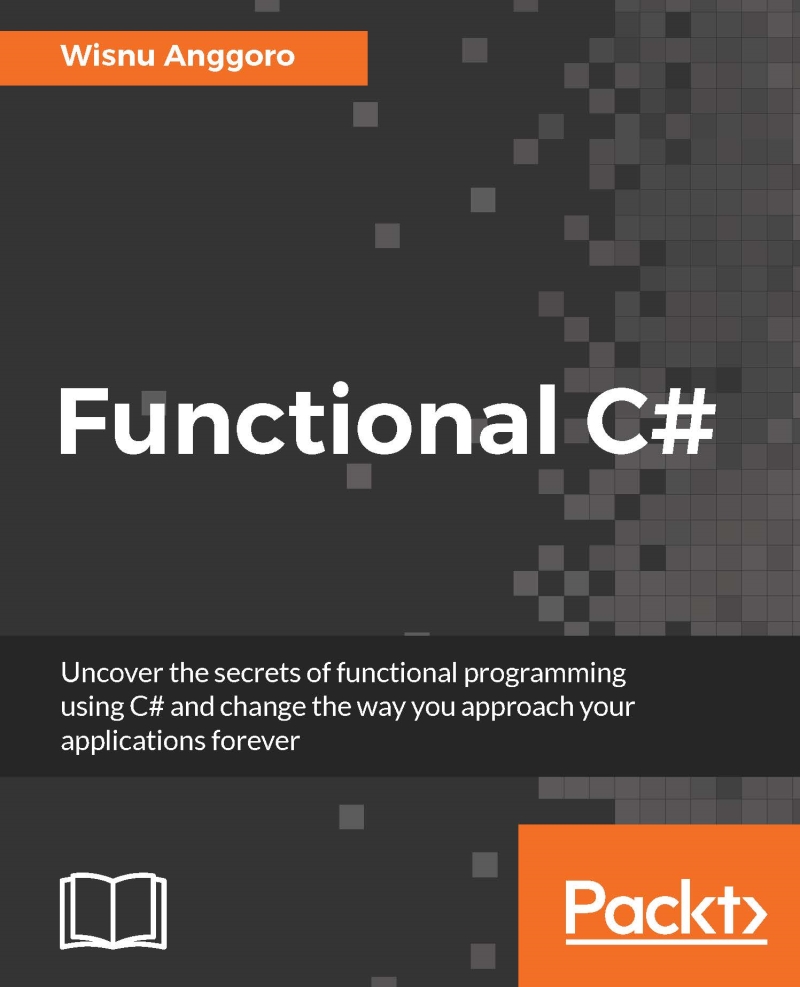
Functional C#

Functional C#

By : Wisnu Anggoro
5 (3)
close
close
Functional C#

Functional C#

5 (3)
By: Wisnu Anggoro

Overview of this book

Functional programming makes your application faster, improves performance, and increases your productivity. C# code is written at a higher level of abstraction, so that code will be closer to business requirements, abstracting away many low-level implementation details. This book bridges the language gap for C# developers by showing you how to create and consume functional constructs in C#. We also bridge the domain gap by showing how functional constructs can be applied in business scenarios. We’ll take you through lambda expressions and extension methods, and help you develop a deep understanding of the concepts and practices of LINQ and recursion in C#. By the end of the book, you will be able to write code using the best approach and will be able to perform unit testing in functional programming, changing how you write your applications and revolutionizing your projects.
Table of Contents (12 chapters)
close
close

Introducing delegates

A delegate is a data type in C# that encapsulates a method that has particular parameters and return types (signatures). In other words, a delegate will define the parameters and the return type of a method. Delegates are similar to function pointers in C/C++ since both stores the reference to the method with a particular signature. Like a function pointer in C/C++, a delegate keeps a memory address of the method it refers to. The compiler will complain if it refers to a function with a different signature. However, because of the unmanaged nature of the C++ language, one can point functions to arbitrary locations (by casting).

Let's take a look at the following delegate syntax:

[AccessModifier] delegate ReturnType DelegateName([parameters]); 

Here is the explanation for each element of the preceding delegate syntax:

  • AccessModifier: This is the modifier that is used to set the accessibility of the delegate. It can be public, private, internal, or protected. However...
Visually different images
CONTINUE READING
83
Tech Concepts
36
Programming languages
73
Tech Tools
Icon Unlimited access to the largest independent learning library in tech of over 8,000 expert-authored tech books and videos.
Icon Innovative learning tools, including AI book assistants, code context explainers, and text-to-speech.
Icon 50+ new titles added per month and exclusive early access to books as they are being written.
Functional C#
notes
bookmark Notes and Bookmarks search Search in title playlist Add to playlist font-size Font size

Change the font size

margin-width Margin width

Change margin width

day-mode Day/Sepia/Night Modes

Change background colour

Close icon Search
Country selected

Close icon Your notes and bookmarks

Confirmation

Modal Close icon
claim successful

Buy this book with your credits?

Modal Close icon
Are you sure you want to buy this book with one of your credits?
Close
YES, BUY

Submit Your Feedback

Modal Close icon
Modal Close icon
Modal Close icon