Sign In Start Free Trial
Account

Add to playlist

Create a Playlist

Modal Close icon
You need to login to use this feature.
  • Book Overview & Buying Geospatial Development By Example with Python
  • Table Of Contents Toc
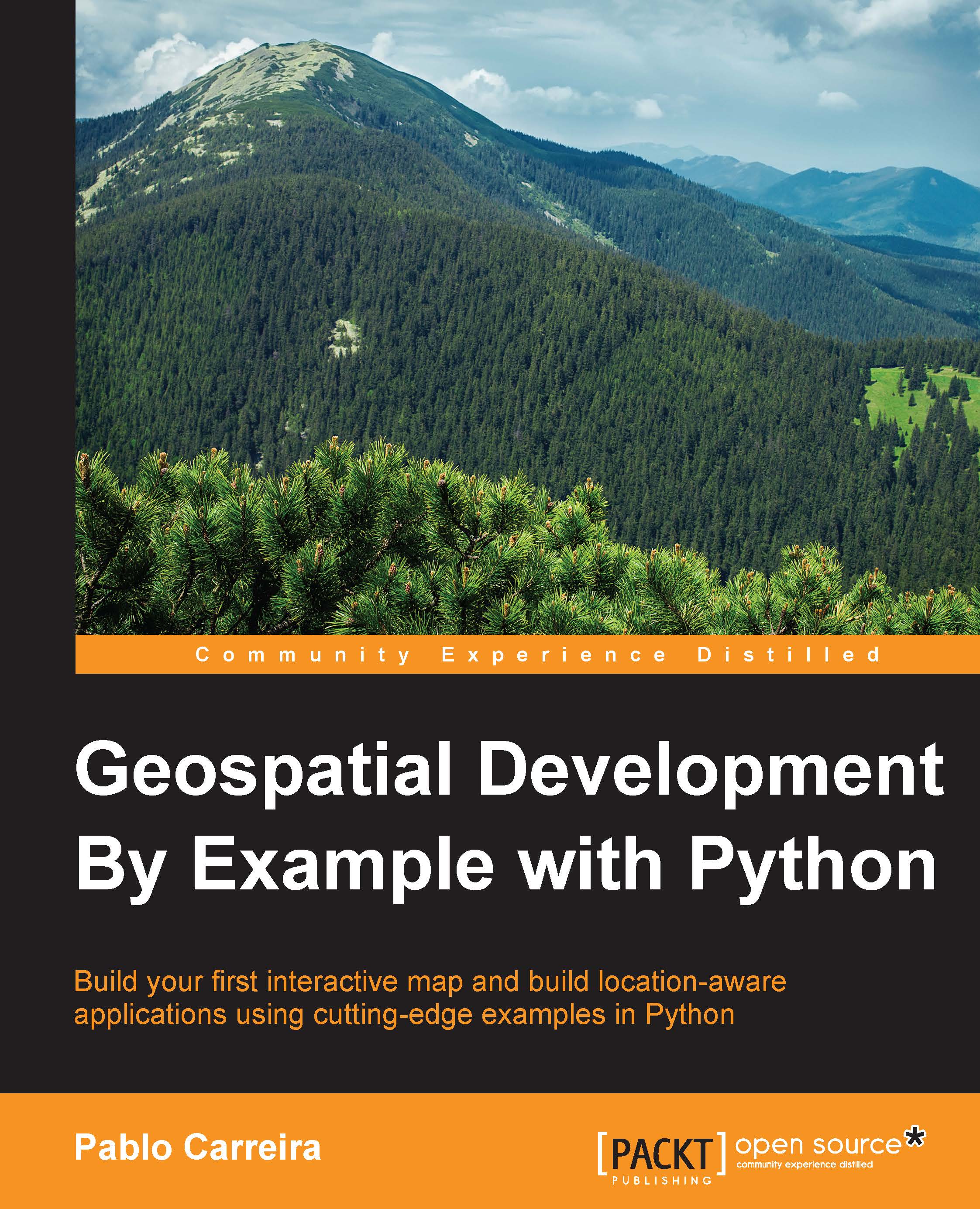
Geospatial Development By Example with Python

Geospatial Development By Example with Python

By : Pablo Carreira
5 (4)
close
close
Geospatial Development By Example with Python

Geospatial Development By Example with Python

5 (4)
By: Pablo Carreira

Overview of this book

From Python programming good practices to the advanced use of analysis packages, this book teaches you how to write applications that will perform complex geoprocessing tasks that can be replicated and reused. Much more than simple scripts, you will write functions to import data, create Python classes that represent your features, and learn how to combine and filter them. With pluggable mechanisms, you will learn how to visualize data and the results of analysis in beautiful maps that can be batch-generated and embedded into documents or web pages. Finally, you will learn how to consume and process an enormous amount of data very efficiently by using advanced tools and modern computers’ parallel processing capabilities.
Table of Contents (12 chapters)
close
close
11
Index

Using Shapely to handle geometries


Shapely is a Python package for the analysis of planar features. It uses functions from the GEOS library and a port of the Java Topology Suite (JTS).

It has mainly the same classes and functions as OGR while dealing with geometries. Although it's not a replacement for OGR, it has a more pythonic and a very intuitive interface, it is better optimized, and it has a well-developed documentation.

To make things clear, Shapely is intended to analyze geometries and only geometries. It does not handle features' attributes, neither is it capable of reading and writing geospatial files.

For a direct comparison of Shapely and OGR, we are going to rewrite the previous examples:

  1. Add the following lines to the wkt_experiments.py file (you can keep or remove the previous code, it's up to you):

    from shapely.geometry import Polygon
    
    print('Examples with Shapely')
    polygon1 = Polygon([(1, 1), (1, 9), (8, 9), (8, 1), (1, 1)])
    print(polygon1.__class__)
    print(polygon1.area)
    
    polygon2...
CONTINUE READING
83
Tech Concepts
36
Programming languages
73
Tech Tools
Icon Unlimited access to the largest independent learning library in tech of over 8,000 expert-authored tech books and videos.
Icon Innovative learning tools, including AI book assistants, code context explainers, and text-to-speech.
Icon 50+ new titles added per month and exclusive early access to books as they are being written.
Geospatial Development By Example with Python
notes
bookmark Notes and Bookmarks search Search in title playlist Add to playlist font-size Font size

Change the font size

margin-width Margin width

Change margin width

day-mode Day/Sepia/Night Modes

Change background colour

Close icon Search
Country selected

Close icon Your notes and bookmarks

Confirmation

Modal Close icon
claim successful

Buy this book with your credits?

Modal Close icon
Are you sure you want to buy this book with one of your credits?
Close
YES, BUY

Submit Your Feedback

Modal Close icon
Modal Close icon
Modal Close icon