Sign In Start Free Trial
Account

Add to playlist

Create a Playlist

Modal Close icon
You need to login to use this feature.
  • Book Overview & Buying Learning JavaScript Data Structures and Algorithms
  • Table Of Contents Toc
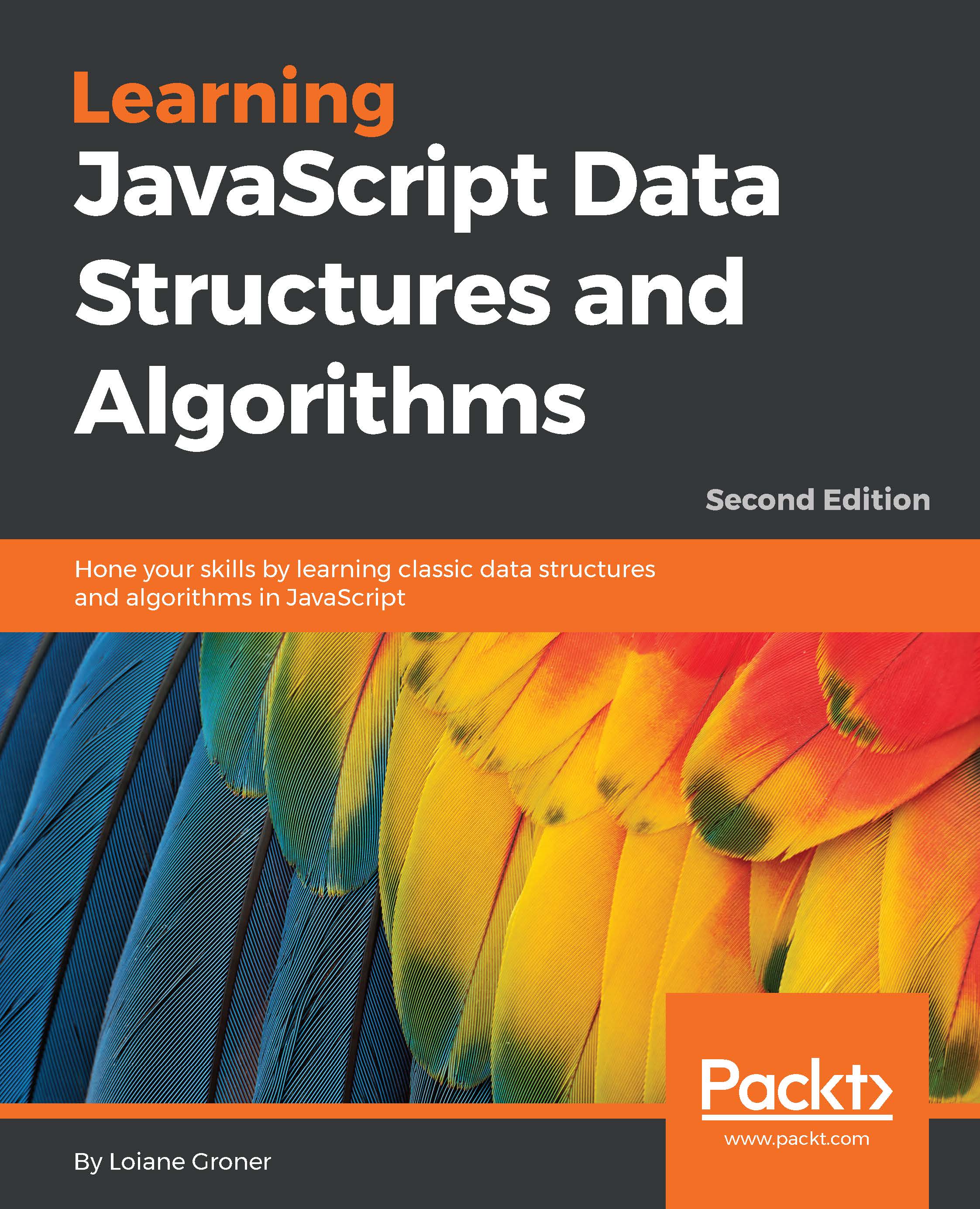
Learning JavaScript Data Structures and Algorithms

Learning JavaScript Data Structures and Algorithms - Second Edition

By : Loiane Avancini
4 (10)
close
close
Learning JavaScript Data Structures and Algorithms

Learning JavaScript Data Structures and Algorithms

4 (10)
By: Loiane Avancini

Overview of this book

This book begins by covering basics of the JavaScript language and introducing ECMAScript 7, before gradually moving on to the current implementations of ECMAScript 6. You will gain an in-depth knowledge of how hash tables and set data structure functions, as well as how trees and hash maps can be used to search files in a HD or represent a database. This book is an accessible route deeper into JavaScript. Graphs being one of the most complex data structures you’ll encounter, we’ll also give you a better understanding of why and how graphs are largely used in GPS navigation systems in social networks. Toward the end of the book, you’ll discover how all the theories presented by this book can be applied in real-world solutions while working on your own computer networks and Facebook searches.
Table of Contents (13 chapters)
close
close

Introducing ECMAScript

If you follow the news and latest trends about JavaScript, you might have heard the hype about ECMAScript 6 and ECMAScript 7. What does ECMAScript have to do with JavaScript and is there a difference?

ECMAScript is a scripting language specification. JavaScript is an implementation of this specification, as are Jscript and ActionScript.

ECMAScript 6 and ECMAScript 7

As we know, JavaScript is a language that runs mostly on browsers (also in servers using NodeJS), and each browser can implement its own version of the available functionalities of JavaScript (as you will learn later on in this book). This specific implementation is based on ECMAScript. Thus, the browsers offer mostly the same functionalities (our JavaScript code will run in all browsers); however, each functionality's behavior may be a little bit different from browser to browser.

All the code presented in this chapter so far is based on ECMAScript 5, which became a standard in December 2009. The most recent release of ECMAScript, at the time this book is being written, is ECMAScript 6, which was standardized in July 2015, almost 6 years after its previous version. The committee responsible for drafting the ECMAScript specifications made the decision to move to a yearly model to define new standards, where new features would be added as they were approved. For this reason, ECMAScript sixth edition was renamed to ECMAScript 2015 (ES6). There is a new version that is also being prepared to be released in the summer of 2016, which is called ECMAScript 2016 or ECMAScript 7 (ES7).

In this topic, we will cover some of the new functionalities introduced in ES6 and ES7.

The compatibility table

It is important to know that, even though ES6 has already been released, its features might not be supported by all browsers. For a better experience, it is best to use the latest version available for the browser you choose to use (Firefox or Chrome).

At the following links, you can verify which features are available in each browser:

Even if the features are not yet available, we can start using new syntax and new functionalities today.

By default, Firefox adds support to ES6 and ES7 as their team ships the implementation of the functionalities.

In Google Chrome, you can enable the functionalities by enabling the experimental JavaScript flag by opening the URL  chrome://flags , as demonstrated in the following image:

The compatibility table

Note

Even with the Enable Experimental JavaScript flag enabled, some of the ES6 features might not be supported in Chrome. The same can be applied to Firefox. To know exactly which features are already supported in each browser, take a look at the compatibility table.

Using Babel.js

Babel ( https://babeljs.io ) is a JavaScript transpiler, also known as a source-to-source compiler. It converts JavaScript code with ES6 and ES7 language features to equivalent code that uses only language features from the widely supported ES5 specification.

There are many different ways of using Babel.js. One of them is installing it according to its setup (https://babeljs.io/docs/setup/ ). Another one is using it directly in the browser through its Try it out option ( https://babeljs.io/repl/ ), as demonstrated in the following screenshot:

Using Babel.js

Along with each example of ES6 and ES7 that will be presented in the following topics, we will also provide a link so that you can run and test the examples in Babel.

CONTINUE READING
83
Tech Concepts
36
Programming languages
73
Tech Tools
Icon Unlimited access to the largest independent learning library in tech of over 8,000 expert-authored tech books and videos.
Icon Innovative learning tools, including AI book assistants, code context explainers, and text-to-speech.
Icon 50+ new titles added per month and exclusive early access to books as they are being written.
Learning JavaScript Data Structures and Algorithms
notes
bookmark Notes and Bookmarks search Search in title playlist Add to playlist download Download options font-size Font size

Change the font size

margin-width Margin width

Change margin width

day-mode Day/Sepia/Night Modes

Change background colour

Close icon Search
Country selected

Close icon Your notes and bookmarks

Confirmation

Modal Close icon
claim successful

Buy this book with your credits?

Modal Close icon
Are you sure you want to buy this book with one of your credits?
Close
YES, BUY

Submit Your Feedback

Modal Close icon
Modal Close icon
Modal Close icon