Sign In Start Free Trial
Account

Add to playlist

Create a Playlist

Modal Close icon
You need to login to use this feature.
  • Book Overview & Buying Python Parallel Programming Cookbook
  • Table Of Contents Toc
  • Feedback & Rating feedback
Python Parallel Programming Cookbook

Python Parallel Programming Cookbook

By : Zaccone
4.1 (11)
close
close
Python Parallel Programming Cookbook

Python Parallel Programming Cookbook

4.1 (11)
By: Zaccone

Overview of this book

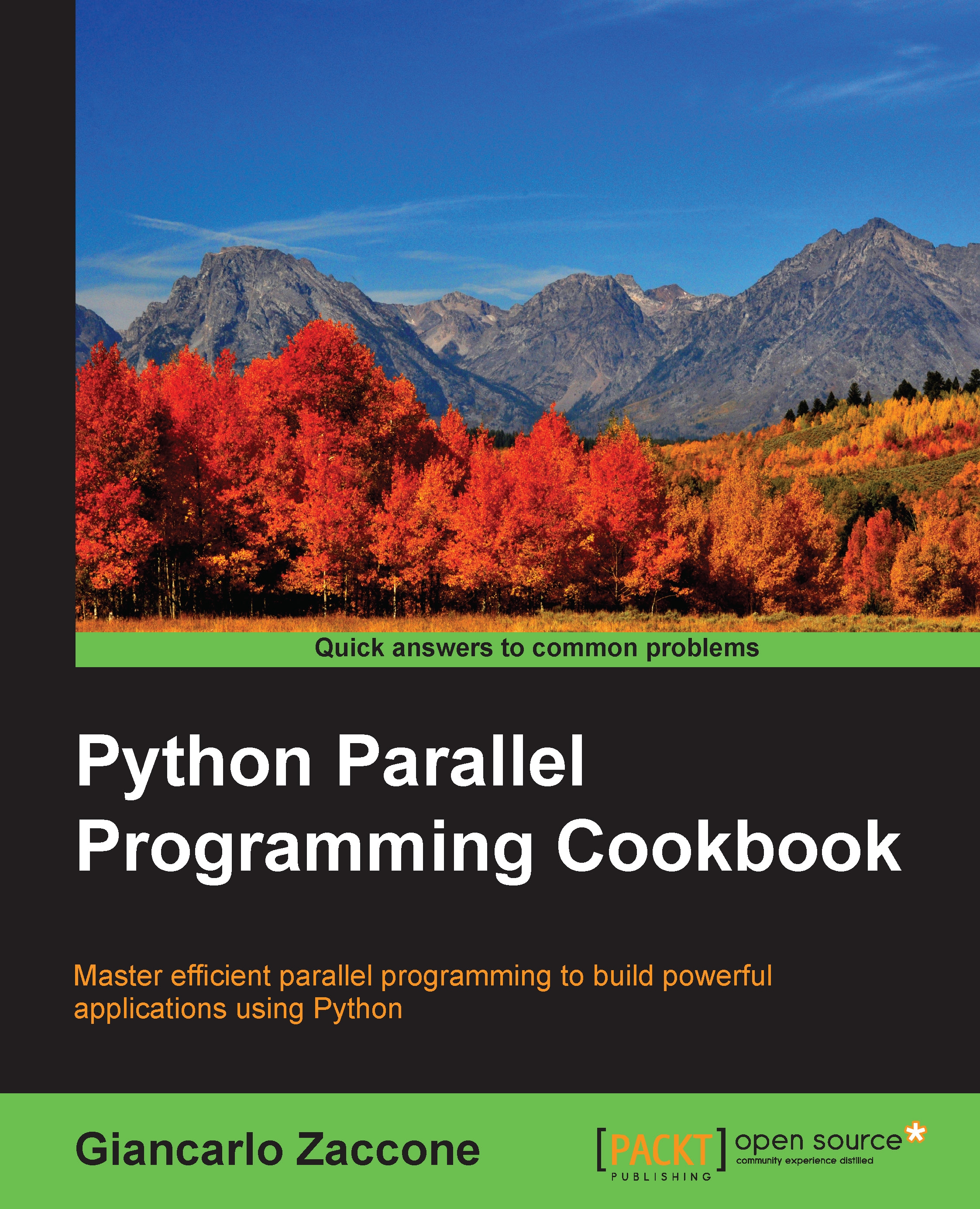
This book will teach you parallel programming techniques using examples in Python and will help you explore the many ways in which you can write code that allows more than one process to happen at once. Starting with introducing you to the world of parallel computing, it moves on to cover the fundamentals in Python. This is followed by exploring the thread-based parallelism model using the Python threading module by synchronizing threads and using locks, mutex, semaphores queues, GIL, and the thread pool. Next you will be taught about process-based parallelism where you will synchronize processes using message passing along with learning about the performance of MPI Python Modules. You will then go on to learn the asynchronous parallel programming model using the Python asyncio module along with handling exceptions. Moving on, you will discover distributed computing with Python, and learn how to install a broker, use Celery Python Module, and create a worker. You will understand anche Pycsp, the Scoop framework, and disk modules in Python. Further on, you will learnGPU programming withPython using the PyCUDA module along with evaluating performance limitations.
Table of Contents (8 chapters)
close
close
7
Index

Introduction

This chapter gives you an overview of parallel programming architectures and programming models. These concepts are useful for inexperienced programmers who have approached parallel programming techniques for the first time. This chapter can be a basic reference for the experienced programmers. The dual characterization of parallel systems is also presented in this chapter. The first characterization is based on the architecture of the system and the second characterization is based on parallel programming paradigms. Parallel programming will always be a challenge for programmers. This programming-based approach is further described in this chapter, when we present the design procedure of a parallel program. The chapter ends with a brief introduction of the Python programming language. The characteristics of the language, ease of use and learning, and extensibility and richness of software libraries and applications make Python a valuable tool for any application and also, of course, for parallel computing. In the final part of the chapter, the concepts of threads and processes are introduced in relation to their use in the language. A typical way to solve a problem of a large-size is to divide it into smaller and independent parts in order to solve all the pieces simultaneously. A parallel program is intended for a program that uses this approach, that is, the use of multiple processors working together on a common task. Each processor works on its section (the independent part) of the problem. Furthermore, a data information exchange between processors could take place during the computation. Nowadays, many software applications require more computing power. One way to achieve this is to increase the clock speed of the processor or to increase the number of processing cores on the chip. Improving the clock speed increases the heat dissipation, thereby decreasing the performance per watt and moreover, this requires special equipment for cooling. Increasing the number of cores seems to be a feasible solution, as power consumption and dissipation are way under the limit and there is no significant gain in performance.

To address this problem, computer hardware vendors decided to adopt multi-core architectures, which are single chips that contain two or more processors (cores). On the other hand, the GPU manufactures also introduced hardware architectures based on multiple computing cores. In fact, today's computers are almost always present in multiple and heterogeneous computing units, each formed by a variable number of cores, for example, the most common multi-core architectures.

Therefore, it became essential for us to take advantage of the computational resources available, to adopt programming paradigms, techniques, and instruments of parallel computing.

Visually different images
CONTINUE READING
83
Tech Concepts
36
Programming languages
73
Tech Tools
Icon Unlimited access to the largest independent learning library in tech of over 8,000 expert-authored tech books and videos.
Icon Innovative learning tools, including AI book assistants, code context explainers, and text-to-speech.
Icon 50+ new titles added per month and exclusive early access to books as they are being written.
Python Parallel Programming Cookbook
notes
bookmark Notes and Bookmarks search Search in title playlist Add to playlist font-size Font size

Change the font size

margin-width Margin width

Change margin width

day-mode Day/Sepia/Night Modes

Change background colour

Close icon Search
Country selected

Close icon Your notes and bookmarks

Confirmation

Modal Close icon
claim successful

Buy this book with your credits?

Modal Close icon
Are you sure you want to buy this book with one of your credits?
Close
YES, BUY

Submit Your Feedback

Modal Close icon
Modal Close icon
Modal Close icon