Sign In Start Free Trial
Account

Add to playlist

Create a Playlist

Modal Close icon
You need to login to use this feature.
  • Book Overview & Buying Reactive Programming for .NET Developers
  • Table Of Contents Toc
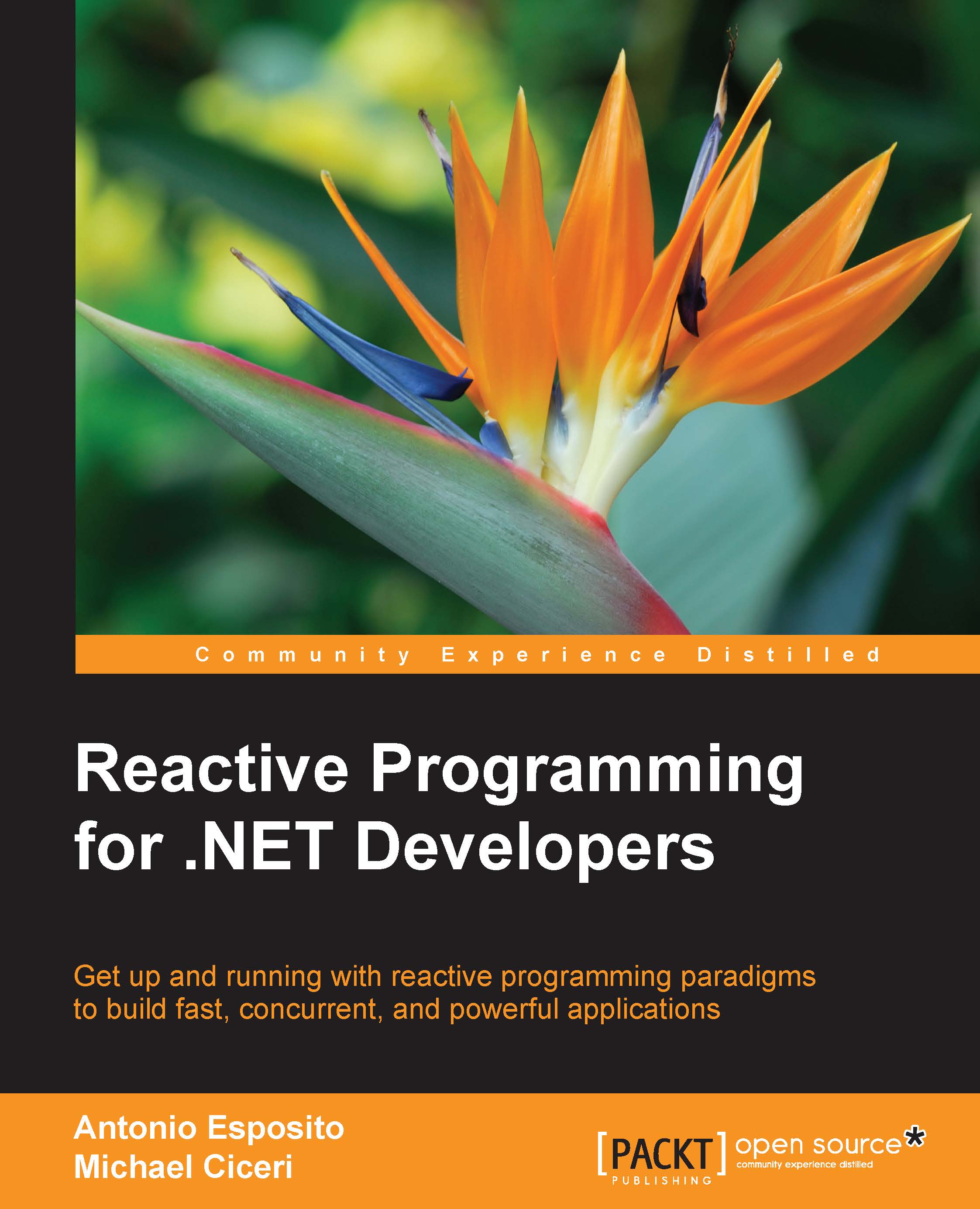
Reactive Programming for .NET Developers

Reactive Programming for .NET Developers

By : Antonio Esposito, Ciceri
4 (2)
close
close
Reactive Programming for .NET Developers

Reactive Programming for .NET Developers

4 (2)
By: Antonio Esposito, Ciceri

Overview of this book

Reactive programming is an innovative programming paradigm focused on time-based problem solving. It makes your programs better-performing, easier to scale, and more reliable. Want to create fast-running applications to handle complex logics and huge datasets for financial and big-data challenges? Then you have picked up the right book! Starting with the principles of reactive programming and unveiling the power of the pull-programming world, this book is your one-stop solution to get a deep practical understanding of reactive programming techniques. You will gradually learn all about reactive extensions, programming, testing, and debugging observable sequence, and integrating events from CLR data-at-rest or events. Finally, you will dive into advanced techniques such as manipulating time in data-flow, customizing operators and providers, and exploring functional reactive programming. By the end of the book, you'll know how to apply reactive programming to solve complex problems and build efficient programs with reactive user interfaces.
Table of Contents (10 chapters)
close
close

Time flow and dynamic change

Time flow and dynamic change are now clear concepts of FRP. In the previous chapter, we discussed over and over again what they are. They represent one of the main axes of FRP together with discrete and continuous semantics.

Concerning reactive systems (hybrid systems), we immediately understood how much important the concepts of execution time and used memory are. These two features may have some problems that could make the system nonreactive. The title of this section suggests a solution for them both. The following are the methods which can be used:

  • A good approach to avoid prolonged execution time or, even worse, the inability to manage the time flow; this results in having control on information flow (data or events)
  • Instead, if we want to control used memory, for example, useless information or instances, it would be interesting to use a dynamically changing system according to the information obtained and architecture that already support these two features...
CONTINUE READING
83
Tech Concepts
36
Programming languages
73
Tech Tools
Icon Unlimited access to the largest independent learning library in tech of over 8,000 expert-authored tech books and videos.
Icon Innovative learning tools, including AI book assistants, code context explainers, and text-to-speech.
Icon 50+ new titles added per month and exclusive early access to books as they are being written.
Reactive Programming for .NET Developers
notes
bookmark Notes and Bookmarks search Search in title playlist Add to playlist download Download options font-size Font size

Change the font size

margin-width Margin width

Change margin width

day-mode Day/Sepia/Night Modes

Change background colour

Close icon Search
Country selected

Close icon Your notes and bookmarks

Confirmation

Modal Close icon
claim successful

Buy this book with your credits?

Modal Close icon
Are you sure you want to buy this book with one of your credits?
Close
YES, BUY

Submit Your Feedback

Modal Close icon
Modal Close icon
Modal Close icon