Sign In Start Free Trial
Account

Add to playlist

Create a Playlist

Modal Close icon
You need to login to use this feature.
  • Book Overview & Buying Learning Julia
  • Table Of Contents Toc
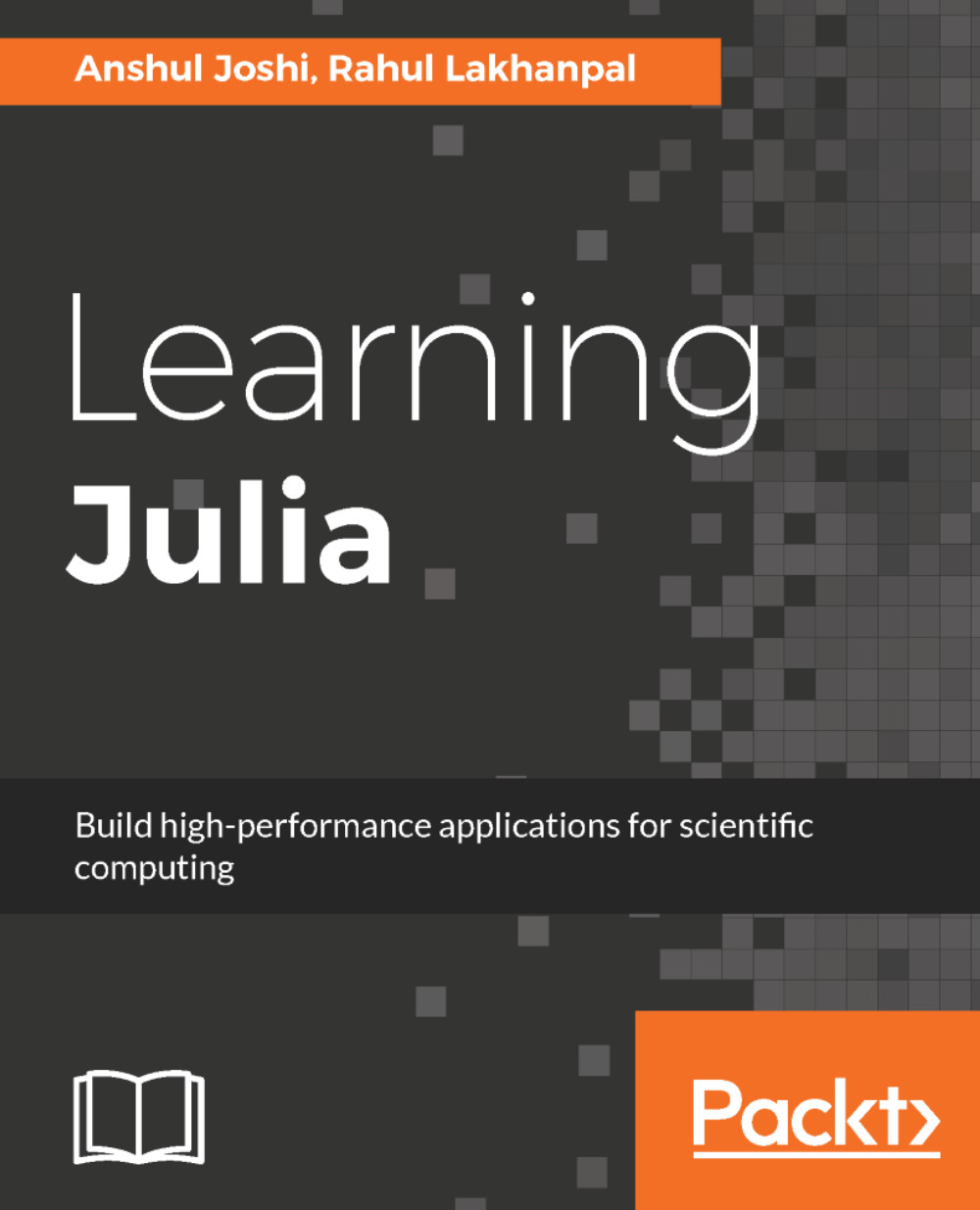
Learning Julia

Learning Julia

By : Anshul Joshi, Lakhanpal
3 (2)
close
close
Learning Julia

Learning Julia

3 (2)
By: Anshul Joshi, Lakhanpal

Overview of this book

Julia is a highly appropriate language for scientific computing, but it comes with all the required capabilities of a general-purpose language. It allows us to achieve C/Fortran-like performance while maintaining the concise syntax of a scripting language such as Python. It is perfect for building high-performance and concurrent applications. From the basics of its syntax to learning built-in object types, this book covers it all. This book shows you how to write effective functions, reduce code redundancies, and improve code reuse. It will be helpful for new programmers who are starting out with Julia to explore its wide and ever-growing package ecosystem and also for experienced developers/statisticians/data scientists who want to add Julia to their skill-set. The book presents the fundamentals of programming in Julia and in-depth informative examples, using a step-by-step approach. You will be taken through concepts and examples such as doing simple mathematical operations, creating loops, metaprogramming, functions, collections, multiple dispatch, and so on. By the end of the book, you will be able to apply your skills in Julia to create and explore applications of any domain.
Table of Contents (11 chapters)
close
close
8
Data Visualization and Graphics

Type introspection and reflection capabilities


Type introspection and reflection capabilities form a very useful part of any modern-day programming language. Their need arises due to the fact that many a time while coding, we come across a situation where we need to understand the types of objects or data that we are dealing with. Sometimes, we may need to find the type of an object, and other times we may end up coding some logic based on that object's types and properties.

Type introspection

As we know from the starting chapters that Julia supports multiple dispatch and we can create a new data type from any abstract data type, let's define a new type, named Student, and then create two sample objects for this type:

julia> type Student
           name::String
           age::Int64
       end

julia> alpha = Student("alpha",24)
Student("alpha", 24)

julia> beta = Student("beta",25)
Student("beta", 25)

Pretty simple! Now that we have two of these students, with the names alpha and beta...

Visually different images
CONTINUE READING
83
Tech Concepts
36
Programming languages
73
Tech Tools
Icon Unlimited access to the largest independent learning library in tech of over 8,000 expert-authored tech books and videos.
Icon Innovative learning tools, including AI book assistants, code context explainers, and text-to-speech.
Icon 50+ new titles added per month and exclusive early access to books as they are being written.
Learning Julia
notes
bookmark Notes and Bookmarks search Search in title playlist Add to playlist download Download options font-size Font size

Change the font size

margin-width Margin width

Change margin width

day-mode Day/Sepia/Night Modes

Change background colour

Close icon Search
Country selected

Close icon Your notes and bookmarks

Confirmation

Modal Close icon
claim successful

Buy this book with your credits?

Modal Close icon
Are you sure you want to buy this book with one of your credits?
Close
YES, BUY

Submit Your Feedback

Modal Close icon
Modal Close icon
Modal Close icon