Sign In Start Free Trial
Account

Add to playlist

Create a Playlist

Modal Close icon
You need to login to use this feature.
  • Book Overview & Buying Clojure Programming Cookbook
  • Table Of Contents Toc
  • Feedback & Rating feedback
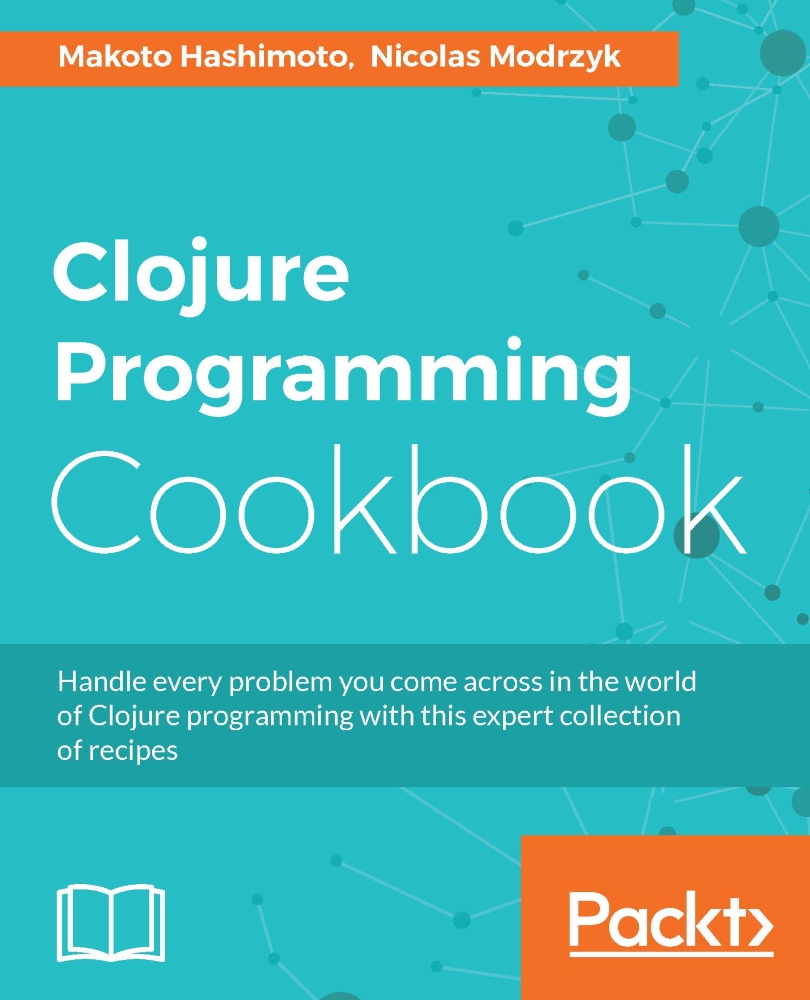
Clojure Programming Cookbook

Clojure Programming Cookbook

By : Makoto Hashimoto, Modrzyk
3 (1)
close
close
Clojure Programming Cookbook

Clojure Programming Cookbook

3 (1)
By: Makoto Hashimoto, Modrzyk

Overview of this book

When it comes to learning and using a new language you need an effective guide to be by your side when things get rough. For Clojure developers, these recipes have everything you need to take on everything this language offers. This book is divided into three high impact sections. The first section gives you an introduction to live programming and best practices. We show you how to interact with your connections by manipulating, transforming, and merging collections. You’ll learn how to work with macros, protocols, multi-methods, and transducers. We’ll also teach you how to work with languages such as Java, and Scala. The next section deals with intermediate-level content and enhances your Clojure skills, here we’ll teach you concurrency programming with Clojure for high performance. We will provide you with advanced best practices, tips on Clojure programming, and show you how to work with Clojure while developing applications. In the final section you will learn how to test, deploy and analyze websocket behavior when your app is deployed in the cloud. Finally, we will take you through DevOps. Developing with Clojure has never been easier with these recipes by your side!
Table of Contents (11 chapters)
close
close

Using functional programming style

In this recipe, we will show you how to define and use anonymous functions and have functions as arguments and return functions. Using the concepts and techniques described here correctly provides higher abstraction.

Getting ready

This section does not make use of any external library, so you can just start a REPL and be ready.

How to do it...

First, let's see some functions take functional arguments.

Functions taking functions as their arguments

Clojure functions such as map and reduce can take functions as arguments.

map

The map function has already been seen in the previous chapters. The map function takes a function as the first argument, applies it to all elements of collection arguments, and returns a lazy sequence.

In the following example, map applies inc to all elements of the collection:

(map inc [1 2 3 4 5]) 
;;=> (2 3 4 5 6) 

The map function takes an arbitrary number of arguments and returns a lazy sequence. The following code applies ...

Visually different images
CONTINUE READING
83
Tech Concepts
36
Programming languages
73
Tech Tools
Icon Unlimited access to the largest independent learning library in tech of over 8,000 expert-authored tech books and videos.
Icon Innovative learning tools, including AI book assistants, code context explainers, and text-to-speech.
Icon 50+ new titles added per month and exclusive early access to books as they are being written.
Clojure Programming Cookbook
notes
bookmark Notes and Bookmarks search Search in title playlist Add to playlist download Download options font-size Font size

Change the font size

margin-width Margin width

Change margin width

day-mode Day/Sepia/Night Modes

Change background colour

Close icon Search
Country selected

Close icon Your notes and bookmarks

Confirmation

Modal Close icon
claim successful

Buy this book with your credits?

Modal Close icon
Are you sure you want to buy this book with one of your credits?
Close
YES, BUY

Submit Your Feedback

Modal Close icon
Modal Close icon
Modal Close icon