Sign In Start Free Trial
Account

Add to playlist

Create a Playlist

Modal Close icon
You need to login to use this feature.
  • Book Overview & Buying Mastering Concurrency Programming with Java 8
  • Table Of Contents Toc
Mastering Concurrency Programming with Java 8

Mastering Concurrency Programming with Java 8

By : Javier Fernández González
3 (4)
close
close
Mastering Concurrency Programming with Java 8

Mastering Concurrency Programming with Java 8

3 (4)
By: Javier Fernández González

Overview of this book

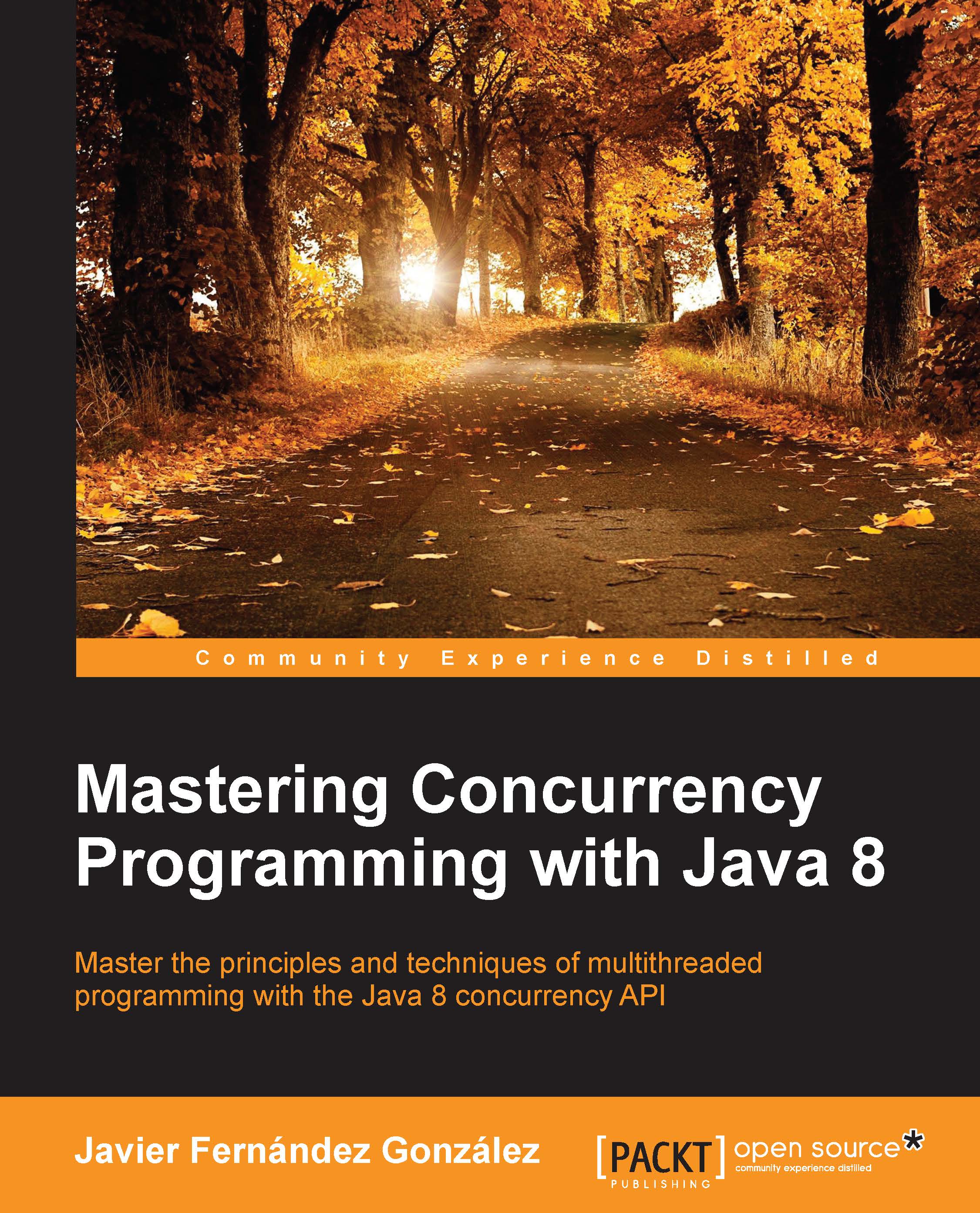
Concurrency programming allows several large tasks to be divided into smaller sub-tasks, which are further processed as individual tasks that run in parallel. All the sub-tasks are combined together once the required results are achieved; they are then merged to get the final output. The whole process is very complex. This process goes from the design of concurrent algorithms to the testing phase where concurrent applications need extra attention. Java includes a comprehensive API with a lot of ready-to-use components to implement powerful concurrency applications in an easy way, but with a high flexibility to adapt these components to your needs. The book starts with a full description of design principles of concurrent applications and how to parallelize a sequential algorithm. We'll show you how to use all the components of the Java Concurrency API from basics to the most advanced techniques to implement them in powerful concurrency applications in Java. You will be using real-world examples of complex algorithms related to machine learning, data mining, natural language processing, image processing in client / server environments. Next, you will learn how to use the most important components of the Java 8 Concurrency API: the Executor framework to execute multiple tasks in your applications, the phaser class to implement concurrent tasks divided into phases, and the Fork/Join framework to implement concurrent tasks that can be split into smaller problems (using the divide and conquer technique). Toward the end, we will cover the new inclusions in Java 8 API, the Map and Reduce model, and the Map and Collect model. The book will also teach you about the data structures and synchronization utilities to avoid data-race conditions and other critical problems. Finally, the book ends with a detailed description of the tools and techniques that you can use to test a Java concurrent application.
Table of Contents (13 chapters)
close
close
12
Index

The Java memory model

When you execute a concurrent application in a computer with several cores or processors, you can have a problem with memory caches. They are very useful to increment the performance of the application, but they can cause data inconsistency. When a task modifies the value of a variable, it's modified in the cache, but it's not modified in the main memory immediately. If another task reads the value of that variable before it's updated in the main memory, it will read the old value of the variable.

Other problems that may exist with concurrent applications are the optimizations introduced by the compilers and code optimizer. Sometimes, they reorder the instructions to get a better performance. In sequential applications, this doesn't cause any problems, but in concurrent applications it can provoke unexpected results.

To solve problems such as this, programming languages introduced memory models. A memory model describes how individual tasks interact with each other through memory and when changes made by one task will be visible to another. It also defines what optimizations of code are allowed and under what circumstances.

There are different memory models. Some of them are very strict (all of the tasks always have access to the same values) and others are less stringent (only some instructions update the values in the main memory). The memory model must be known by the compiler and optimizer developers, and it's transparent to the rest of the programmers.

Java was the first programming language that defined its memory model. The original memory model defined in the JVM had some issues, and it was redefined in Java 5. That memory model is the same in Java 8. It's defined in JSR 133. Basically, the Java Memory Model defines the following:

  • It defines the behavior of the volatile, synchronized, and final keywords.
  • It ensures that a properly synchronized concurrent program runs correctly on all architectures.
  • It creates a partial ordering of the volatile read, volatile write, lock, and unlock instructions denominated as happens-before. Task synchronization helps us establish the happens-before relations too. If one action happens-before another, then the first is visible to and ordered before the second.
  • When a task acquires a monitor, the memory cache is invalidated.
  • When a task releases a monitor, the cache data is flushed into the main memory.
  • It's transparent for Java programmers.

The main objective of the Java memory model is that the properly written concurrent application will behave correctly on every Java Virtual Machine (JVM) regardless of operating system, CPU architecture, and the number of CPUs and cores.

Visually different images
CONTINUE READING
83
Tech Concepts
36
Programming languages
73
Tech Tools
Icon Unlimited access to the largest independent learning library in tech of over 8,000 expert-authored tech books and videos.
Icon Innovative learning tools, including AI book assistants, code context explainers, and text-to-speech.
Icon 50+ new titles added per month and exclusive early access to books as they are being written.
Mastering Concurrency Programming with Java 8
notes
bookmark Notes and Bookmarks search Search in title playlist Add to playlist download Download options font-size Font size

Change the font size

margin-width Margin width

Change margin width

day-mode Day/Sepia/Night Modes

Change background colour

Close icon Search
Country selected

Close icon Your notes and bookmarks

Confirmation

Modal Close icon
claim successful

Buy this book with your credits?

Modal Close icon
Are you sure you want to buy this book with one of your credits?
Close
YES, BUY

Submit Your Feedback

Modal Close icon
Modal Close icon
Modal Close icon