Sign In Start Free Trial
Account

Add to playlist

Create a Playlist

Modal Close icon
You need to login to use this feature.
  • Book Overview & Buying Mastering Clojure
  • Table Of Contents Toc
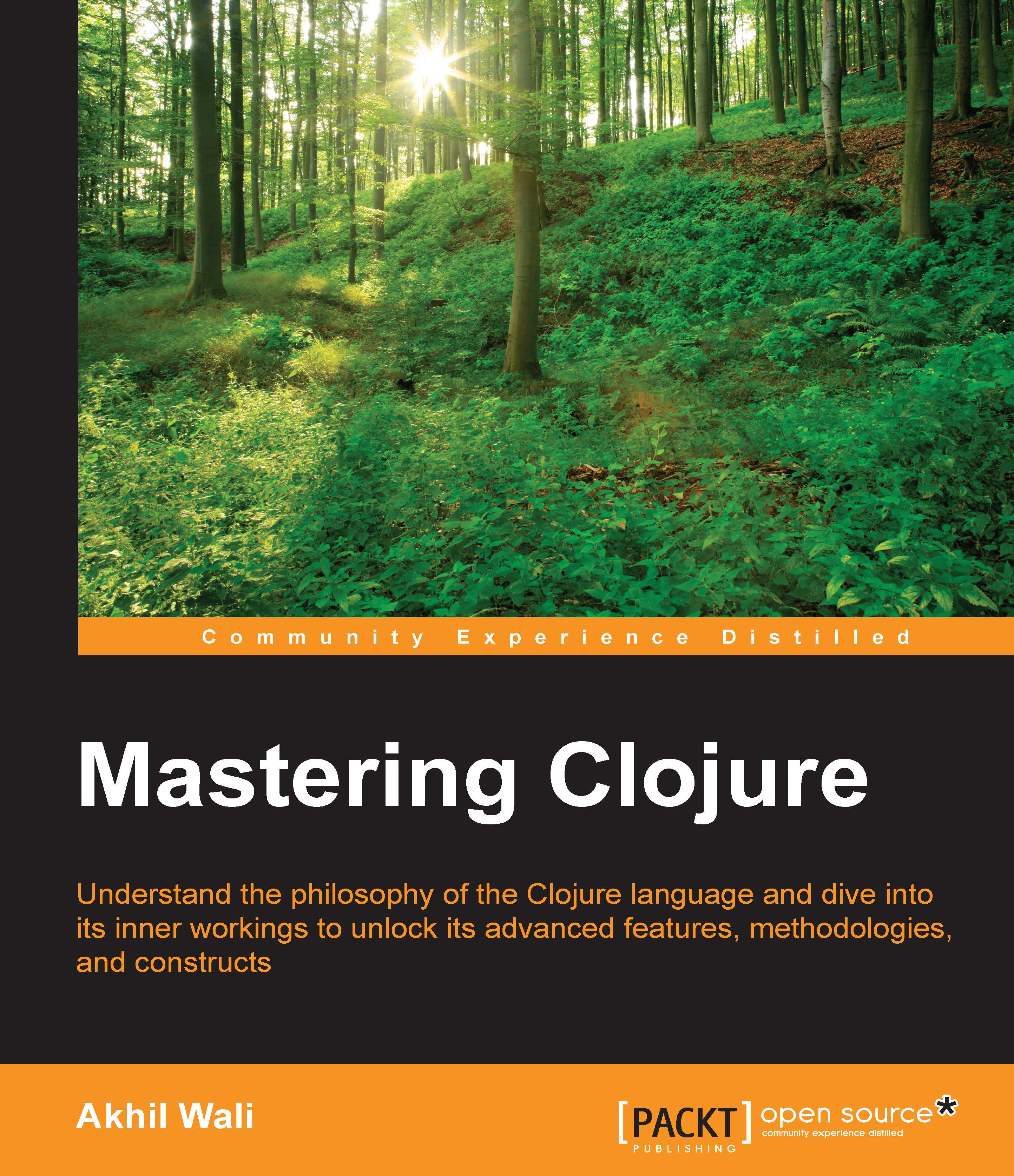
Mastering Clojure

Mastering Clojure

By : Wali
3.5 (2)
close
close
Mastering Clojure

Mastering Clojure

3.5 (2)
By: Wali

Overview of this book

Clojure is a general-purpose language from the Lisp family with an emphasis on functional programming. It has some interesting concepts and features such as immutability, gradual typing, thread-safe concurrency primitives, and macro-based metaprogramming, which makes it a great choice to create modern, performant, and scalable applications. Mastering Clojure gives you an insight into the nitty-gritty details and more advanced features of the Clojure programming language to create more scalable, maintainable, and elegant applications. You’ll start off by learning the details of sequences, concurrency primitives, and macros. Packed with a lot of examples, you’ll get a walkthrough on orchestrating concurrency and parallelism, which will help you understand Clojure reducers, and we’ll walk through composing transducers so you know about functional composition and process transformation inside out. We also explain how reducers and transducers can be used to handle data in a more performant manner. Later on, we describe how Clojure also supports other programming paradigms such as pure functional programming and logic programming. Furthermore, you’ll level up your skills by taking advantage of Clojure's powerful macro system. Parallel, asynchronous, and reactive programming techniques are also described in detail. Lastly, we’ll show you how to test and troubleshoot your code to speed up your development cycles and allow you to deploy the code faster.
Table of Contents (14 chapters)
close
close
12
A. References
13
Index

Conventions

In this book, you will find a number of text styles that distinguish between different kinds of information. Here are some examples of these styles and an explanation of their meaning.

Code words in text, database table names, folder names, filenames, file extensions, pathnames, dummy URLs, user input, and Twitter handles are shown as follows: "Hence, for trees that are represented as sequences, we should use the seq-zip function instead."

A block of code is set as follows:

(f/defun fibo
  ([0] 0N)
  ([1] 1N)
  ([n] (+ (fibo (- n 1))
          (fibo (- n 2)))))

When we wish to draw your attention to a particular part of a code block, the relevant lines or items are set in bold:

(f/defun fibo
  ([0] 0N)
  ([1] 1N)
  ([n] (+ (fibo (- n 1))
          (fibo (- n 2)))))

Any command-line input or output is written as follows:

$ lein repl

Another simple convention that we use is to always show the Clojure code that's entered in the REPL (read-evaluate-print-loop) starting with the user> prompt. In practice, this prompt will change depending on the Clojure namespace that we are currently using. However, for simplicity, code in the REPL always starts with the user> prompt in this book, as follows:

user> (cons 0 ())
(0)
user> (cons 0 nil)
(0)
user> (rest (cons 0 nil))
()

For convenience, the REPL output in this book is pretty-printed (using the clojure.pprint/pprint function). Objects that are printed in the REPL output are enclosed within the #< and > symbols. We must note that the output of the time form in your own REPL may not completely match the output shown in the code examples of this book. Rather, the use of time forms is meant to give you an idea of the scale of the time taken to execute a given expression. Similarly, the output of the code examples that use the rand-int function may not exactly match the output in your REPL.

Some examples in this book use ClojureScript, and the files for these examples will have a .cljs extension. Also, all macros used in these examples will have to be explicitly included using the :require-macros clause of the ns form. The HTML and CSS files associated with the ClojureScript examples in this book will not be shown in this book, but can always be found in the book's code bundle.

Note

Warnings or important notes appear in a box like this.

Tip

Tips and tricks appear like this.

CONTINUE READING
83
Tech Concepts
36
Programming languages
73
Tech Tools
Icon Unlimited access to the largest independent learning library in tech of over 8,000 expert-authored tech books and videos.
Icon Innovative learning tools, including AI book assistants, code context explainers, and text-to-speech.
Icon 50+ new titles added per month and exclusive early access to books as they are being written.
Mastering Clojure
notes
bookmark Notes and Bookmarks search Search in title playlist Add to playlist download Download options font-size Font size

Change the font size

margin-width Margin width

Change margin width

day-mode Day/Sepia/Night Modes

Change background colour

Close icon Search
Country selected

Close icon Your notes and bookmarks

Confirmation

Modal Close icon
claim successful

Buy this book with your credits?

Modal Close icon
Are you sure you want to buy this book with one of your credits?
Close
YES, BUY

Submit Your Feedback

Modal Close icon
Modal Close icon
Modal Close icon