Sign In Start Free Trial
Account

Add to playlist

Create a Playlist

Modal Close icon
You need to login to use this feature.
  • Book Overview & Buying C++ Windows Programming
  • Table Of Contents Toc
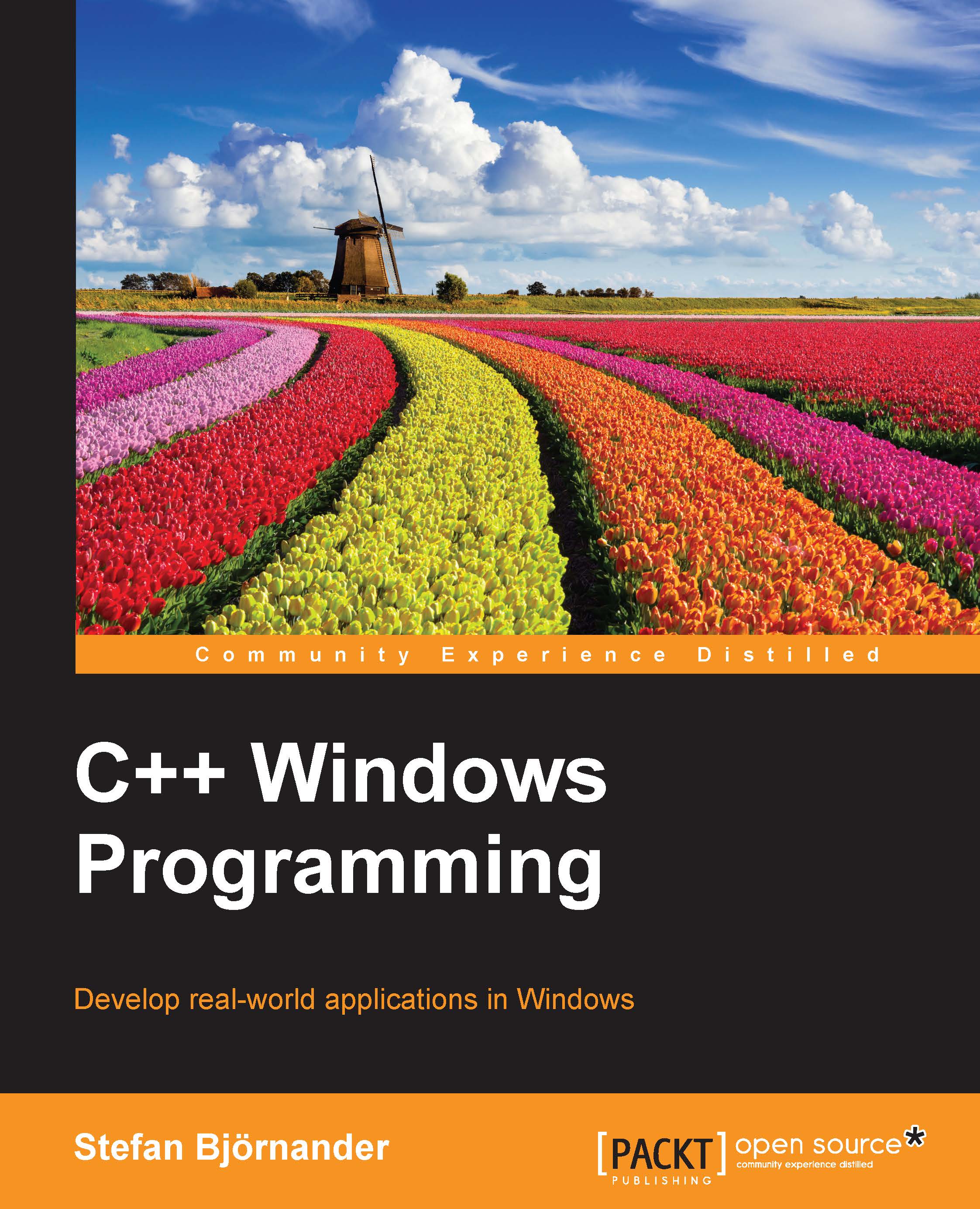
C++ Windows Programming

C++ Windows Programming

By : Stefan Bjornander
2.3 (4)
close
close
C++ Windows Programming

C++ Windows Programming

2.3 (4)
By: Stefan Bjornander

Overview of this book

It is critical that modern developers have the right tools to build practical, user-friendly, and efficient applications in order to compete in today’s market. Through hands-on guidance, this book illustrates and demonstrates C++ best practices and the Small Windows object-oriented class library to ease your development of interactive Windows applications. Begin with a focus on high level application development using Small Windows. Learn how to build four real-world applications which focus on the general problems faced when developing graphical applications. Get essential troubleshooting guidance on drawing, spreadsheet, and word processing applications. Finally finish up with a deep dive into the workings of the Small Windows class library, which will give you all the insights you need to build your own object-oriented class library in C++.
Table of Contents (16 chapters)
close
close
Lock Free Chapter
1
1. Introduction

The DynamicList class

The DynamicList class can be regarded as a more advanced version of the C++ standard classes list and vector. It varies its size dynamically:

DynamicList.h

namespace SmallWindows { 
  template <class Type> 
  class DynamicList { 
    public: 

The IfFuncPtr pointer is a function prototype that is used when testing (without changing) a value in the list. It takes a constant value and a void pointer and returns a Boolean value. DoFuncPtr is used when changing a value in the list and takes a (non-constant) value and a void pointer. The void pointers are sent by the calling methods; they hold additional information:

      typedef bool (*IfFuncPtr)(const Type& value, void* voidPtr); 
      typedef void (*DoFuncPtr)(Type& value, void* voidPtr); 

The list can be initialized by, and assigned to, another list. The default constructor creates an empty list, and the destructor deallocates the memory from the list:

      DynamicList(); 
      DynamicList(const DynamicList...
CONTINUE READING
83
Tech Concepts
36
Programming languages
73
Tech Tools
Icon Unlimited access to the largest independent learning library in tech of over 8,000 expert-authored tech books and videos.
Icon Innovative learning tools, including AI book assistants, code context explainers, and text-to-speech.
Icon 50+ new titles added per month and exclusive early access to books as they are being written.
C++ Windows Programming
notes
bookmark Notes and Bookmarks search Search in title playlist Add to playlist download Download options font-size Font size

Change the font size

margin-width Margin width

Change margin width

day-mode Day/Sepia/Night Modes

Change background colour

Close icon Search
Country selected

Close icon Your notes and bookmarks

Confirmation

Modal Close icon
claim successful

Buy this book with your credits?

Modal Close icon
Are you sure you want to buy this book with one of your credits?
Close
YES, BUY

Submit Your Feedback

Modal Close icon
Modal Close icon
Modal Close icon