Sign In Start Free Trial
Account

Add to playlist

Create a Playlist

Modal Close icon
You need to login to use this feature.
  • Book Overview & Buying Modern C++ Programming Cookbook
  • Table Of Contents Toc
  • Feedback & Rating feedback
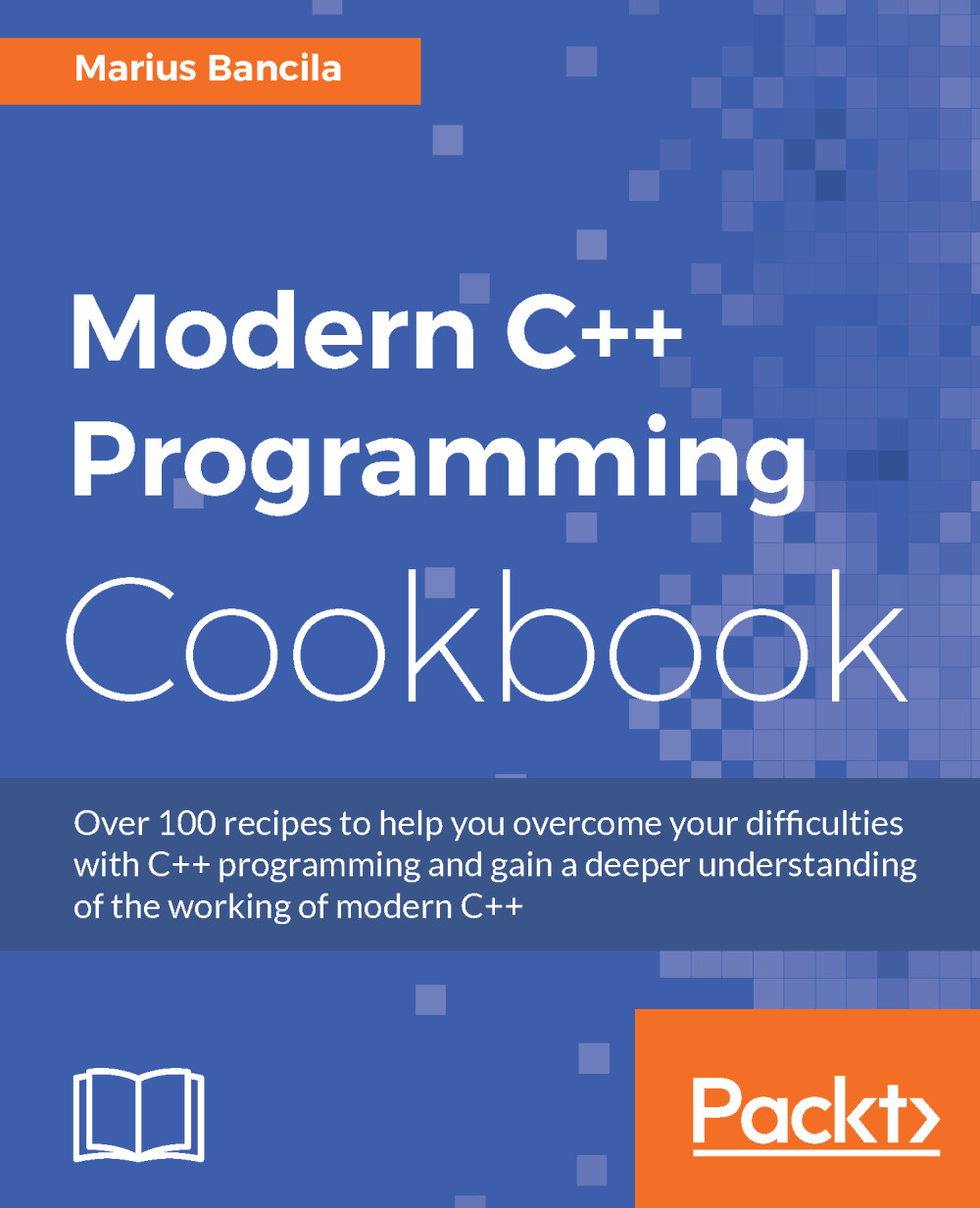
Modern C++ Programming Cookbook

Modern C++ Programming Cookbook

By : Marius Bancila
4 (7)
close
close
Modern C++ Programming Cookbook

Modern C++ Programming Cookbook

4 (7)
By: Marius Bancila

Overview of this book

C++ is one of the most widely used programming languages. Fast, efficient, and flexible, it is used to solve many problems. The latest versions of C++ have seen programmers change the way they code, giving up on the old-fashioned C-style programming and adopting modern C++ instead. Beginning with the modern language features, each recipe addresses a specific problem, with a discussion that explains the solution and offers insight into how it works. You will learn major concepts about the core programming language as well as common tasks faced while building a wide variety of software. You will learn about concepts such as concurrency, performance, meta-programming, lambda expressions, regular expressions, testing, and many more in the form of recipes. These recipes will ensure you can make your applications robust and fast. By the end of the book, you will understand the newer aspects of C++11/14/17 and will be able to overcome tasks that are time-consuming or would break your stride while developing.
Table of Contents (13 chapters)
close
close

Checking the properties of an existing file or directory


The filesystem library provides functions and types that enable developers to check for the existence of a filesystem object, such as a file or directory, its properties, such as the type (file, directory, symbolic link, and so on), the last write time, permissions, and others. In this recipe, we will look at what these types and functions are and how they can be used.

Getting ready

Before continuing with this recipe, you should read the Working with filesystem paths recipe.

For the following code samples, we will use the namespace alias fs for the std::filesystem namespace. The filesystem library is available in the header with the same name, <filesystem>. Also, we will use the variables shown here, path for the path of a file and err for receiving potential operating system error codes from the filesystem APIs:

    auto path = fs::current_path() / "main.cpp";
    auto err = std::error_code{};

How to do it...

Use the following library...

Visually different images
CONTINUE READING
83
Tech Concepts
36
Programming languages
73
Tech Tools
Icon Unlimited access to the largest independent learning library in tech of over 8,000 expert-authored tech books and videos.
Icon Innovative learning tools, including AI book assistants, code context explainers, and text-to-speech.
Icon 50+ new titles added per month and exclusive early access to books as they are being written.
Modern C++ Programming Cookbook
notes
bookmark Notes and Bookmarks search Search in title playlist Add to playlist download Download options font-size Font size

Change the font size

margin-width Margin width

Change margin width

day-mode Day/Sepia/Night Modes

Change background colour

Close icon Search
Country selected

Close icon Your notes and bookmarks

Confirmation

Modal Close icon
claim successful

Buy this book with your credits?

Modal Close icon
Are you sure you want to buy this book with one of your credits?
Close
YES, BUY

Submit Your Feedback

Modal Close icon
Modal Close icon
Modal Close icon