Sign In Start Free Trial
Account

Add to playlist

Create a Playlist

Modal Close icon
You need to login to use this feature.
  • Book Overview & Buying Learning Concurrent Programming in Scala
  • Table Of Contents Toc
  • Feedback & Rating feedback
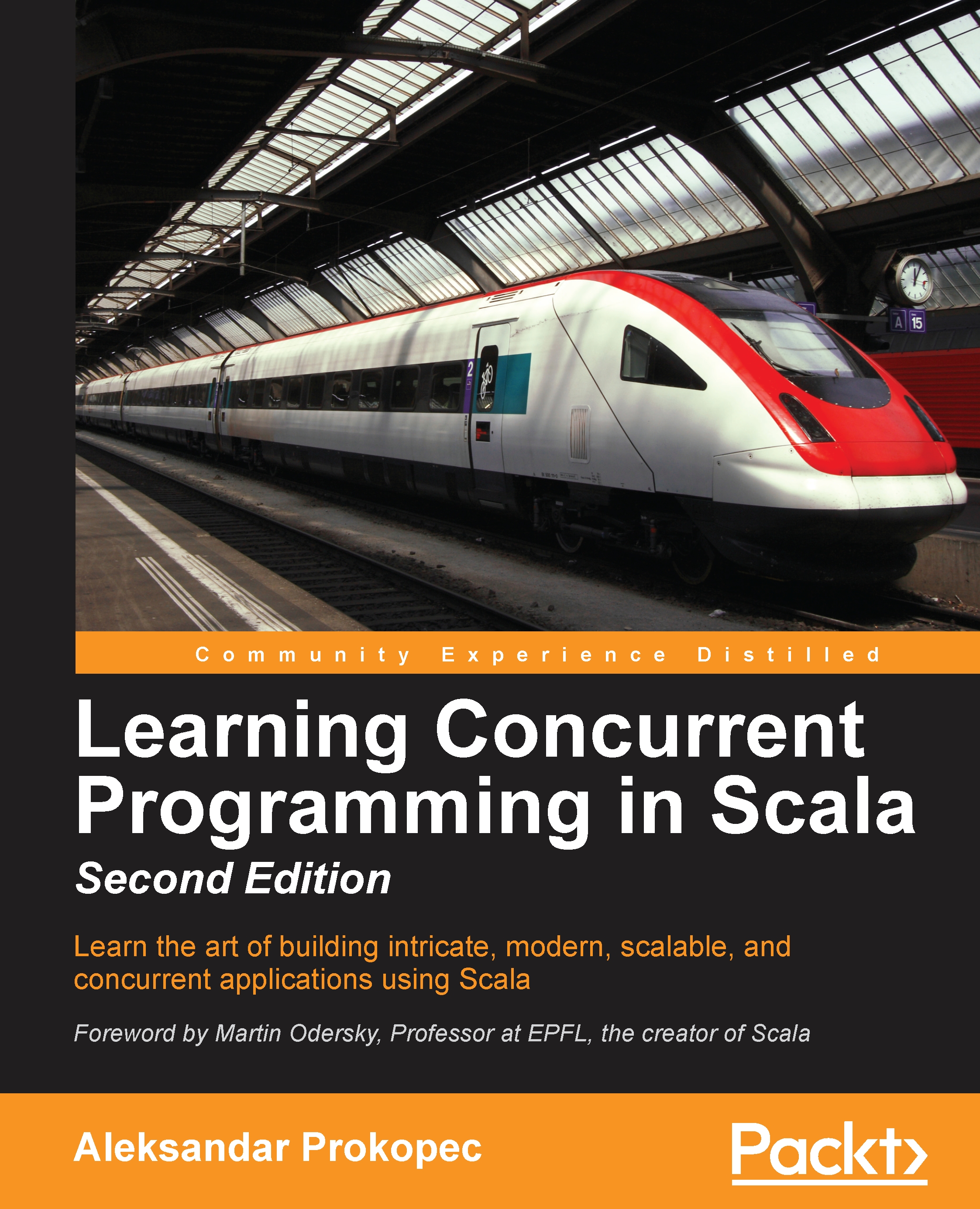
Learning Concurrent Programming in Scala

Learning Concurrent Programming in Scala - Second Edition

By : Prokopec
4.8 (16)
close
close
Learning Concurrent Programming in Scala

Learning Concurrent Programming in Scala

4.8 (16)
By: Prokopec

Overview of this book

Scala is a modern, multiparadigm programming language designed to express common programming patterns in a concise, elegant, and type-safe way. Scala smoothly integrates the features of object-oriented and functional languages. In this second edition, you will find updated coverage of the Scala 2.12 platform. The Scala 2.12 series targets Java 8 and requires it for execution. The book starts by introducing you to the foundations of concurrent programming on the JVM, outlining the basics of the Java Memory Model, and then shows some of the classic building blocks of concurrency, such as the atomic variables, thread pools, and concurrent data structures, along with the caveats of traditional concurrency. The book then walks you through different high-level concurrency abstractions, each tailored toward a specific class of programming tasks, while touching on the latest advancements of async programming capabilities of Scala. It also covers some useful patterns and idioms to use with the techniques described. Finally, the book presents an overview of when to use which concurrency library and demonstrates how they all work together, and then presents new exciting approaches to building concurrent and distributed systems. Who this book is written for If you are a Scala programmer with no prior knowledge of concurrent programming, or seeking to broaden your existing knowledge about concurrency, this book is for you. Basic knowledge of the Scala programming language will be helpful.
Table of Contents (11 chapters)
close
close

Overview of new features in Scala 2.12

At the time of writing, the next planned release of the language is Scala 2.12. From the user and API perspective, Scala 2.12 does not introduce new ground-breaking features. The goal of the 2.12 release is to improve code optimization and make Scala compliant with the Java 8 runtime. Since Scala's primary target is the Java runtime, making Scala compliant with Java 8 runtime will reduce the size of compiled programs and JAR files, better performance and faster compilation. From the user perspective, the major change is that you will have to install the JDK 8 framework instead of JDK 7.

The particular changes in Scala 2.12 worth mentioning are the following:

  • In previous versions, traits compiled to a single interface if all of their methods were abstract. If the trait had a concrete method implementation, the compiler generated two class files--one containing the JVM interface, and another class file containing the implementations of the concrete methods. In Scala 2.12, the compiler will generate a single interface file containing the Java 8 default methods. The net effect is reduced code size.
  • Previously, each Scala closure was compiled into a separate class. Starting with 2.12, Scala closures are compiled into Java 8-style lambdas. The consequence is reduced code size and potentially better optimizations by the Java 8 runtime.
  • Scala compiles into Java bytecodes, which are then interpreted on the Java Virtual Machine. In Scala 2.12, the old compiler backend is replaced with a new implementation that generates bytecode more quickly with a positive impact on compilation speed.
  • Scala 2.12 comes with a new optimizer, which is enabled with the -opt compiler flag. The new optimizer is more aggressive at inlining final methods, does better escape analysis for objects and functions that are created and used in a single method, and does dead code elimination. All this has a positive impact on the performance of Scala programs.
  • Scala 2.12 allows using lambdas for Single Abstract Method (SAM) types. SAM types are classes or traits that have exactly one abstract method, which is normally implemented by extending the class. Assume that we have a method invocation with an argument whose expected type is a SAM type. If the user passes a lambda, that is, a function literal, instead of a SAM type instance, the 2.12 compiler will automatically convert the function object into an instance of the SAM type.
Visually different images
CONTINUE READING
83
Tech Concepts
36
Programming languages
73
Tech Tools
Icon Unlimited access to the largest independent learning library in tech of over 8,000 expert-authored tech books and videos.
Icon Innovative learning tools, including AI book assistants, code context explainers, and text-to-speech.
Icon 50+ new titles added per month and exclusive early access to books as they are being written.
Learning Concurrent Programming in Scala
notes
bookmark Notes and Bookmarks search Search in title playlist Add to playlist font-size Font size

Change the font size

margin-width Margin width

Change margin width

day-mode Day/Sepia/Night Modes

Change background colour

Close icon Search
Country selected

Close icon Your notes and bookmarks

Confirmation

Modal Close icon
claim successful

Buy this book with your credits?

Modal Close icon
Are you sure you want to buy this book with one of your credits?
Close
YES, BUY

Submit Your Feedback

Modal Close icon
Modal Close icon
Modal Close icon