Sign In Start Free Trial
Account

Add to playlist

Create a Playlist

Modal Close icon
You need to login to use this feature.
  • Book Overview & Buying C++17 STL Cookbook
  • Table Of Contents Toc
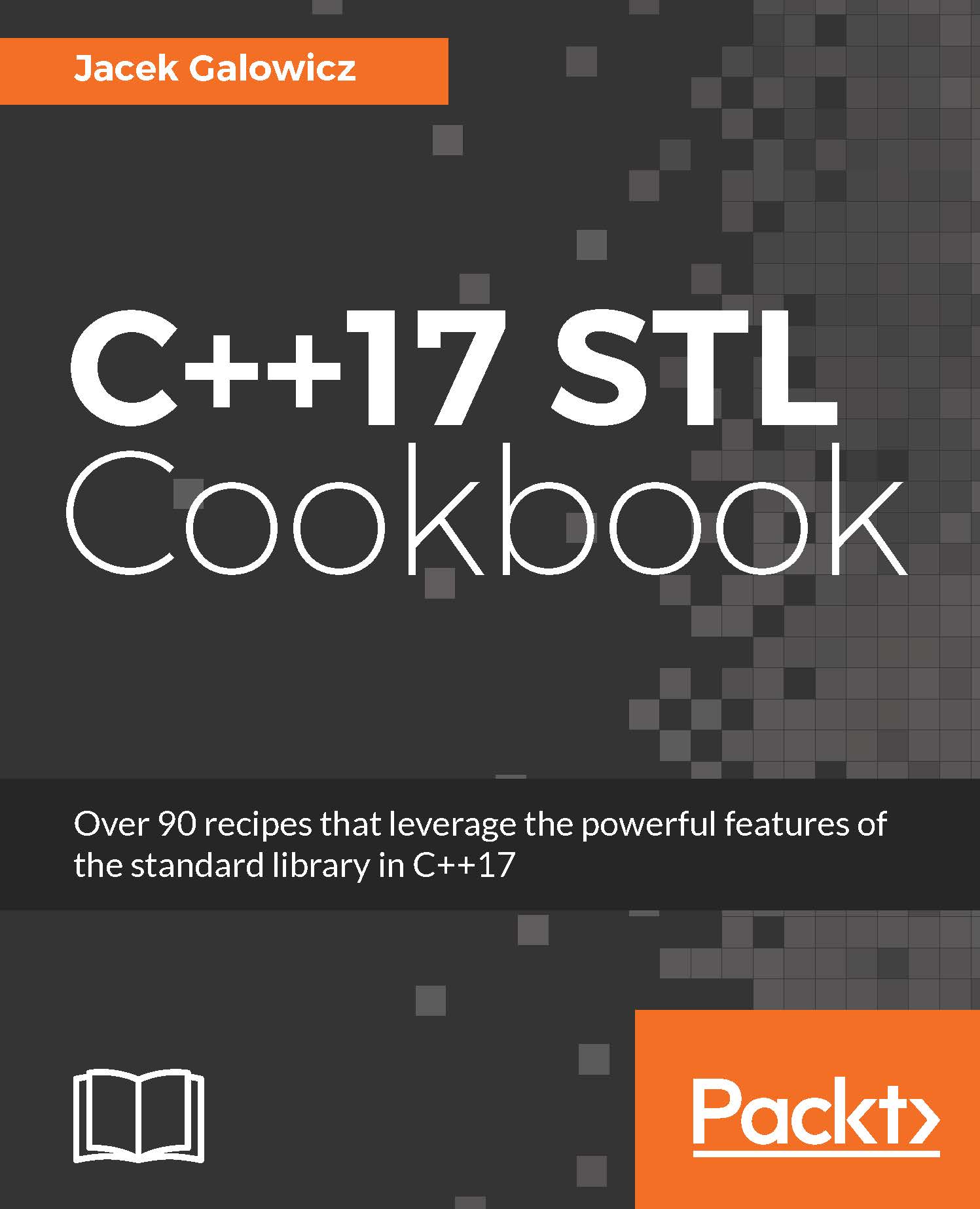
C++17 STL Cookbook

C++17 STL Cookbook

By : Galowicz
4.3 (15)
close
close
C++17 STL Cookbook

C++17 STL Cookbook

4.3 (15)
By: Galowicz

Overview of this book

C++ has come a long way and is in use in every area of the industry. Fast, efficient, and flexible, it is used to solve many problems. The upcoming version of C++ will see programmers change the way they code. If you want to grasp the practical usefulness of the C++17 STL in order to write smarter, fully portable code, then this book is for you. Beginning with new language features, this book will help you understand the language’s mechanics and library features, and offers insight into how they work. Unlike other books, ours takes an implementation-specific, problem-solution approach that will help you quickly overcome hurdles. You will learn the core STL concepts, such as containers, algorithms, utility classes, lambda expressions, iterators, and more, while working on practical real-world recipes. These recipes will help you get the most from the STL and show you how to program in a better way. By the end of the book, you will be up to date with the latest C++17 features and save time and effort while solving tasks elegantly using the STL.
Table of Contents (11 chapters)
close
close

Automatically handling shared heap memory with std::shared_ptr


In the last recipe, we learned how to use unique_ptr. This is an enormously useful and important class because it helps us manage dynamically allocated objects. However, it can only handle single ownership. It is not possible to let multiple objects own the same dynamically allocated object because, then, it would be unclear who has to delete it later.

The pointer type, shared_ptr, was designed for specifically this case. Shared pointers can be copied arbitrarily often. An internal reference counting mechanism tracks how many objects are still maintaining a pointer to the payload object. Only the last shared pointer that goes out of scope will call delete on the payload object. This way, we can be sure that we do not get memory leaks because objects are deleted automatically after use. At the same time, we can be sure that they are not deleted too early, or too often (every created object must only be deleted once).

In this recipe...

CONTINUE READING
83
Tech Concepts
36
Programming languages
73
Tech Tools
Icon Unlimited access to the largest independent learning library in tech of over 8,000 expert-authored tech books and videos.
Icon Innovative learning tools, including AI book assistants, code context explainers, and text-to-speech.
Icon 50+ new titles added per month and exclusive early access to books as they are being written.
C++17 STL Cookbook
notes
bookmark Notes and Bookmarks search Search in title playlist Add to playlist font-size Font size

Change the font size

margin-width Margin width

Change margin width

day-mode Day/Sepia/Night Modes

Change background colour

Close icon Search
Country selected

Close icon Your notes and bookmarks

Confirmation

Modal Close icon
claim successful

Buy this book with your credits?

Modal Close icon
Are you sure you want to buy this book with one of your credits?
Close
YES, BUY

Submit Your Feedback

Modal Close icon
Modal Close icon
Modal Close icon