Sign In Start Free Trial
Account

Add to playlist

Create a Playlist

Modal Close icon
You need to login to use this feature.
  • Book Overview & Buying QGIS Python Programming Cookbook, Second Edition
  • Table Of Contents Toc
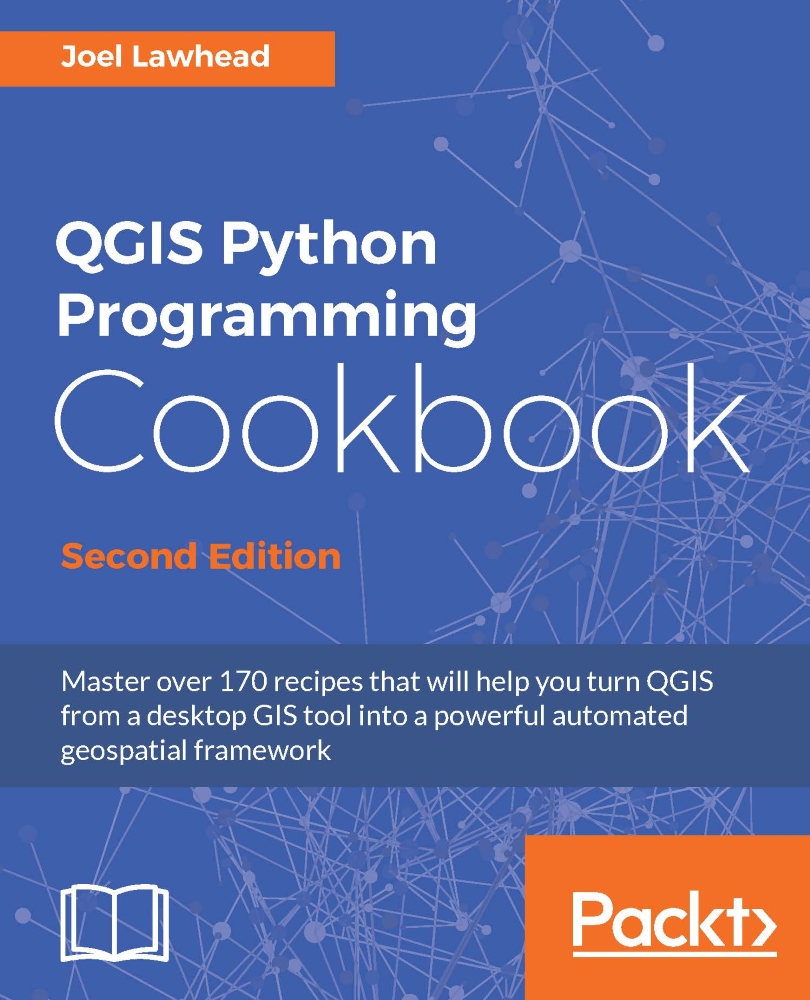
QGIS Python Programming Cookbook, Second Edition

QGIS Python Programming Cookbook, Second Edition - Second Edition

By : Joel Lawhead
1.5 (2)
close
close
QGIS Python Programming Cookbook, Second Edition

QGIS Python Programming Cookbook, Second Edition

1.5 (2)
By: Joel Lawhead

Overview of this book

QGIS is a desktop geographic information system that facilitates data viewing, editing, and analysis. Paired with the most efficient scripting language—Python, we can write effective scripts that extend the core functionality of QGIS. Based on version QGIS 2.18, this book will teach you how to write Python code that works with spatial data to automate geoprocessing tasks in QGIS. It will cover topics such as querying and editing vector data and using raster data. You will also learn to create, edit, and optimize a vector layer for faster queries, reproject a vector layer, reduce the number of vertices in a vector layer without losing critical data, and convert a raster to a vector. Following this, you will work through recipes that will help you compose static maps, create heavily customized maps, and add specialized labels and annotations. As well as this, we’ll also share a few tips and tricks based on different aspects of QGIS.
Table of Contents (10 chapters)
close
close

Visualizing data on a globe

Ever since the release of Google Earth, spinning globe applications are a useful and popular method of geographical exploration. QGIS has an experimental plugin called QGIS Globe that is similar to Google Earth; however, it is extremely unstable. In this recipe, we'll display a layer in Google Earth.

Getting ready

You will need to use the QGIS plugin manager to install the mmqgis plugin.

Make sure you have Google Earth installed from https://www.google.com/earth/.

You will also need the following dataset from a previous recipe. It is a zipped directory called ufo, which you should uncompress to your qgis_data directory:

https://github.com/GeospatialPython/Learn/raw/master/ufo.zip

How to do it...

We will load our layer and set up the attribute we want to use for the Google Earth KML output as descriptors. We'll use the mmqgis plugin to output our layer to KML. Finally, we'll use a cross-platform technique to open the file, which will trigger...

CONTINUE READING
83
Tech Concepts
36
Programming languages
73
Tech Tools
Icon Unlimited access to the largest independent learning library in tech of over 8,000 expert-authored tech books and videos.
Icon Innovative learning tools, including AI book assistants, code context explainers, and text-to-speech.
Icon 50+ new titles added per month and exclusive early access to books as they are being written.
QGIS Python Programming Cookbook, Second Edition
notes
bookmark Notes and Bookmarks search Search in title playlist Add to playlist download Download options font-size Font size

Change the font size

margin-width Margin width

Change margin width

day-mode Day/Sepia/Night Modes

Change background colour

Close icon Search
Country selected

Close icon Your notes and bookmarks

Confirmation

Modal Close icon
claim successful

Buy this book with your credits?

Modal Close icon
Are you sure you want to buy this book with one of your credits?
Close
YES, BUY

Submit Your Feedback

Modal Close icon
Modal Close icon
Modal Close icon