Sign In Start Free Trial
Account

Add to playlist

Create a Playlist

Modal Close icon
You need to login to use this feature.
  • Book Overview & Buying Mobile Test Automation with Appium
  • Table Of Contents Toc
  • Feedback & Rating feedback
Mobile Test Automation with Appium

Mobile Test Automation with Appium

By : Verma
2 (4)
close
close
Mobile Test Automation with Appium

Mobile Test Automation with Appium

2 (4)
By: Verma

Overview of this book

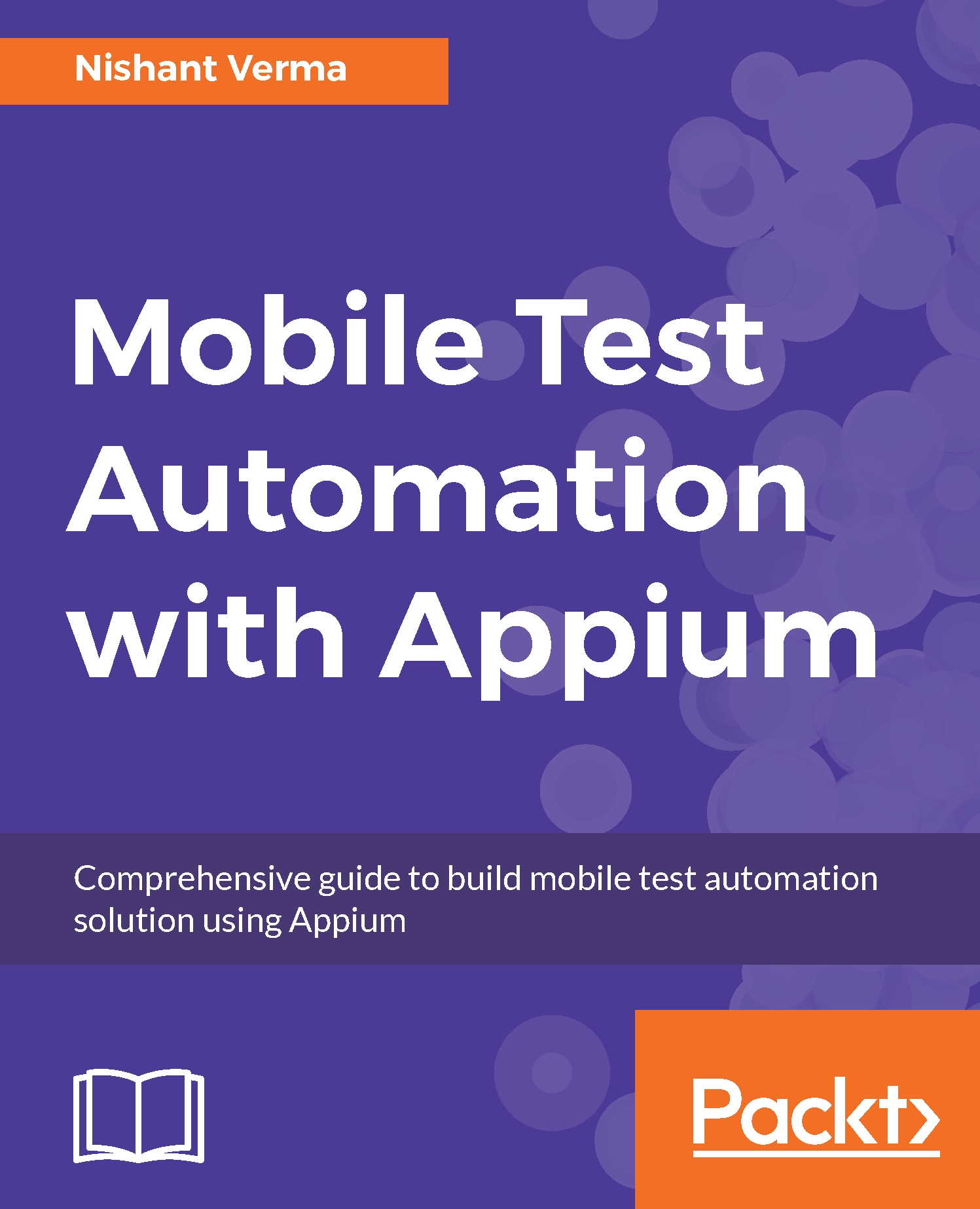
Appium is an open source test automation framework for mobile applications. It allows you to test all three types of mobile applications: native, hybrid, and mobile web. It allows you to run the automated tests on actual devices, emulators, and simulators. Today, when every mobile app is made on at least two platforms, iOS and Android, you need a tool that allows you to test across platforms. Having two different frameworks for the same app increases the cost of the product and time to maintain it as well. Appium helps save this cost. With mobile app growth exploding, mobile app automation is mainstream now. In this book, author Nishant Verma provides you with a firm grounding in the concepts of Appium while diving into how to set up appium & Cucumber-jvm test automation framework, implement page object design pattern, automate gestures, test execution on emulators and physical devices, and implement continuous integration with Jenkins. The mobile app we have referenced in this book is Quikr because of its relatively lower learning curve to understand the application. It's a local classifieds shopping app.
Table of Contents (14 chapters)
close
close
5
Understanding Appium Inspector to Find Locators
7
How to Automate Gestures
9
How to Run Appium Test on Devices and Emulators

Refactoring -1


Note

Note: We will take one of the feature files or code bases (Android in this case) to demonstrate some of the concepts while refactoring. This can also be followed with the other iOS code written.

In this first refactoring, we will remove the manual dependency of starting and stopping the Appium server, and we will do it programmatically:

  • Create a new class called StartingSteps under the steps package
  • In the StartingSteps class, create two empty methods, called startAppiumServer and stopAppiumServer:
      public void startAppiumServer(){
      //code to start appium server
      }

      public void stopAppiumServer(){
      // Code to stop appium server
      }

At this point in time, we need to know the concept of hooks in cucumber. So basically, cucumber gives you a number of hooks, which allow one to run certain code at a certain point in the test life cycle. These hooks can be used and defined in a class file in the steps folder. However, cucumber doesn't mandate the location...

Visually different images
CONTINUE READING
83
Tech Concepts
36
Programming languages
73
Tech Tools
Icon Unlimited access to the largest independent learning library in tech of over 8,000 expert-authored tech books and videos.
Icon Innovative learning tools, including AI book assistants, code context explainers, and text-to-speech.
Icon 50+ new titles added per month and exclusive early access to books as they are being written.
Mobile Test Automation with Appium
notes
bookmark Notes and Bookmarks search Search in title playlist Add to playlist download Download options font-size Font size

Change the font size

margin-width Margin width

Change margin width

day-mode Day/Sepia/Night Modes

Change background colour

Close icon Search
Country selected

Close icon Your notes and bookmarks

Confirmation

Modal Close icon
claim successful

Buy this book with your credits?

Modal Close icon
Are you sure you want to buy this book with one of your credits?
Close
YES, BUY

Submit Your Feedback

Modal Close icon
Modal Close icon
Modal Close icon