
Sign In Start Free Trial
Account

Add to playlist

Create a Playlist

Modal Close icon
You need to login to use this feature.
  • Book Overview & Buying Learning Functional Programming in Go
  • Table Of Contents Toc
  • Feedback & Rating feedback
Learning Functional Programming in Go

Learning Functional Programming in Go

By : Sheehan
4.1 (8)
close
close
Learning Functional Programming in Go

Learning Functional Programming in Go

4.1 (8)
By: Sheehan

Overview of this book

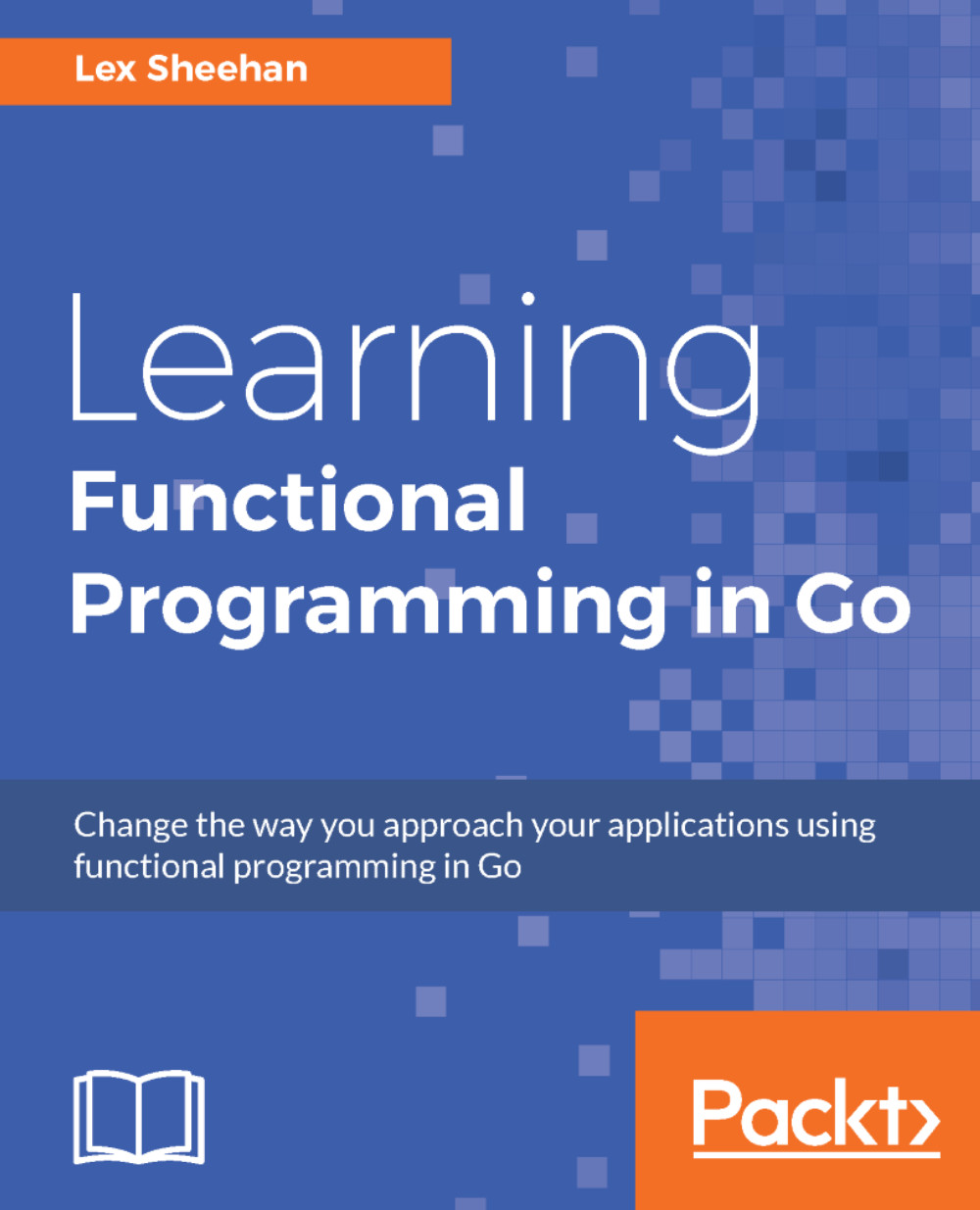
Lex Sheehan begins slowly, using easy-to-understand illustrations and working Go code to teach core functional programming (FP) principles such as referential transparency, laziness, recursion, currying, and chaining continuations. This book is a tutorial for programmers looking to learn FP and apply it to write better code. Lex guides readers from basic techniques to advanced topics in a logical, concise, and clear progression. The book is divided into four modules. The first module explains the functional style of programming: pure functional programming, manipulating collections, and using higher-order functions. In the second module, you will learn design patterns that you can use to build FP-style applications. In the next module, you will learn FP techniques that you can use to improve your API signatures, increase performance, and build better cloud-native applications. The last module covers Category Theory, Functors, Monoids, Monads, Type classes and Generics. By the end of the book, you will be adept at building applications the FP way.
Table of Contents (13 chapters)
close
close

Software design methodology

Software design is where we:

  • Gather requirements
  • Create specifications from requirements
  • Implement a solution based on the specifications
  • Review results and iterate to improve the solution

Traditional waterfall development depends on a perfect understanding of the product requirements at the outset and minimal errors being executed in each phase. Source: http://scrumreferencecard.com/scrum-reference-card/

Scrum blends all the development activities into each iteration, adapting to discovered realities at fixed intervals:

In the process of creating specifications, artifacts such as Unified Markup Language (UML) diagrams are often created to help us think about the problem and craft a viable solution.

Analysis is where we model real-world operations, breaking apart pieces...

Visually different images
CONTINUE READING
83
Tech Concepts
36
Programming languages
73
Tech Tools
Icon Unlimited access to the largest independent learning library in tech of over 8,000 expert-authored tech books and videos.
Icon Innovative learning tools, including AI book assistants, code context explainers, and text-to-speech.
Icon 50+ new titles added per month and exclusive early access to books as they are being written.
Learning Functional Programming in Go
notes
bookmark Notes and Bookmarks search Search in title playlist Add to playlist download Download options font-size Font size

Change the font size

margin-width Margin width

Change margin width

day-mode Day/Sepia/Night Modes

Change background colour

Close icon Search
Country selected

Close icon Your notes and bookmarks

Confirmation

Modal Close icon
claim successful

Buy this book with your credits?

Modal Close icon
Are you sure you want to buy this book with one of your credits?
Close
YES, BUY

Submit Your Feedback

Modal Close icon
Modal Close icon
Modal Close icon