Sign In Start Free Trial
Account

Add to playlist

Create a Playlist

Modal Close icon
You need to login to use this feature.
  • Book Overview & Buying Learning Java Lambdas
  • Table Of Contents Toc
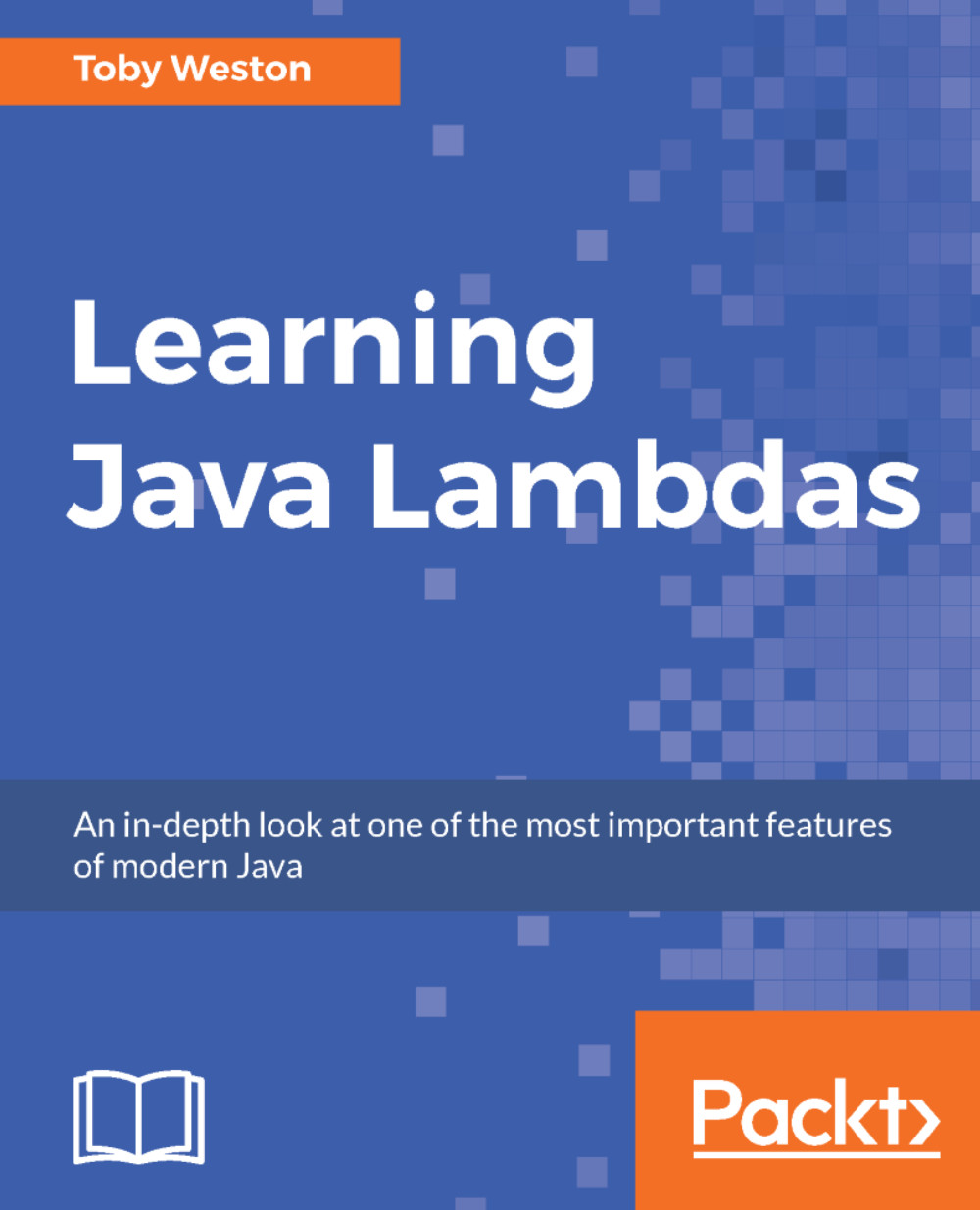
Learning Java Lambdas

Learning Java Lambdas

By : Toby Weston
close
close
Learning Java Lambdas

Learning Java Lambdas

By: Toby Weston

Overview of this book

In this short book, we take an in-depth look at lambdas in Java, and their supporting features. The book covers essential topics, such as functional interfaces and type inference, and the key differences between lambdas and closures. You will learn about the background to functional programming and lambdas, before moving on to understanding the basic syntax of lambdas and what differentiates these anonymous functions from standard anonymous classes. Lastly, you'll learn how to invoke lambdas and look at the bytecode generated. After reading this book, you'll understand lambdas in depth, their background, syntax, implementation details, and how and when to use them. You'll also have a clear knowledge of the difference between functions and classes, and why that's relevant to lambdas. This knowledge will enable you to appreciate the improvements to type inference that drive a lot of the new features in modern Java, and will increase your understanding of method references and scoping.
Table of Contents (5 chapters)
close
close

Scoping


The good news with lambdas is that they don't introduce any new scoping. Using variables within a lambda will refer to variables residing in the enclosing environment.

This is what's called lexical scoping. It means that lambdas don't introduce a new level of scoping at all; you can directly access fields, methods and variables from the enclosing scope. It's also the case for the this and super keywords. So we don't have to worry about the crazy nested class syntax for resolving scope.

Let's take a look at an example. We have an example class here, with a member variable i set to the value of 5.

public static class Example {
    int i = 5;

    public Integer example() {
        Supplier<Integer> function = () -> i * 2;
        return function.get();
    }
}

In the example method, a lambda uses a variable called i and multiplies it by two.

Because lambdas are lexically scoped, i simply refers to the enclosing classes' variable. It's value at...

Visually different images
CONTINUE READING
83
Tech Concepts
36
Programming languages
73
Tech Tools
Icon Unlimited access to the largest independent learning library in tech of over 8,000 expert-authored tech books and videos.
Icon Innovative learning tools, including AI book assistants, code context explainers, and text-to-speech.
Icon 50+ new titles added per month and exclusive early access to books as they are being written.
Learning Java Lambdas
notes
bookmark Notes and Bookmarks search Search in title playlist Add to playlist font-size Font size

Change the font size

margin-width Margin width

Change margin width

day-mode Day/Sepia/Night Modes

Change background colour

Close icon Search
Country selected

Close icon Your notes and bookmarks

Confirmation

Modal Close icon
claim successful

Buy this book with your credits?

Modal Close icon
Are you sure you want to buy this book with one of your credits?
Close
YES, BUY

Submit Your Feedback

Modal Close icon
Modal Close icon
Modal Close icon