Sign In Start Free Trial
Account

Add to playlist

Create a Playlist

Modal Close icon
You need to login to use this feature.
  • Book Overview & Buying C# 7 and .NET Core Cookbook
  • Table Of Contents Toc
C# 7 and .NET Core Cookbook

C# 7 and .NET Core Cookbook - Second Edition

By : Dirk Strauss, Fabio Claudio Ferracchiati
3.3 (6)
close
close
C# 7 and .NET Core Cookbook

C# 7 and .NET Core Cookbook

3.3 (6)
By: Dirk Strauss, Fabio Claudio Ferracchiati

Overview of this book

C# has recently been open-sourced and C# 7 comes with a host of new features for building powerful, cross-platform applications. This book will be your solution to some common programming problems that you come across with C# and will also help you get started with .NET Core 1.1. Through a recipe-based approach, this book will help you overcome common programming challenges and get your applications ready to face the modern world. We start by running you through new features in C# 7, such as tuples, pattern matching, and so on, giving you hands-on experience with them. Moving forward, you will work with generics and the OOP features in C#. You will then move on to more advanced topics, such as reactive extensions, Regex, code analyzers, and asynchronous programming. This book will also cover new, cross-platform .NET Core 1.1 features and teach you how to utilize .NET Core on macOS. Then, we will explore microservices as well as serverless computing and how these benefit modern developers. Finally, you will learn what you can do with Visual Studio 2017 to put mobile application development across multiple platforms within the reach of any developer.
Table of Contents (17 chapters)
close
close

Deconstruction

Tuples can be consumed using a deconstruction declaration. This simply splits a Tuple into its individual parts and assigns these parts to new variables. This is called deconstruction, and it is not only reserved for Tuples.

Getting ready

Remember when we used Tuples at the beginning of this chapter? Well we were using code similar to the following to get the values returned by the Tuple literal.

var (average, studentCount) = ch1.GetAverageAndCount(scores);

This was deconstructing the parts of the Tuple into the new variables average and studentCount. I do not, however, want to take a look at Tuples again. What I want to do is show how you can implement a deconstruction declaration on any type. To do this, all that we need to do is ensure that the type has a deconstructor method. We will modify our existing Student class to add a deconstructor.

How to do it...

  1. If you created the Student class earlier, you should have something similar to this in your code:
        public class Student
{
public string Name { get; set; }
public string LastName { get; set; }
public List<int> CourseCodes { get; set; }
}
  1. To create a deconstructor, add a Deconstruct method to your Student class. You will notice that this is a void method that takes two out parameters (in this instance). We then just assign the values of Name and LastName to the out parameters.
If we wanted to deconstruct more values in the Student class, we would pass in more out parameters, one for each value we wanted to deconstruct.
        public void Deconstruct(out string name, out string lastName)
{
name = Name;
lastName = LastName;
}
  1. Your modified Student class should now look as follows:
        public class Student
{
public string Name { get; set; }
public string LastName { get; set; }
public List<int> CourseCodes { get; set; }

public void Deconstruct(out string name, out string lastName)
{
name = Name;
lastName = LastName;
}
}
  1. Consuming our Student class (just like we did with Tuples) can now be accomplished as follows:
        Student student = new Student();
student.Name = "Dirk";
student.LastName = "Strauss";

var (FirstName, Surname) = student;
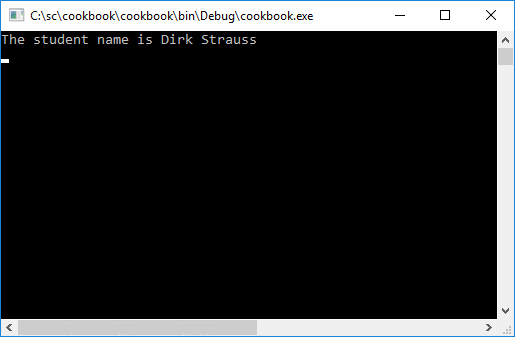
WriteLine($"The student name is {FirstName} {Surname}");
  1. Running the Console Application will display the deconstructed values returned from the Student class.
  1. Deconstructors can just as easily be used in extension methods. This is quite a nice way to extend the existing type to include a deconstruction declaration. To implement this, we need to remove the deconstructor from our Student class. You can just comment it out for now, but essentially this is what we are after:
        public class Student
{
public string Name { get; set; }
public string LastName { get; set; }
public List<int> CourseCodes { get; set; }
}
  1. The Student class now does not contain a deconstructor. Head on over to the extension methods class and add the following extension method:
        public static void Deconstruct(this Student student, 
out string firstItem, out string secondItem)
{
firstItem = student.Name;
secondItem = student.LastName;
}
  1. The extension method acts on a Student type only. It follows the same basic implementation of the deconstructor created earlier in the Student class itself. Running the console application again, you will see the same result as before. The only difference is that the code is now using the extension method to deconstruct values in the Student class.

How it works...

In the code example, we set the student name and last name to specific values. This was just to illustrate the use of deconstruction. A more likely scenario would be to pass a student number to the Student class (in the constructor perhaps), as follows:

Student student = new Student(studentNumber);

The implementation within the Student class would then perform a database lookup using the student number passed through in the constructor. This will then return the student details. A more likely implementation of the Student class would probably look as follows:

public class Student
{
public Student(string studentNumber)
{
(Name, LastName) = GetStudentDetails(studentNumber);
}
public string Name { get; private set; }
public string LastName { get; private set; }
public List<int> CourseCodes { get; private set; }

public void Deconstruct(out string name, out string lastName)
{
name = Name;
lastName = LastName;
}

private (string name, string surname) GetStudentDetails(string studentNumber)
{
var detail = (n: "Dirk", s: "Strauss");
// Do something with student number to return the student details
return detail;
}
}

You will notice that the GetStudentDetails() method is just a dummy implementation. This is where the database lookup will start and the values will be returned from here. The code that calls the Student class now makes more sense. We call the Student class, pass it a student number, and deconstruct it to find the student's first name and surname.

Student student = new Student("S20323742");
var (FirstName, Surname) = student;
WriteLine($"The student name is {FirstName} {Surname}");
CONTINUE READING
83
Tech Concepts
36
Programming languages
73
Tech Tools
Icon Unlimited access to the largest independent learning library in tech of over 8,000 expert-authored tech books and videos.
Icon Innovative learning tools, including AI book assistants, code context explainers, and text-to-speech.
Icon 50+ new titles added per month and exclusive early access to books as they are being written.
C# 7 and .NET Core Cookbook
notes
bookmark Notes and Bookmarks search Search in title playlist Add to playlist font-size Font size

Change the font size

margin-width Margin width

Change margin width

day-mode Day/Sepia/Night Modes

Change background colour

Close icon Search
Country selected

Close icon Your notes and bookmarks

Confirmation

Modal Close icon
claim successful

Buy this book with your credits?

Modal Close icon
Are you sure you want to buy this book with one of your credits?
Close
YES, BUY

Submit Your Feedback

Modal Close icon
Modal Close icon
Modal Close icon