
Sign In Start Free Trial
Account

Add to playlist

Create a Playlist

Modal Close icon
You need to login to use this feature.
  • Book Overview & Buying Spring 5.0 Projects
  • Table Of Contents Toc
Spring 5.0 Projects

Spring 5.0 Projects

By : Nilang Patel
3 (2)
close
close
Spring 5.0 Projects

Spring 5.0 Projects

3 (2)
By: Nilang Patel

Overview of this book

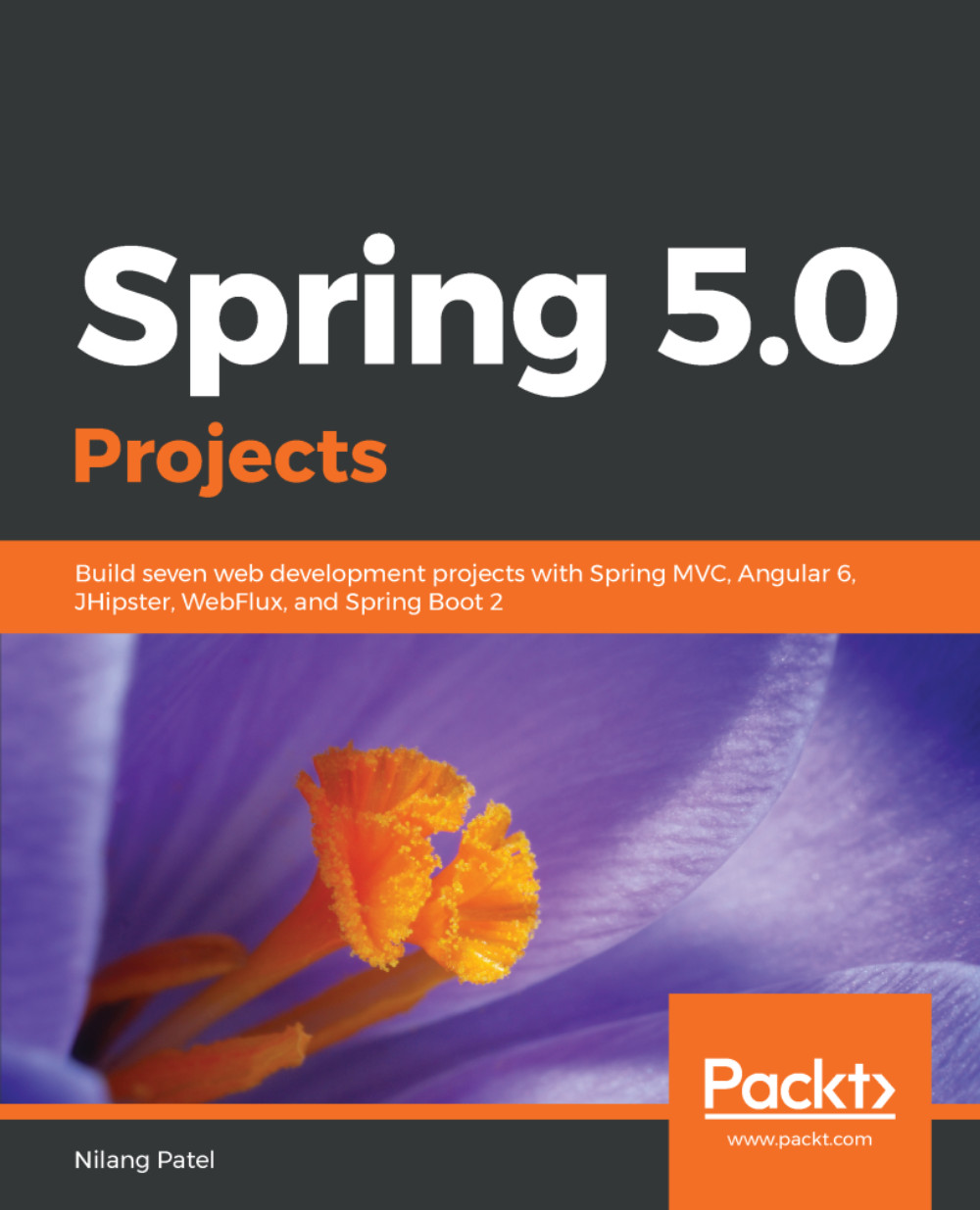
Spring makes it easy to create RESTful applications, merge with social services, communicate with modern databases, secure your system, and make your code modular and easy to test. With the arrival of Spring Boot, developers can really focus on the code and deliver great value, with minimal contour. This book will show you how to build various projects in Spring 5.0, using its features and third party tools. We'll start by creating a web application using Spring MVC, Spring Data, the World Bank API for some statistics on different countries, and MySQL database. Moving ahead, you'll build a RESTful web services application using Spring WebFlux framework. You'll be then taken through creating a Spring Boot-based simple blog management system, which uses Elasticsearch as the data store. Then, you'll use Spring Security with the LDAP libraries for authenticating users and create a central authentication and authorization server using OAuth 2 protocol. Further, you'll understand how to create Spring Boot-based monolithic application using JHipster. Toward the end, we'll create an online book store with microservice architecture using Spring Cloud and Net?ix OSS components, and a task management system using Spring and Kotlin. By the end of the book, you'll be able to create coherent and ?exible real-time web applications using Spring Framework.
Table of Contents (9 chapters)
close
close

Summary

Reactive is definitely a promising new technology that will help to build a scalable and high-performance application. Spring has done an impressive job of supporting Reactive Systems with a new framework called WebFlux. Reactive is the future of next-generation applications, and it is needed almost everywhere: datastores, middle layers, frontends, or even mobile platforms.

Through this chapter, we learned the basics of Reactive Systems and Reactive Programming followed by various techniques to achieve it. We then learned about Reactive Streams, which is one of the most popular ways of implementing a Reactive System. Starting with the Reactive Streams specifications and the basic fundamentals, we explored various JVM-based libraries that provide an implementation for a particular specification. We did some hands-on work with RxJava and Project Reactor and learned the underlying...

CONTINUE READING
83
Tech Concepts
36
Programming languages
73
Tech Tools
Icon Unlimited access to the largest independent learning library in tech of over 8,000 expert-authored tech books and videos.
Icon Innovative learning tools, including AI book assistants, code context explainers, and text-to-speech.
Icon 50+ new titles added per month and exclusive early access to books as they are being written.
Spring 5.0 Projects
notes
bookmark Notes and Bookmarks search Search in title playlist Add to playlist download Download options font-size Font size

Change the font size

margin-width Margin width

Change margin width

day-mode Day/Sepia/Night Modes

Change background colour

Close icon Search
Country selected

Close icon Your notes and bookmarks

Confirmation

Modal Close icon
claim successful

Buy this book with your credits?

Modal Close icon
Are you sure you want to buy this book with one of your credits?
Close
YES, BUY

Submit Your Feedback

Modal Close icon
Modal Close icon
Modal Close icon