
Sign In Start Free Trial
Account

Add to playlist

Create a Playlist

Modal Close icon
You need to login to use this feature.
  • Book Overview & Buying Developing Middleware in Java EE 8
  • Table Of Contents Toc
  • Feedback & Rating feedback
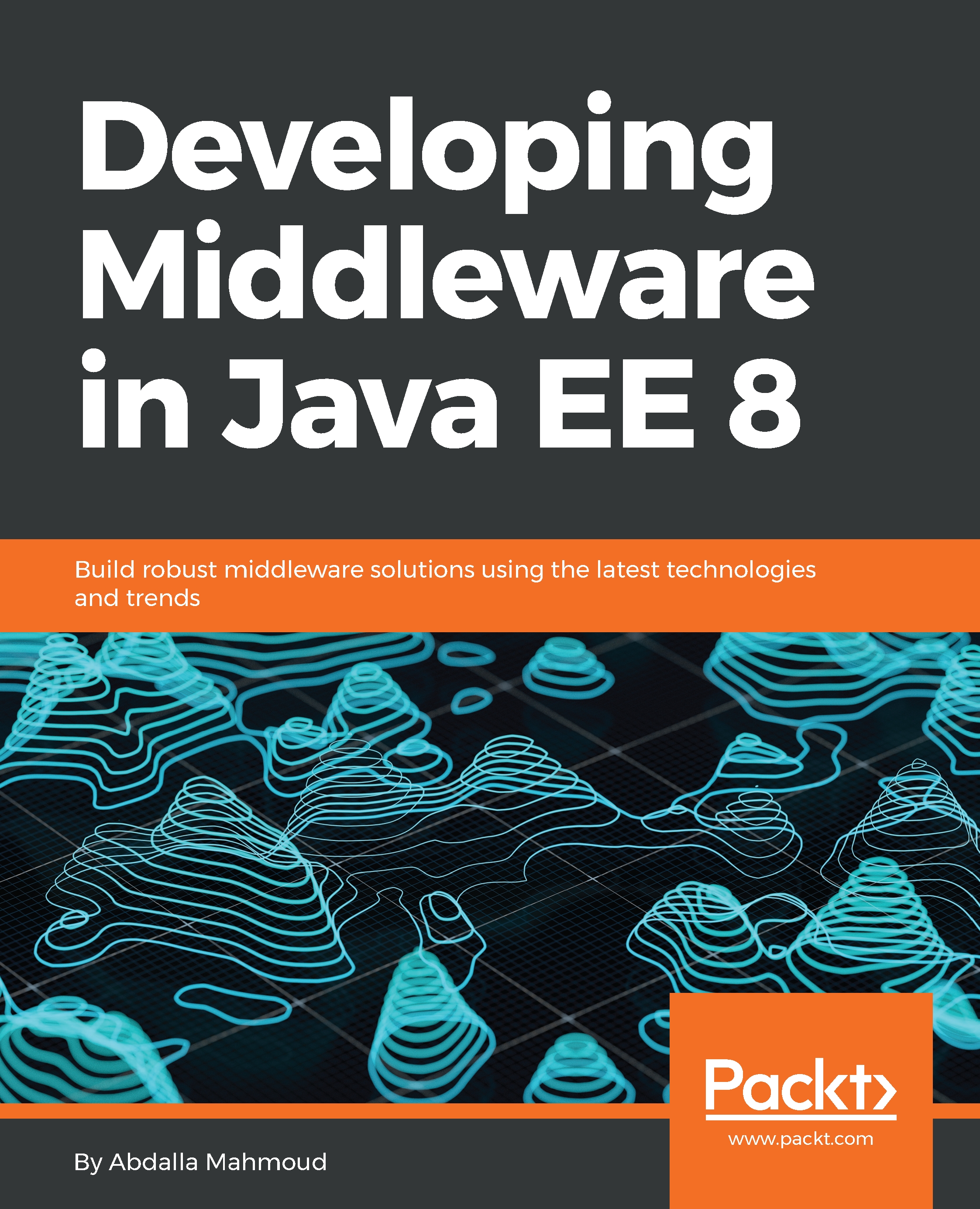
Developing Middleware in Java EE 8

Developing Middleware in Java EE 8

By : Abdalla Mahmoud
close
close
Developing Middleware in Java EE 8

Developing Middleware in Java EE 8

By: Abdalla Mahmoud

Overview of this book

Middleware is the infrastructure in software based applications that enables businesses to solve problems, operate more efficiently, and make money. As the use of middleware extends beyond a single application, the importance of having it written by experts increases substantially. This book will help you become an expert in developing middleware for a variety of applications. The book starts off by exploring the latest Java EE 8 APIs with newer features and managing dependencies with CDI 2.0. You will learn to implement object-to-relational mapping using JPA 2.1 and validate data using bean validation. You will also work with different types of EJB to develop business logic, and with design RESTful APIs by utilizing different HTTP methods and activating JAX-RS features in enterprise applications. You will learn to secure your middleware with Java Security 1.0 and implement various authentication techniques, such as OAuth authentication. In the concluding chapters, you will use various test technologies, such as JUnit and Mockito, to test applications, and Docker to deploy your enterprise applications. By the end of the book, you will be proficient in developing robust, effective, and distributed middleware for your business.
Table of Contents (12 chapters)
close
close

Providing alternative implementations to your bean

One of the greatest features of CDI is that you can provide two or more different implementations to the same bean. This is very useful if you wish to do one of the following:

  • Handling client-specific business logic that is determined at runtime. For example, providing different payment mechanisms for a purchase transaction.
  • Supporting different versions for different deployment scenarios. For example, providing an implementation that handles taxes in the USA, and another one for Europe.
  • Easier management for test-driven development. For example, you can provide a primary implementation for production, and another mocked one for testing.

To do that, we should first rewrite our bean as an abstract element (abstract class or interface) and then we will be able to provide different implementations according to the basic OOP principles...

Visually different images
CONTINUE READING
83
Tech Concepts
36
Programming languages
73
Tech Tools
Icon Unlimited access to the largest independent learning library in tech of over 8,000 expert-authored tech books and videos.
Icon Innovative learning tools, including AI book assistants, code context explainers, and text-to-speech.
Icon 50+ new titles added per month and exclusive early access to books as they are being written.
Developing Middleware in Java EE 8
notes
bookmark Notes and Bookmarks search Search in title playlist Add to playlist download Download options font-size Font size

Change the font size

margin-width Margin width

Change margin width

day-mode Day/Sepia/Night Modes

Change background colour

Close icon Search
Country selected

Close icon Your notes and bookmarks

Confirmation

Modal Close icon
claim successful

Buy this book with your credits?

Modal Close icon
Are you sure you want to buy this book with one of your credits?
Close
YES, BUY

Submit Your Feedback

Modal Close icon
Modal Close icon
Modal Close icon