
Sign In Start Free Trial
Account

Add to playlist

Create a Playlist

Modal Close icon
You need to login to use this feature.
  • Book Overview & Buying Java EE 8 High Performance
  • Table Of Contents Toc
  • Feedback & Rating feedback
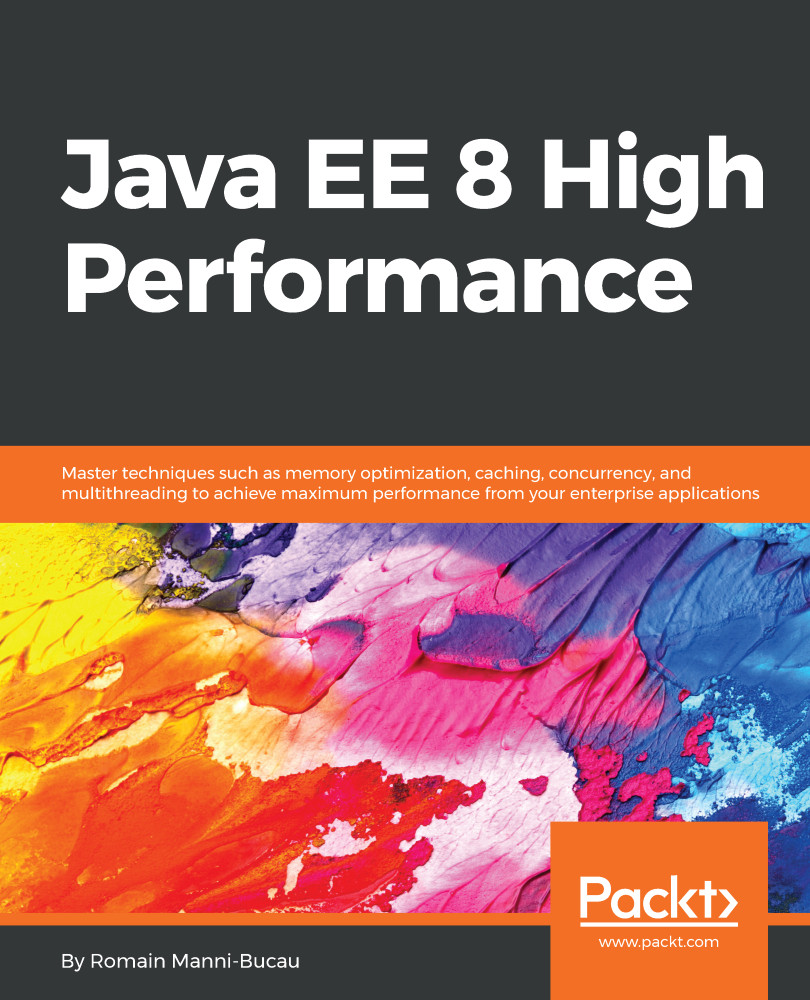
Java EE 8 High Performance

Java EE 8 High Performance

By : Romain Manni-Bucau
3.9 (36)
close
close
Java EE 8 High Performance

Java EE 8 High Performance

3.9 (36)
By: Romain Manni-Bucau

Overview of this book

The ease with which we write applications has been increasing, but with this comes the need to address their performance. A balancing act between easily implementing complex applications and keeping their performance optimal is a present-day need. In this book, we explore how to achieve this crucial balance while developing and deploying applications with Java EE 8. The book starts by analyzing various Java EE specifications to identify those potentially affecting performance adversely. Then, we move on to monitoring techniques that enable us to identify performance bottlenecks and optimize performance metrics. Next, we look at techniques that help us achieve high performance: memory optimization, concurrency, multi-threading, scaling, and caching. We also look at fault tolerance solutions and the importance of logging. Lastly, you will learn to benchmark your application and also implement solutions for continuous performance evaluation. By the end of the book, you will have gained insights into various techniques and solutions that will help create high-performance applications in the Java EE 8 environment.
Table of Contents (12 chapters)
close
close

Reactive programming and Java EE

Reactive programming lets your code be called instead of calling your code. You can visualize it as being event-based instead of procedural. Here is an example to compare both the styles:

public void processData(Data data) {
if (validator.isValid(data)) {
service.save(data);
return data;
}
throw new InvalidDataException();
}

This is a very simple and common implementation of a business method where we call two services: validator and service. The first one will validate the data by checking whether it exists in the database, the values are in the expected ranges, and so on, while the second one will actually process the updates (a database, for instance).

The issue with this style is that the data validation and persistence are bound in a single processData method, which defines the entire execution environment (threading...

Visually different images
CONTINUE READING
83
Tech Concepts
36
Programming languages
73
Tech Tools
Icon Unlimited access to the largest independent learning library in tech of over 8,000 expert-authored tech books and videos.
Icon Innovative learning tools, including AI book assistants, code context explainers, and text-to-speech.
Icon 50+ new titles added per month and exclusive early access to books as they are being written.
Java EE 8 High Performance
notes
bookmark Notes and Bookmarks search Search in title playlist Add to playlist download Download options font-size Font size

Change the font size

margin-width Margin width

Change margin width

day-mode Day/Sepia/Night Modes

Change background colour

Close icon Search
Country selected

Close icon Your notes and bookmarks

Confirmation

Modal Close icon
claim successful

Buy this book with your credits?

Modal Close icon
Are you sure you want to buy this book with one of your credits?
Close
YES, BUY

Submit Your Feedback

Modal Close icon
Modal Close icon
Modal Close icon