
Sign In Start Free Trial
Account

Add to playlist

Create a Playlist

Modal Close icon
You need to login to use this feature.
  • Book Overview & Buying Functional Python Programming
  • Table Of Contents Toc
  • Feedback & Rating feedback
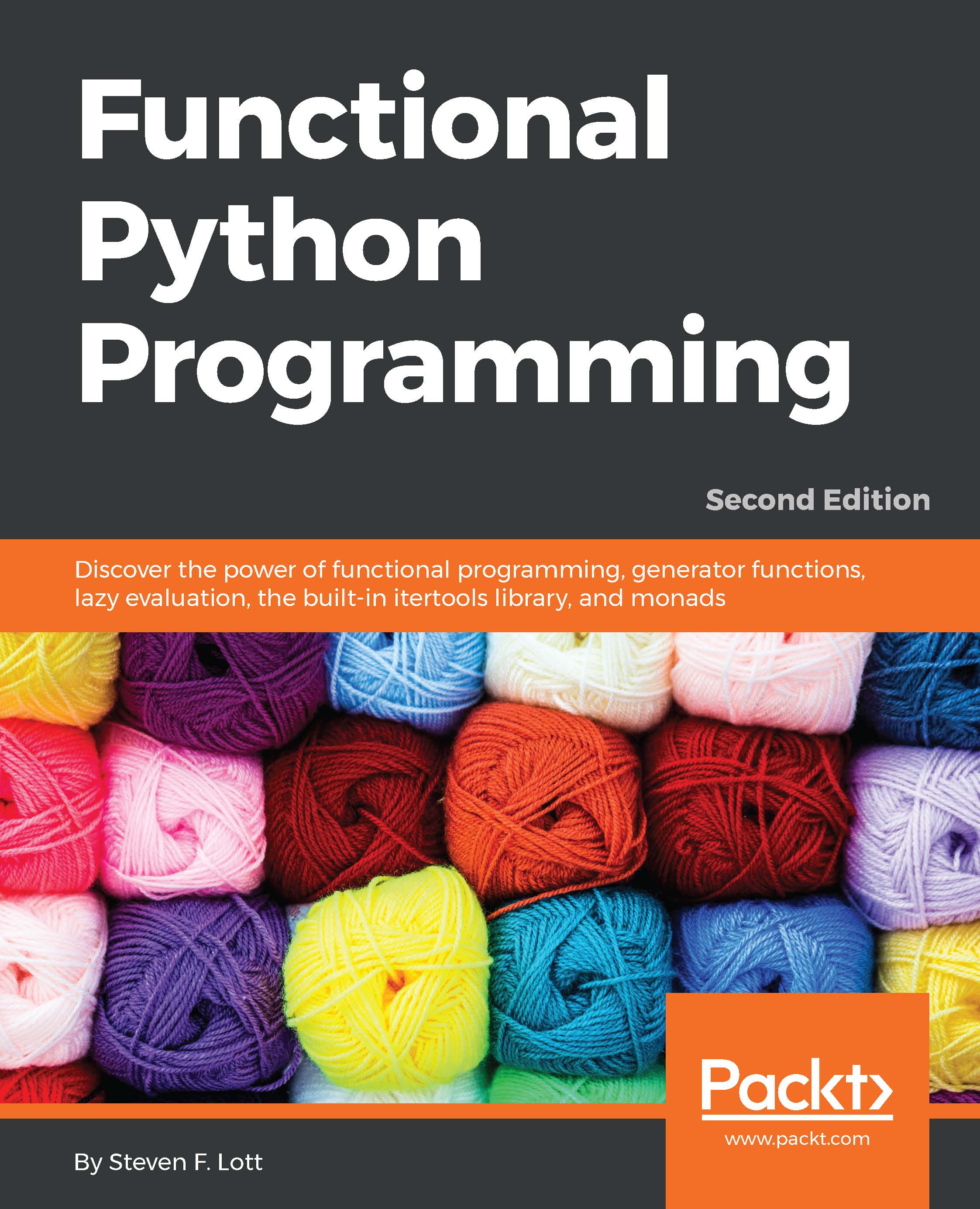
Functional Python Programming

Functional Python Programming - Second Edition

By : Steven F. Lott
3.7 (3)
close
close
Functional Python Programming

Functional Python Programming

3.7 (3)
By: Steven F. Lott

Overview of this book

If you’re a Python developer who wants to discover how to take the power of functional programming (FP) and bring it into your own programs, then this book is essential for you, even if you know next to nothing about the paradigm. Starting with a general overview of functional concepts, you’ll explore common functional features such as first-class and higher-order functions, pure functions, and more. You’ll see how these are accomplished in Python 3.6 to give you the core foundations you’ll build upon. After that, you’ll discover common functional optimizations for Python to help your apps reach even higher speeds. You’ll learn FP concepts such as lazy evaluation using Python’s generator functions and expressions. Moving forward, you’ll learn to design and implement decorators to create composite functions. You'll also explore data preparation techniques and data exploration in depth, and see how the Python standard library fits the functional programming model. Finally, to top off your journey into the world of functional Python, you’ll at look at the PyMonad project and some larger examples to put everything into perspective.
Table of Contents (18 chapters)
close
close

Recursion instead of an explicit loop state

Functional programs don't rely on loops and the associated overhead of tracking the state of loops. Instead, functional programs try to rely on the much simpler approach of recursive functions. In some languages, the programs are written as recursions, but Tail-CallOptimization (TCO) in the compiler changes them to loops. We'll introduce some recursion here and examine it closely in Chapter 6, Recursions and Reductions.

We'll look at a simple iteration to test a number for being prime. A prime number is a natural number, evenly divisible by only 1 and itself. We can create a naïve and poorly-performing algorithm to determine whether a number has any factors between 2 and the number. This algorithm has the advantage of simplicity; it works acceptably for solving Project Euler problems. Read up on Miller-Rabin...

Visually different images
CONTINUE READING
83
Tech Concepts
36
Programming languages
73
Tech Tools
Icon Unlimited access to the largest independent learning library in tech of over 8,000 expert-authored tech books and videos.
Icon Innovative learning tools, including AI book assistants, code context explainers, and text-to-speech.
Icon 50+ new titles added per month and exclusive early access to books as they are being written.
Functional Python Programming
notes
bookmark Notes and Bookmarks search Search in title playlist Add to playlist font-size Font size

Change the font size

margin-width Margin width

Change margin width

day-mode Day/Sepia/Night Modes

Change background colour

Close icon Search
Country selected

Close icon Your notes and bookmarks

Confirmation

Modal Close icon
claim successful

Buy this book with your credits?

Modal Close icon
Are you sure you want to buy this book with one of your credits?
Close
YES, BUY

Submit Your Feedback

Modal Close icon
Modal Close icon
Modal Close icon