Sign In Start Free Trial
Account

Add to playlist

Create a Playlist

Modal Close icon
You need to login to use this feature.
  • Book Overview & Buying Java EE 8 Design Patterns and Best Practices
  • Table Of Contents Toc
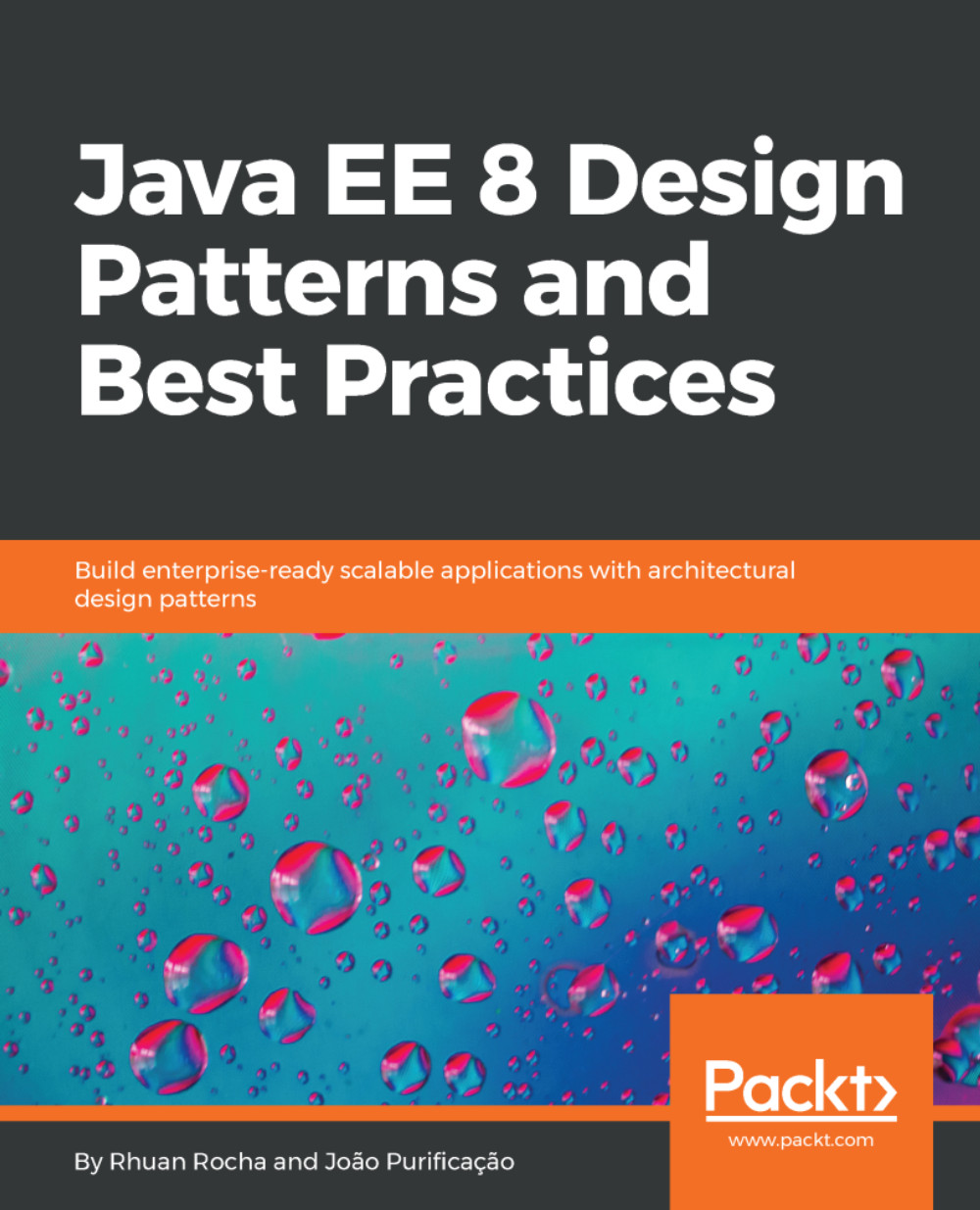
Java EE 8 Design Patterns and Best Practices

Java EE 8 Design Patterns and Best Practices

By : Alberto Simoes, Rocha, Purificação
5 (1)
close
close
Java EE 8 Design Patterns and Best Practices

Java EE 8 Design Patterns and Best Practices

5 (1)
By: Alberto Simoes, Rocha, Purificação

Overview of this book

Patterns are essential design tools for Java developers. Java EE Design Patterns and Best Practices helps developers attain better code quality and progress to higher levels of architectural creativity by examining the purpose of each available pattern and demonstrating its implementation with various code examples. This book will take you through a number of patterns and their Java EE-specific implementations. In the beginning, you will learn the foundation for, and importance of, design patterns in Java EE, and then will move on to implement various patterns on the presentation tier, business tier, and integration tier. Further, you will explore the patterns involved in Aspect-Oriented Programming (AOP) and take a closer look at reactive patterns. Moving on, you will be introduced to modern architectural patterns involved in composing microservices and cloud-native applications. You will get acquainted with security patterns and operational patterns involved in scaling and monitoring, along with some patterns involved in deployment. By the end of the book, you will be able to efficiently address common problems faced when developing applications and will be comfortable working on scalable and maintainable projects of any size.
Table of Contents (14 chapters)
close
close
5
Aspect-Oriented Programming and Design Patterns

Advantages and drawbacks of a microservices-based application


Like any other technology, there are advantages and disadvantages in using microservices-based architecture. Several problems may appear during the implementation of microservices, but the advantages can overcome the complexity encountered during development. 

The following are the advantages of the microservices architecture:

  • Small multitask team.
  • Services can be written in different languages. This is a positive point because depending on the service, a specific language may provide more tools than another in obtaining the functionality served by the service.
  • The deployment is faster and integration is performed more automatically. Changes of requirements mean only the deployment of the related microservice.
  • The latest libraries, frameworks, and technologies can be quickly used.
  • Greater fault tolerance.
  • The microservice is related to the product and not to the project. The developer has more freedom and thus can develop the service...
Visually different images
CONTINUE READING
83
Tech Concepts
36
Programming languages
73
Tech Tools
Icon Unlimited access to the largest independent learning library in tech of over 8,000 expert-authored tech books and videos.
Icon Innovative learning tools, including AI book assistants, code context explainers, and text-to-speech.
Icon 50+ new titles added per month and exclusive early access to books as they are being written.
Java EE 8 Design Patterns and Best Practices
notes
bookmark Notes and Bookmarks search Search in title playlist Add to playlist download Download options font-size Font size

Change the font size

margin-width Margin width

Change margin width

day-mode Day/Sepia/Night Modes

Change background colour

Close icon Search
Country selected

Close icon Your notes and bookmarks

Confirmation

Modal Close icon
claim successful

Buy this book with your credits?

Modal Close icon
Are you sure you want to buy this book with one of your credits?
Close
YES, BUY

Submit Your Feedback

Modal Close icon
Modal Close icon
Modal Close icon