Sign In Start Free Trial
Account

Add to playlist

Create a Playlist

Modal Close icon
You need to login to use this feature.
  • Book Overview & Buying Solidity Programming Essentials
  • Table Of Contents Toc
  • Feedback & Rating feedback
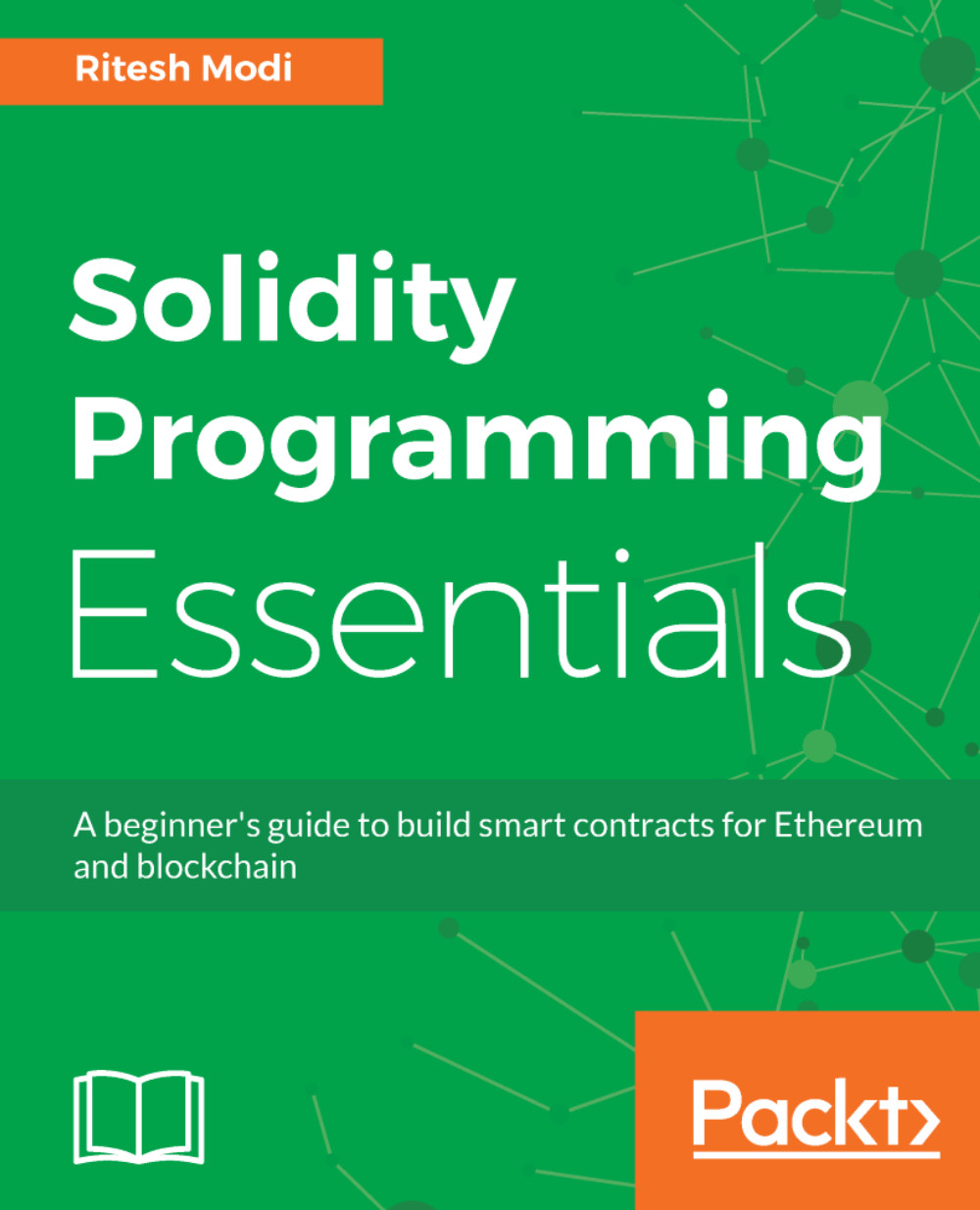
Solidity Programming Essentials

Solidity Programming Essentials

By : Ritesh Modi
3.6 (10)
close
close
Solidity Programming Essentials

Solidity Programming Essentials

3.6 (10)
By: Ritesh Modi

Overview of this book

Solidity is a contract-oriented language whose syntax is highly influenced by JavaScript, and is designed to compile code for the Ethereum Virtual Machine. Solidity Programming Essentials will be your guide to understanding Solidity programming to build smart contracts for Ethereum and blockchain from ground-up. We begin with a brief run-through of blockchain, Ethereum, and their most important concepts or components. You will learn how to install all the necessary tools to write, test, and debug Solidity contracts on Ethereum. Then, you will explore the layout of a Solidity source file and work with the different data types. The next set of recipes will help you work with operators, control structures, and data structures while building your smart contracts. We take you through function calls, return types, function modifers, and recipes in object-oriented programming with Solidity. Learn all you can on event logging and exception handling, as well as testing and debugging smart contracts. By the end of this book, you will be able to write, deploy, and test smart contracts in Ethereum. This book will bring forth the essence of writing contracts using Solidity and also help you develop Solidity skills in no time.
Table of Contents (12 chapters)
close
close

Storage and memory data locations


Each variable declared and used within a contract has a data location. EVM provides the following four data structures for storing variables:

  • Storage: This is global memory available to all functions within the contract. This storage is a permanent storage that Ethereum stores on every node within its environment.
  • Memory: This is local memory available to every function within a contract. This is short lived and fleeting memory that gets torn down when the function completes its execution.
  • Calldata: This is where all incoming function execution data, including function arguments, is stored. This is a non-modifiable memory location.
  • Stack: EVM maintains a stack for loading variables and intermediate values for working with Ethereum instruction set. This is working set memory for EVM. A stack is 1,024 levels deep in EVM and if it store anything more than this it raises an exception.

The data location of a variable is dependent on the following two factors:

  • Location...
Visually different images
CONTINUE READING
83
Tech Concepts
36
Programming languages
73
Tech Tools
Icon Unlimited access to the largest independent learning library in tech of over 8,000 expert-authored tech books and videos.
Icon Innovative learning tools, including AI book assistants, code context explainers, and text-to-speech.
Icon 50+ new titles added per month and exclusive early access to books as they are being written.
Solidity Programming Essentials
notes
bookmark Notes and Bookmarks search Search in title playlist Add to playlist download Download options font-size Font size

Change the font size

margin-width Margin width

Change margin width

day-mode Day/Sepia/Night Modes

Change background colour

Close icon Search
Country selected

Close icon Your notes and bookmarks

Confirmation

Modal Close icon
claim successful

Buy this book with your credits?

Modal Close icon
Are you sure you want to buy this book with one of your credits?
Close
YES, BUY

Submit Your Feedback

Modal Close icon
Modal Close icon
Modal Close icon