Sign In Start Free Trial
Account

Add to playlist

Create a Playlist

Modal Close icon
You need to login to use this feature.
  • Book Overview & Buying Java EE 8 Development with Eclipse
  • Table Of Contents Toc
  • Feedback & Rating feedback
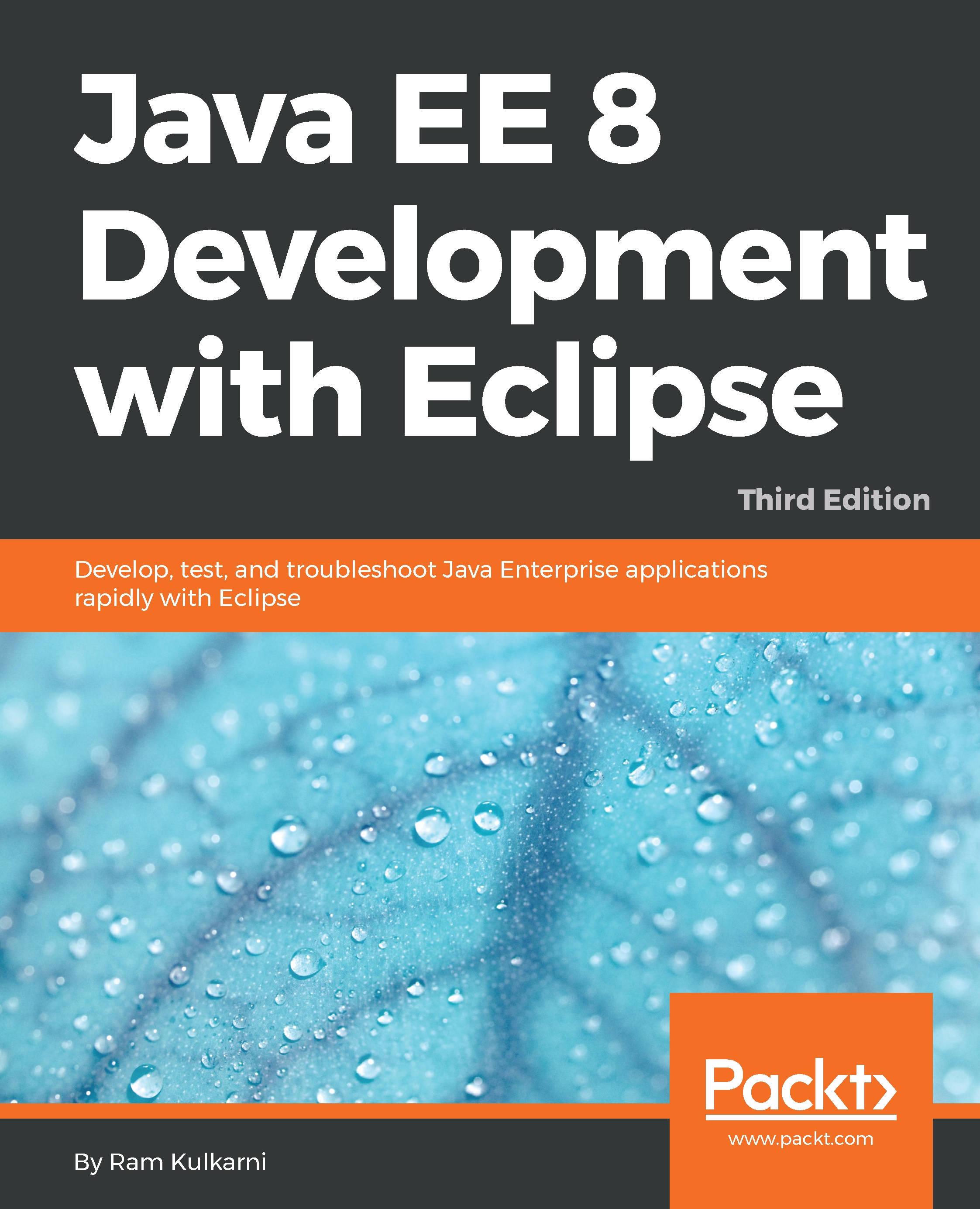
Java EE 8 Development with Eclipse

Java EE 8 Development with Eclipse - Third Edition

3 (1)
close
close
Java EE 8 Development with Eclipse

Java EE 8 Development with Eclipse

3 (1)

Overview of this book

Java EE is one of the most popular tools for enterprise application design and development. With recent changes to Java EE 8 specifications, Java EE application development has become a lot simpler with the new specifications, some of which compete with the existing specifications. This guide provides a complete overview of developing highly performant, robust and secure enterprise applications with Java EE with Eclipse. The book begins by exploring different Java EE technologies and how to use them (JSP, JSF, JPA, JDBC, EJB, and more), along with suitable technologies for different scenarios. You will learn how to set up the development environment for Java EE applications and understand Java EE specifications in detail, with an emphasis on examples. The book takes you through deployment of an application in Tomcat, GlassFish Servers, and also in the cloud. It goes beyond the basics and covers topics like debugging, testing, deployment, and securing your Java EE applications. You'll also get to know techniques to develop cloud-ready microservices in Java EE.
Table of Contents (15 chapters)
close
close
Lock Free Chapter
1
Introducing JEE and Eclipse

Calculating unit test coverage


Unit tests tell you whether your application code behaves as expected. Unit tests are important to maintain code quality and catch errors early in the development cycle. However, this goal is at risk if you do not write enough unit tests to test your application code, or if you have not tested all possible input conditions in the test cases and the exception paths. To measure the quality and adequacy of your test cases, you need to calculate the coverage of your test cases. In simple terms, coverage tells you what percentage of your application code was touched by running your unit tests. There are different measures to calculate coverage:

  • Number of lines covered
  • Number of branches covered (created using the if, else, elseif, switch, and try/catch statements)
  • Number of functions covered

Together, these three measures give a fair measurement of the quality of your unit tests. There are many code coverage tools for Java. In this chapter, we will take a look at an...

Visually different images
CONTINUE READING
83
Tech Concepts
36
Programming languages
73
Tech Tools
Icon Unlimited access to the largest independent learning library in tech of over 8,000 expert-authored tech books and videos.
Icon Innovative learning tools, including AI book assistants, code context explainers, and text-to-speech.
Icon 50+ new titles added per month and exclusive early access to books as they are being written.
Java EE 8 Development with Eclipse
notes
bookmark Notes and Bookmarks search Search in title playlist Add to playlist font-size Font size

Change the font size

margin-width Margin width

Change margin width

day-mode Day/Sepia/Night Modes

Change background colour

Close icon Search
Country selected

Close icon Your notes and bookmarks

Confirmation

Modal Close icon
claim successful

Buy this book with your credits?

Modal Close icon
Are you sure you want to buy this book with one of your credits?
Close
YES, BUY

Submit Your Feedback

Modal Close icon
Modal Close icon
Modal Close icon