
Sign In Start Free Trial
Account

Add to playlist

Create a Playlist

Modal Close icon
You need to login to use this feature.
  • Book Overview & Buying Clean Code in Python
  • Table Of Contents Toc
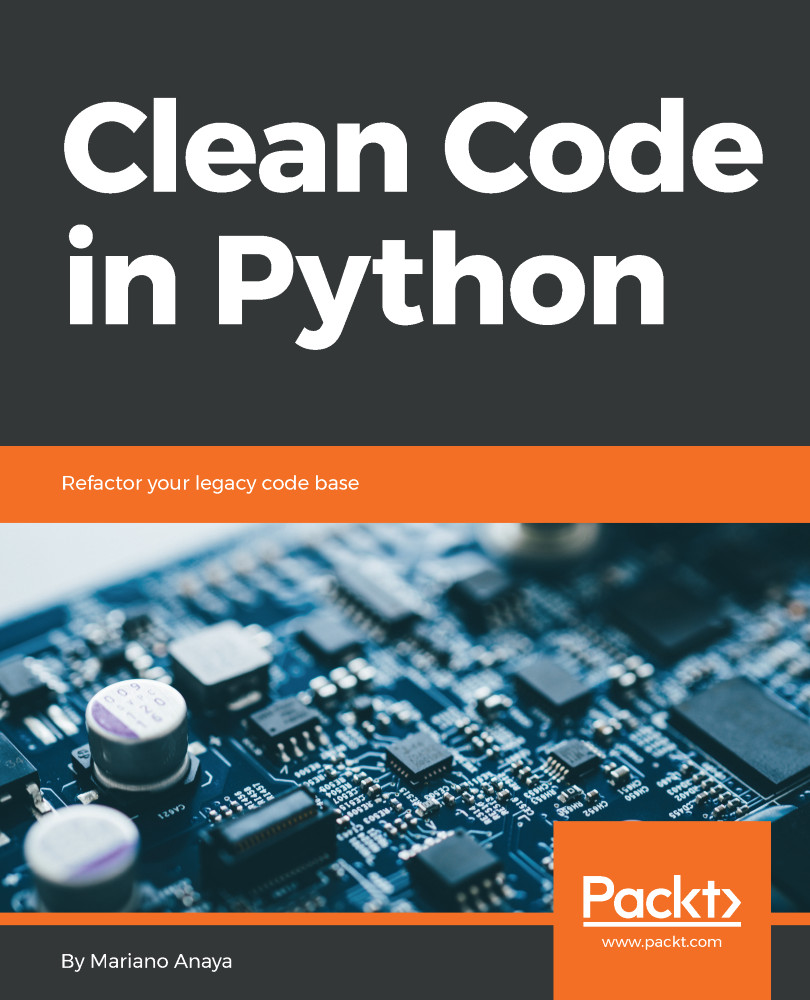
Clean Code in Python

Clean Code in Python

By : Mariano Anaya
3.7 (3)
close
close
Clean Code in Python

Clean Code in Python

3.7 (3)
By: Mariano Anaya

Overview of this book

Python is currently used in many different areas such as software construction, systems administration, and data processing. In all of these areas, experienced professionals can find examples of inefficiency, problems, and other perils, as a result of bad code. After reading this book, readers will understand these problems, and more importantly, how to correct them. The book begins by describing the basic elements of writing clean code and how it plays an important role in Python programming. You will learn about writing efficient and readable code using the Python standard library and best practices for software design. You will learn to implement the SOLID principles in Python and use decorators to improve your code. The book delves more deeply into object oriented programming in Python and shows you how to use objects with descriptors and generators. It will also show you the design principles of software testing and how to resolve software problems by implementing design patterns in your code. In the final chapter we break down a monolithic application to a microservice one, starting from the code as the basis for a solid platform. By the end of the book, you will be proficient in applying industry approved coding practices to design clean, sustainable and readable Python code.
Table of Contents (12 chapters)
close
close

Types of descriptors

Based on the methods we have just explored, we can make an important distinction among descriptors in terms of how they work. Understanding this distinction plays an important role in working effectively with descriptors, and will also help to avoid caveats or common errors at runtime.

If a descriptor implements the __set__ or __delete__ methods, it is called a data descriptor. Otherwise, a descriptor that solely implements __get__ is a non-data descriptor. Notice that __set_name__ does not affect this classification at all.

When trying to resolve an attribute of an object, a data descriptor will always take precedence over the dictionary of the object, whereas a non-data descriptor will not. This means that in a non-data descriptor if the object has a key on its dictionary with the same name as the descriptor, this one will always be called, and the descriptor...

CONTINUE READING
83
Tech Concepts
36
Programming languages
73
Tech Tools
Icon Unlimited access to the largest independent learning library in tech of over 8,000 expert-authored tech books and videos.
Icon Innovative learning tools, including AI book assistants, code context explainers, and text-to-speech.
Icon 50+ new titles added per month and exclusive early access to books as they are being written.
Clean Code in Python
notes
bookmark Notes and Bookmarks search Search in title playlist Add to playlist download Download options font-size Font size

Change the font size

margin-width Margin width

Change margin width

day-mode Day/Sepia/Night Modes

Change background colour

Close icon Search
Country selected

Close icon Your notes and bookmarks

Confirmation

Modal Close icon
claim successful

Buy this book with your credits?

Modal Close icon
Are you sure you want to buy this book with one of your credits?
Close
YES, BUY

Submit Your Feedback

Modal Close icon
Modal Close icon
Modal Close icon