
Sign In Start Free Trial
Account

Add to playlist

Create a Playlist

Modal Close icon
You need to login to use this feature.
  • Book Overview & Buying Learn Type-Driven Development
  • Table Of Contents Toc
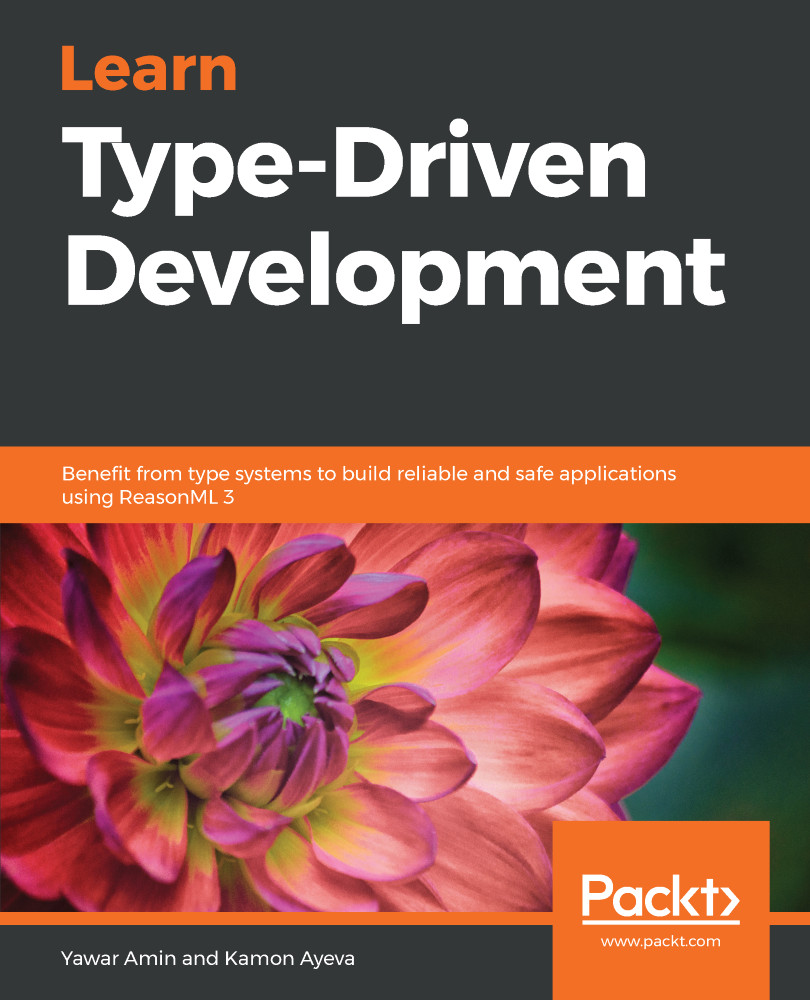
Learn Type-Driven Development

Learn Type-Driven Development

By : Soumya Mukherjee, Amin, Kamon Ayeva
5 (1)
close
close
Learn Type-Driven Development

Learn Type-Driven Development

5 (1)
By: Soumya Mukherjee, Amin, Kamon Ayeva

Overview of this book

Type-driven development is an approach that uses a static type system to achieve results including safety and efficiency. Types are used to express relationships and other assumptions directly in the code, and these assumptions are enforced by the compiler before the code is run. Learn Type-Driven Development covers how to use these type systems to check the logical consistency of your code. This book begins with the basic idea behind type-driven development. You’ll learn about values (or terms) and how they contrast with types. As you progress through the chapters, you’ll cover how to combine types and values inside modules and build structured types out of simpler ones. You’ll then understand how to express choices or alternatives directly in the type system using variants, polymorphic variants, and generalized algebraic data types. You’ll also get to grips with sum types, build sophisticated data types from generics, and explore functions that express change in the types of values. In the concluding chapters, you’ll cover advanced techniques for code reuse, such as parametric polymorphism and subtyping. By end of this book, you will have learned how to iterate through a type-driven process of solving coding problems using static types, together with dynamic behavior, to obtain more safety and speed.
Table of Contents (12 chapters)
close
close

Putting Alternative Values in Types

In the previous chapter, we saw how to build values that capture multiple types of values together, and the different ways that we can build those types. This lets us say that we have a value of the composite (product) type only if we have all of the values of their composed types. Sometimes though, we need values that must be only one type out of several types.

In this chapter, we will cover these only one types, namely:

  • Variant types
  • Polymorphic variant types
  • Generalized algebraic data types

Collectively, these types are known as sum types because the number of possible values that a sum type can contain is the sum of the number of possible values of each of its component types. We'll see how this is true in this chapter!

Visually different images
CONTINUE READING
83
Tech Concepts
36
Programming languages
73
Tech Tools
Icon Unlimited access to the largest independent learning library in tech of over 8,000 expert-authored tech books and videos.
Icon Innovative learning tools, including AI book assistants, code context explainers, and text-to-speech.
Icon 50+ new titles added per month and exclusive early access to books as they are being written.
Learn Type-Driven Development
notes
bookmark Notes and Bookmarks search Search in title playlist Add to playlist download Download options font-size Font size

Change the font size

margin-width Margin width

Change margin width

day-mode Day/Sepia/Night Modes

Change background colour

Close icon Search
Country selected

Close icon Your notes and bookmarks

Confirmation

Modal Close icon
claim successful

Buy this book with your credits?

Modal Close icon
Are you sure you want to buy this book with one of your credits?
Close
YES, BUY

Submit Your Feedback

Modal Close icon
Modal Close icon
Modal Close icon