Sign In Start Free Trial
Account

Add to playlist

Create a Playlist

Modal Close icon
You need to login to use this feature.
  • Book Overview & Buying Hands-On Spring Security 5 for Reactive Applications
  • Table Of Contents Toc
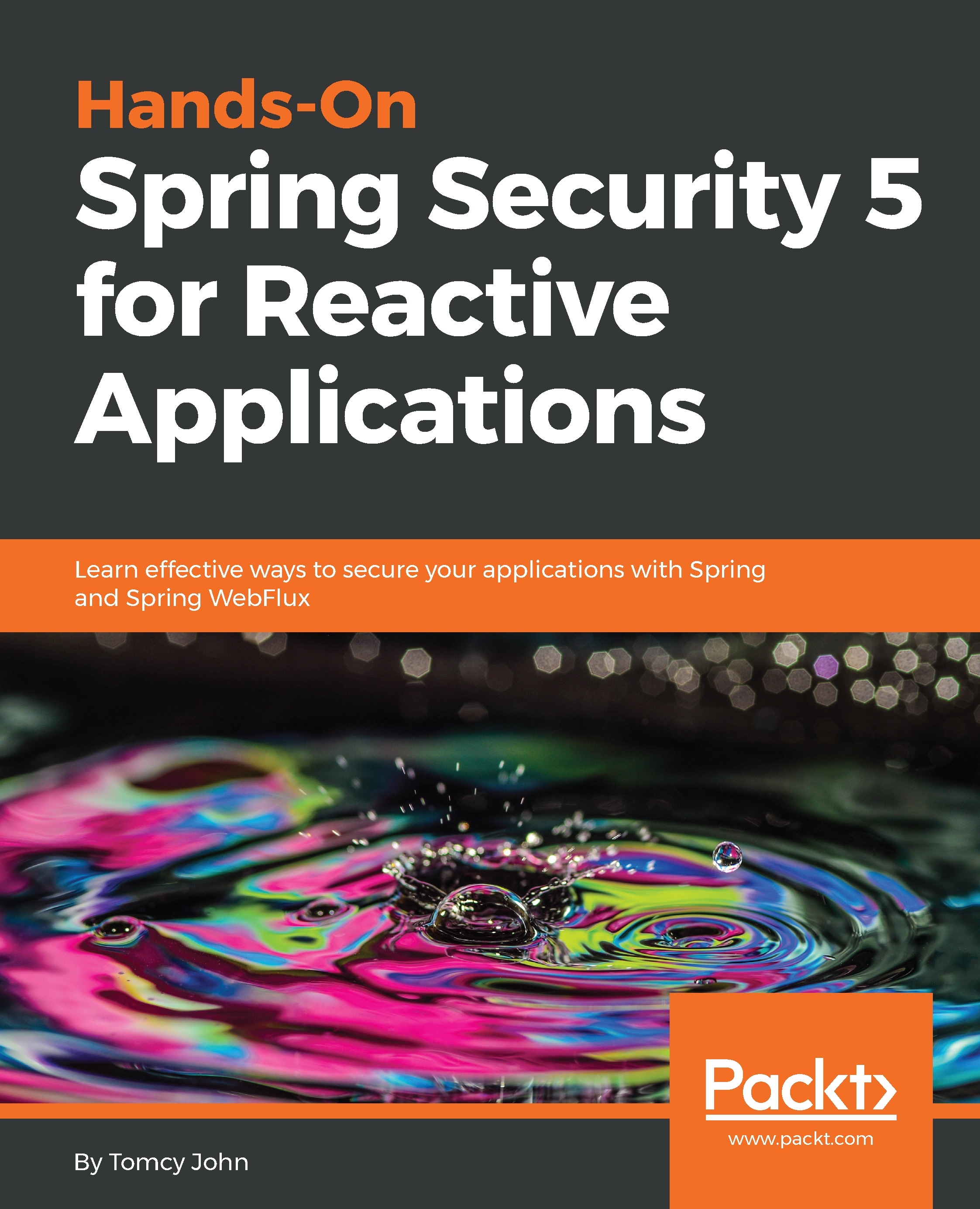
Hands-On Spring Security 5 for Reactive Applications

Hands-On Spring Security 5 for Reactive Applications

By : Tomcy John
3 (2)
close
close
Hands-On Spring Security 5 for Reactive Applications

Hands-On Spring Security 5 for Reactive Applications

3 (2)
By: Tomcy John

Overview of this book

Spring Security enables developers to seamlessly integrate authorization, authentication, and a range of security features for complex enterprise applications. This book provides a hands-on approach to developing reactive applications using Spring and will help you get up and running in no time. Complete with step-by-step explanations, practical examples, and self-assessment questions, the book begins by explaining the essential concepts of reactive programming, Spring Framework, and Spring Security. You’ll then learn about a variety of authentication mechanisms and how to integrate them easily with a Spring MVC application. You’ll also understand how to achieve authorization in a Spring WebFlux application using Spring Security. Furthermore, the book will take you through the configuration required to implement OAuth2 for securing REST APIs, and guide you in integrating security in microservices and serverless applications. Finally, you’ll be able to augment add-ons that will enhance any Spring Security module. By the end of the book, you’ll be equipped to integrate Spring Security into your Java enterprise applications proficiently.
Table of Contents (9 chapters)
close
close

Channel security


In addition to authentication and authorization, Spring Security can also be used to check for any additional property presence for each request reaching the server. It can check for protocol (transport type, HTTP, or HTTPS), presence of certain HTTP headers, and more. SSL is now the de facto standard for any web application (or website) to comply with, and many search engines (such as Google, for example) even penalize you if your website is not HTTPS. SSL is made use of in securing the channel on which data flows from client to server and vice versa.

Spring Security can be configured to explicitly check for URL patterns and explicitly redirect the user to HTTPS if they are coming with the HTTP protocol.

This can be easily done by configuring the appropriate URL pattern in your Spring Security configuration, as shown here:

http.authorizeRequests()
      .requiresChannel().antMatchers("/httpsRequired/**").requiresSecure();

When users access the /httpsRequired/** URL pattern...

CONTINUE READING
83
Tech Concepts
36
Programming languages
73
Tech Tools
Icon Unlimited access to the largest independent learning library in tech of over 8,000 expert-authored tech books and videos.
Icon Innovative learning tools, including AI book assistants, code context explainers, and text-to-speech.
Icon 50+ new titles added per month and exclusive early access to books as they are being written.
Hands-On Spring Security 5 for Reactive Applications
notes
bookmark Notes and Bookmarks search Search in title playlist Add to playlist download Download options font-size Font size

Change the font size

margin-width Margin width

Change margin width

day-mode Day/Sepia/Night Modes

Change background colour

Close icon Search
Country selected

Close icon Your notes and bookmarks

Confirmation

Modal Close icon
claim successful

Buy this book with your credits?

Modal Close icon
Are you sure you want to buy this book with one of your credits?
Close
YES, BUY

Submit Your Feedback

Modal Close icon
Modal Close icon
Modal Close icon