Sign In Start Free Trial
Account

Add to playlist

Create a Playlist

Modal Close icon
You need to login to use this feature.
  • Book Overview & Buying Julia 1.0 Programming Cookbook
  • Table Of Contents Toc
  • Feedback & Rating feedback
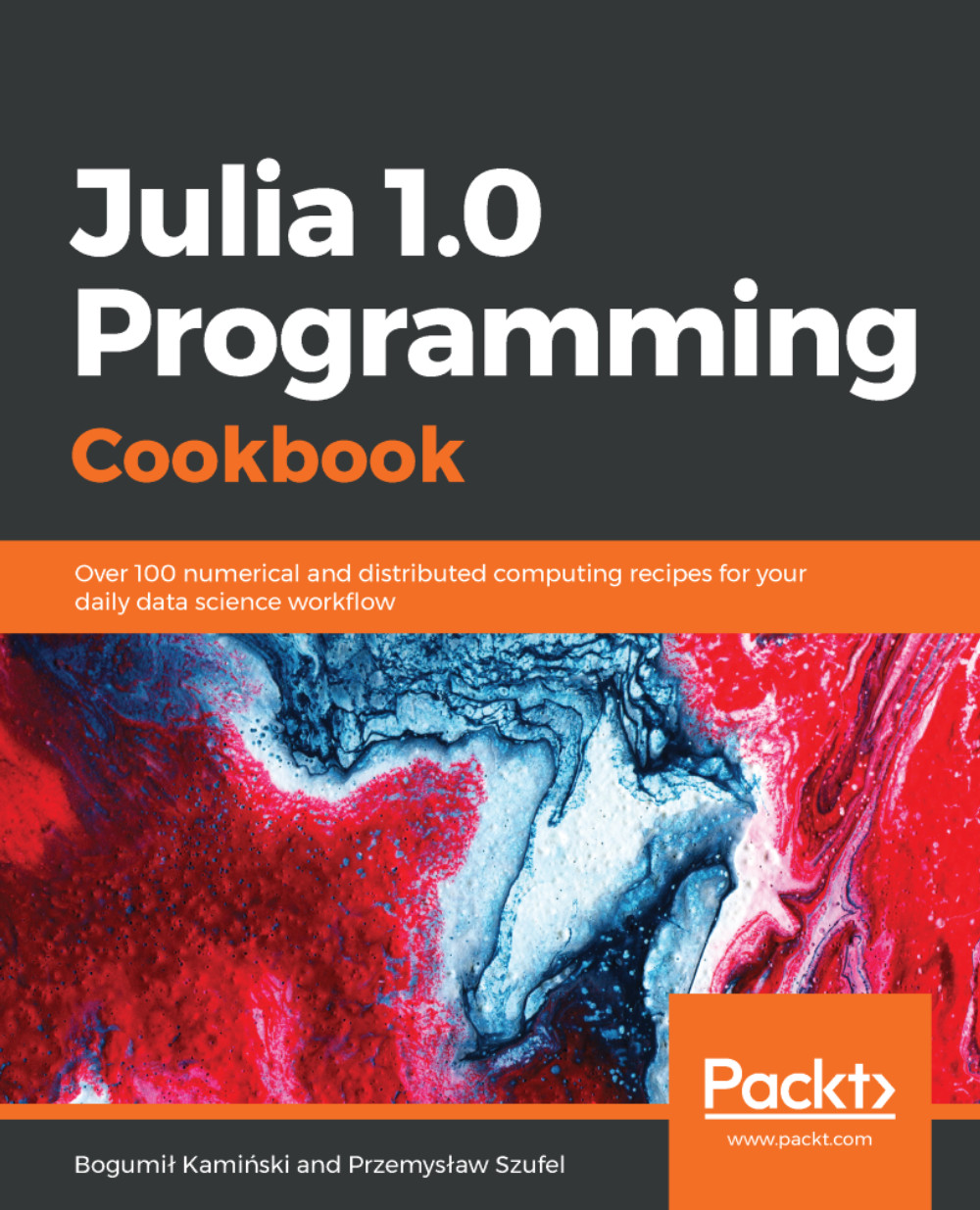
Julia 1.0 Programming Cookbook

Julia 1.0 Programming Cookbook

By : Kamiński, Szufel
3.3 (4)
close
close
Julia 1.0 Programming Cookbook

Julia 1.0 Programming Cookbook

3.3 (4)
By: Kamiński, Szufel

Overview of this book

Julia, with its dynamic nature and high-performance, provides comparatively minimal time for the development of computational models with easy-to-maintain computational code. This book will be your solution-based guide as it will take you through different programming aspects with Julia. Starting with the new features of Julia 1.0, each recipe addresses a specific problem, providing a solution and explaining how it works. You will work with the powerful Julia tools and data structures along with the most popular Julia packages. You will learn to create vectors, handle variables, and work with functions. You will be introduced to various recipes for numerical computing, distributed computing, and achieving high performance. You will see how to optimize data science programs with parallel computing and memory allocation. We will look into more advanced concepts such as metaprogramming and functional programming. Finally, you will learn how to tackle issues while working with databases and data processing, and will learn about on data science problems, data modeling, data analysis, data manipulation, parallel processing, and cloud computing with Julia. By the end of the book, you will have acquired the skills to work more effectively with your data
Table of Contents (12 chapters)
close
close

Defining primitive types


In Julia, you are able to define your own composite types, as explained in the previous recipe. However, you can also define your own raw-bytes type, like Float64 or UInt32.

Getting ready

ARGB (see https://en.wikipedia.org/wiki/RGBA_color_space#ARGB_(word-order)) is a method of encoding the color of a pixel, where A (

) stands for pixel opacity, and R (red), G (green), and B (blue) are the components of its color. Each component takes eight bits, making 32 bits in total. In this recipe, we will create a custom primitive type that facilitates working with ARGB-encoded data.

Note

In the GitHub repository for this recipe, you will find the commands.txt file that contains the presented sequence of shell and Julia commands. Additionally, in the argb.jl file you can find the definitions of the ARGB type and related methods used in this recipe.

Now open your favorite terminal to execute the commands.

How to do it...

Start by inspecting the contents of the argb.jl file. First, we...

Visually different images
CONTINUE READING
83
Tech Concepts
36
Programming languages
73
Tech Tools
Icon Unlimited access to the largest independent learning library in tech of over 8,000 expert-authored tech books and videos.
Icon Innovative learning tools, including AI book assistants, code context explainers, and text-to-speech.
Icon 50+ new titles added per month and exclusive early access to books as they are being written.
Julia 1.0 Programming Cookbook
notes
bookmark Notes and Bookmarks search Search in title playlist Add to playlist download Download options font-size Font size

Change the font size

margin-width Margin width

Change margin width

day-mode Day/Sepia/Night Modes

Change background colour

Close icon Search
Country selected

Close icon Your notes and bookmarks

Confirmation

Modal Close icon
claim successful

Buy this book with your credits?

Modal Close icon
Are you sure you want to buy this book with one of your credits?
Close
YES, BUY

Submit Your Feedback

Modal Close icon
Modal Close icon
Modal Close icon