
Sign In Start Free Trial
Account

Add to playlist

Create a Playlist

Modal Close icon
You need to login to use this feature.
  • Book Overview & Buying Python 3 Object-Oriented Programming
  • Table Of Contents Toc
  • Feedback & Rating feedback
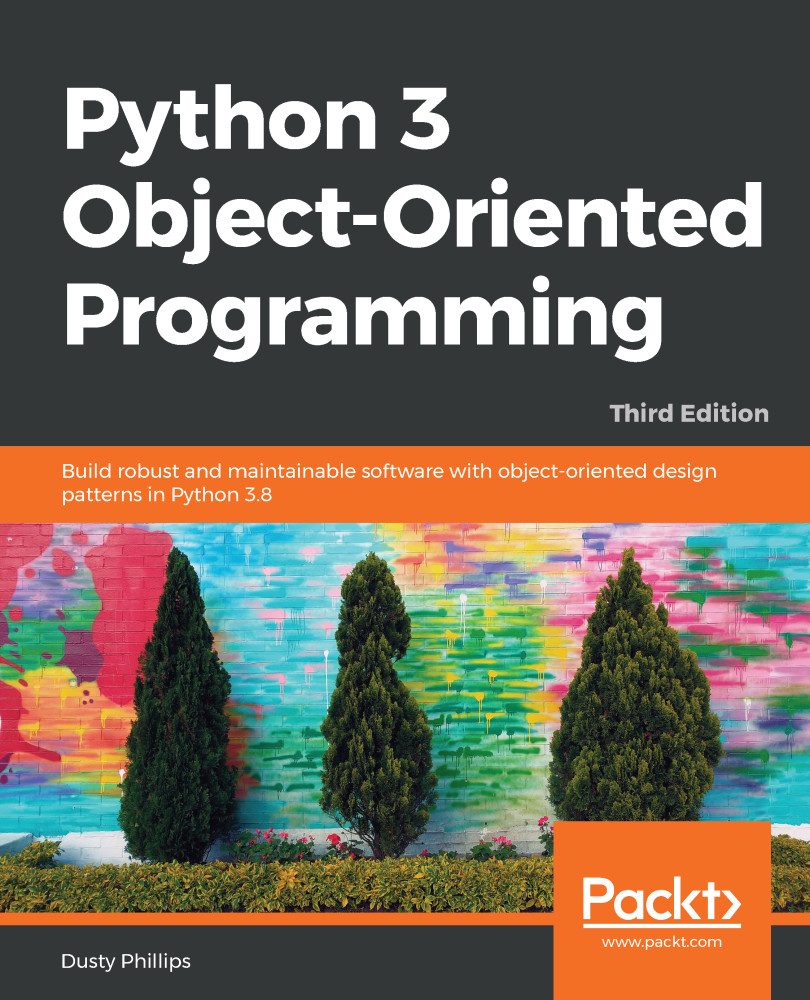
Python 3 Object-Oriented Programming

Python 3 Object-Oriented Programming - Third Edition

By : Dusty Phillips
4.3 (30)
close
close
Python 3 Object-Oriented Programming

Python 3 Object-Oriented Programming

4.3 (30)
By: Dusty Phillips

Overview of this book

Object-oriented programming (OOP) is a popular design paradigm in which data and behaviors are encapsulated in such a way that they can be manipulated together. This third edition of Python 3 Object-Oriented Programming fully explains classes, data encapsulation, and exceptions with an emphasis on when you can use each principle to develop well-designed software. Starting with a detailed analysis of object-oriented programming, you will use the Python programming language to clearly grasp key concepts from the object-oriented paradigm. You will learn how to create maintainable applications by studying higher level design patterns. The book will show you the complexities of string and file manipulation, and how Python distinguishes between binary and textual data. Not one, but two very powerful automated testing systems, unittest and pytest, will be introduced in this book. You'll get a comprehensive introduction to Python's concurrent programming ecosystem. By the end of the book, you will have thoroughly learned object-oriented principles using Python syntax and be able to create robust and reliable programs confidently.
Table of Contents (15 chapters)
close
close

Expecting the Unexpected

Programs are very fragile. It would be ideal if code always returned a valid result, but sometimes a valid result can't be calculated. For example, it's not possible to divide by zero, or to access the eighth item in a five-item list.

In the old days, the only way around this was to rigorously check the inputs for every function to make sure they made sense. Typically, functions had special return values to indicate an error condition; for example, they could return a negative number to indicate that a positive value couldn't be calculated. Different numbers might mean different errors occurred. Any code that called this function would have to explicitly check for an error condition and act accordingly. A lot of developers didn't bother to do this, and programs simply crashed. However, in the object-oriented world, this is not the case...

Visually different images
CONTINUE READING
83
Tech Concepts
36
Programming languages
73
Tech Tools
Icon Unlimited access to the largest independent learning library in tech of over 8,000 expert-authored tech books and videos.
Icon Innovative learning tools, including AI book assistants, code context explainers, and text-to-speech.
Icon 50+ new titles added per month and exclusive early access to books as they are being written.
Python 3 Object-Oriented Programming
notes
bookmark Notes and Bookmarks search Search in title playlist Add to playlist font-size Font size

Change the font size

margin-width Margin width

Change margin width

day-mode Day/Sepia/Night Modes

Change background colour

Close icon Search
Country selected

Close icon Your notes and bookmarks

Confirmation

Modal Close icon
claim successful

Buy this book with your credits?

Modal Close icon
Are you sure you want to buy this book with one of your credits?
Close
YES, BUY

Submit Your Feedback

Modal Close icon
Modal Close icon
Modal Close icon