Sign In Start Free Trial
Account

Add to playlist

Create a Playlist

Modal Close icon
You need to login to use this feature.
  • Book Overview & Buying Nest.js: A Progressive Node.js Framework
  • Table Of Contents Toc
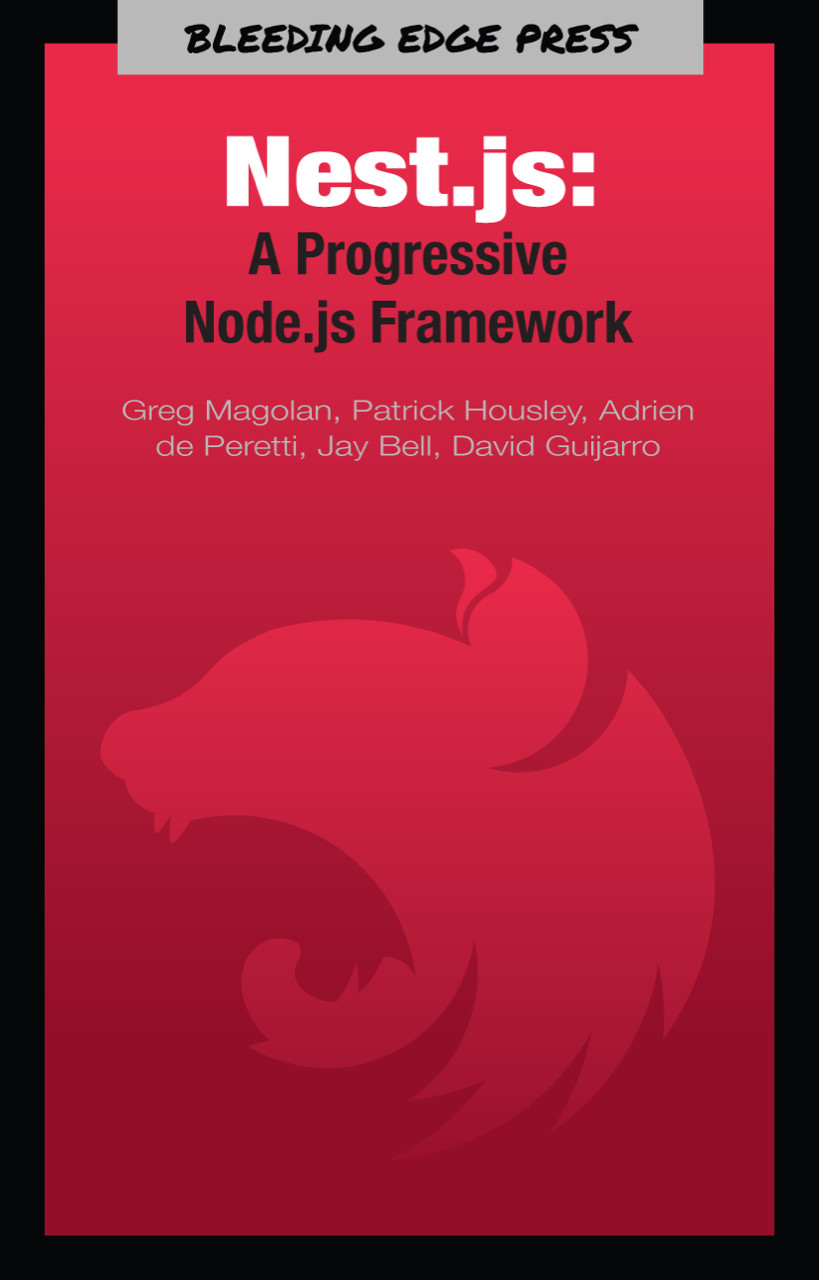
Nest.js: A Progressive Node.js Framework

Nest.js: A Progressive Node.js Framework

By : Greg Magolan, Patrick Housley, Adrien de Peretti, Jay Bell, David Guijarro
close
close
Nest.js: A Progressive Node.js Framework

Nest.js: A Progressive Node.js Framework

By: Greg Magolan, Patrick Housley, Adrien de Peretti, Jay Bell, David Guijarro

Overview of this book

Nest.js is a modern web framework built on a Node.js Express server. With the knowledge of how to use this framework, you can give your applications an organized codebase and a well-defined structure. The book begins by showing how to use Nest.js controllers, providers, modules, bootstrapping, and middleware in your applications. You’ll learn to use the authentication feature of Node.js to manage the restriction access in your application, and how to leverage the Dependency Injection pattern to speed up your application development. As you advance through the book, you'll also see how Nest.js uses TypeORM—an Object Relational Mapping (ORM) that works with several relational databases. You’ll use Nest.js microservices to extract part of your application’s business logic and execute it within a separate Nest.js context. Toward the end of the book, you’ll learn to write tests (both unit tests as well as end-to-end ones) and how to check the percentage of the code your tests cover. By the end of this book, you’ll have all the knowledge you need to build your own Nest.js applications.
Table of Contents (16 chapters)
close
close

API request and response decorators

So far we have been primarily focused on decorating controllers, so the Nest.js swagger module can build a swagger document containing all of the inputs our APIs expect or could use. The Nest.js swagger module also contains decorators that can be used to describe with what and how APIs respond and the format of the content it expects to receive and send. These decorators help form a complete picture of how a specific API works when looking at the swagger document or when using the swagger UI.

All of the APIs we have covered in our example blog application follow a typical modal of accepting inputs in the form of JSON. However, it is possible that an application may need to take a different input type, often referred to as a MIME type. For example, we could allow users of our example blog application to upload an avatar image. An image cannot easily be represented as JSON so we would need to build an API that takes an input MIME type of image/png. We...

CONTINUE READING
83
Tech Concepts
36
Programming languages
73
Tech Tools
Icon Unlimited access to the largest independent learning library in tech of over 8,000 expert-authored tech books and videos.
Icon Innovative learning tools, including AI book assistants, code context explainers, and text-to-speech.
Icon 50+ new titles added per month and exclusive early access to books as they are being written.
Nest.js: A Progressive Node.js Framework
notes
bookmark Notes and Bookmarks search Search in title playlist Add to playlist font-size Font size

Change the font size

margin-width Margin width

Change margin width

day-mode Day/Sepia/Night Modes

Change background colour

Close icon Search
Country selected

Close icon Your notes and bookmarks

Confirmation

Modal Close icon
claim successful

Buy this book with your credits?

Modal Close icon
Are you sure you want to buy this book with one of your credits?
Close
YES, BUY

Submit Your Feedback

Modal Close icon
Modal Close icon
Modal Close icon