Sign In Start Free Trial
Account

Add to playlist

Create a Playlist

Modal Close icon
You need to login to use this feature.
  • Book Overview & Buying Software Architecture with C++
  • Table Of Contents Toc
Software Architecture with C++

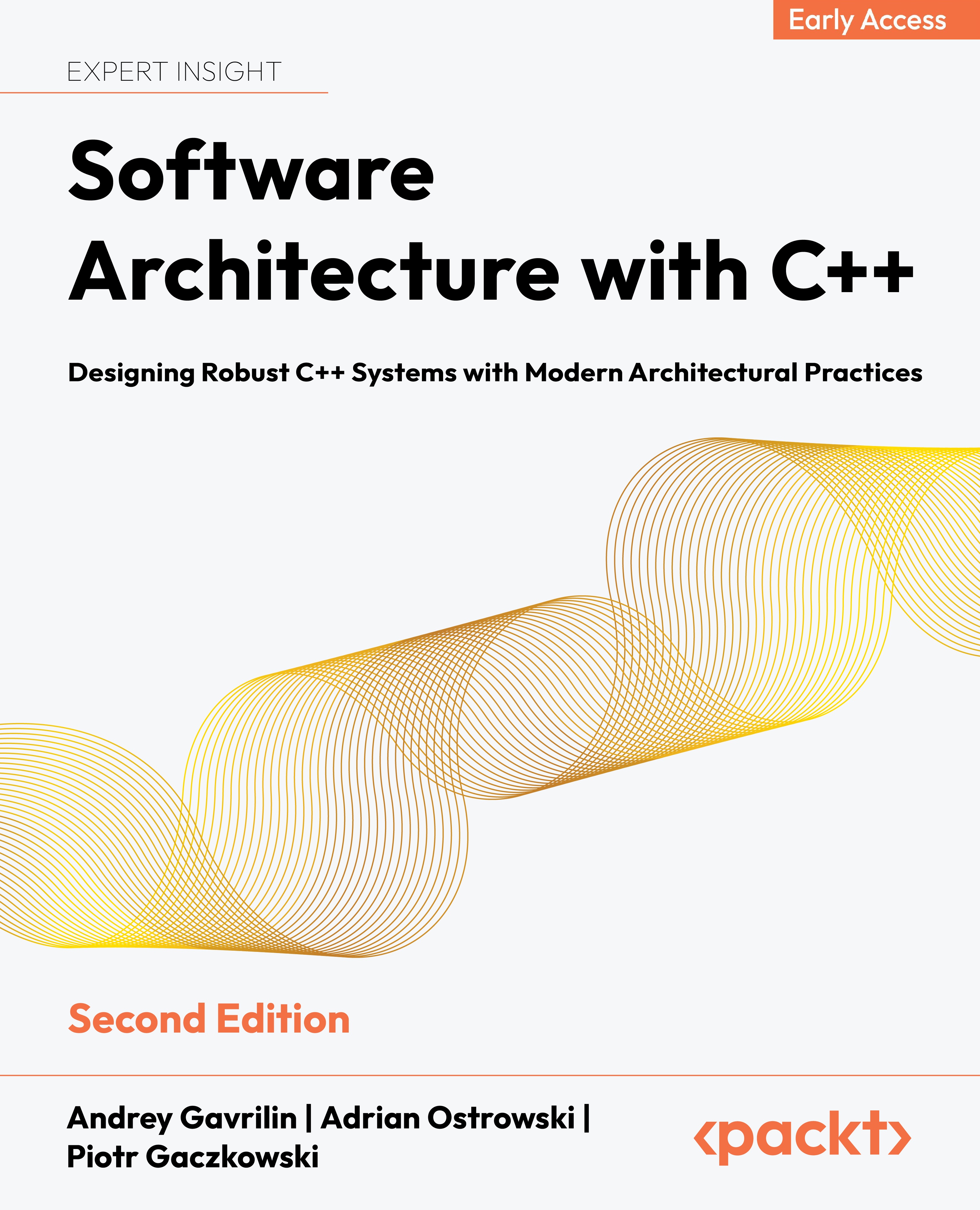
Software Architecture with C++ - Second Edition

By : Andrey Gavrilin, Adrian Ostrowski, Piotr Gaczkowski
close
close
Software Architecture with C++

Software Architecture with C++

By: Andrey Gavrilin, Adrian Ostrowski, Piotr Gaczkowski

Overview of this book

Designing scalable and maintainable software with C++ requires more than language expertise—it demands strong architectural thinking. This practical guide equips you with the skills to design and build robust, distributed systems using modern C++. Starting with fundamental architectural principles and design philosophies, the book walks you through practical approaches to designing and deploying reliable systems. This edition contains significant updates across the book, including new chapters on observability, package management, and C++ modules to address real-world software challenges. You will explore software decomposition strategies, design and system patterns, fault tolerance, API management, and testability—all applied with C++. Additionally, the book covers modern CI/CD pipelines, cloud-native design, microservices, and modular development, helping developers navigate today's fast-evolving software landscape. With updated examples and a renewed emphasis on maintainable and observable architectures, this edition equips C++ professionals to architect modern systems. By the end of this book, you will be able to design, build, test, and deploy well-architected solutions using modern C++ and proven architectural techniques.
Table of Contents (5 chapters)
close
close
1
Software Architecture with C++, Designing Robust C++ Systems with Modern Architectural Practices

Exploring the fundamentals of good architecture

It's important to know how to recognize a good architecture from a bad one, but it's not an easy task. Recognizing anti-patterns is an important aspect of it, but for an architecture to be good, primarily it must support delivering what's expected from the software, which involves meeting functional requirements, addressing attributes of the solution, or dealing with the constraints coming from various places. Many of these aspects can be easily derived from the architecture context.

Architecture context

The context is what an architect takes into account when designing a solid solution. It comprises requirements, assumptions, and constraints, which can come from the stakeholders, as well as the business and technical environments. It also influences the stakeholders and the environments, for example, by allowing the company to enter a new market segment.

Stakeholders

Stakeholders are all the people that are somehow involved with the product. Those can be your customers, the users of your system, or the management. Communication is a key skill for every architect and properly managing your stakeholder's needs is key to delivering what they expected and in a way they wanted.Different things are important to different groups of stakeholders, so try to gather input from all those groups.Your customers will probably care about the cost of writing and running the software, the functionality it delivers, its lifetime, time to market, and the quality of your solution.The users of your system can be divided into two groups: end users and administrators. The first ones usually care about things such as the usability, user experience, and performance of the software. For the latter, more important aspects are user management, system configuration, security, backups, and recovery.Finally, things that could matter for stakeholders working in management are keeping the development costs low, achieving business goals, being on track with the development schedule, and maintaining product quality.

Business and technical environments

Architecture can be influenced by the business side of the company. Important related aspects are the time to market, the rollout schedule, the organizational structure, utilization of the workforce, and investment in existing assets.By technical environment, we mean the technologies already used in a company or those that are for any reason required to be part of the solution. Other systems that we need to integrate with are also a vital part of the technical environment. The technical expertise of the available software engineers is of importance here, too: the technological decisions an architect makes can impact staffing the project, and the ratio of junior to senior developers can influence how a project should be governed. Good architecture should take all of that into account.Equipped with all this knowledge, let's now discuss a somewhat controversial topic that you'll most probably encounter as an architect in your daily work, as it relates to a very common development methodology.

Visually different images
CONTINUE READING
83
Tech Concepts
36
Programming languages
73
Tech Tools
Icon Unlimited access to the largest independent learning library in tech of over 8,000 expert-authored tech books and videos.
Icon Innovative learning tools, including AI book assistants, code context explainers, and text-to-speech.
Icon 50+ new titles added per month and exclusive early access to books as they are being written.
Software Architecture with C++
notes
bookmark Notes and Bookmarks search Search in title playlist Add to playlist download Download options font-size Font size

Change the font size

margin-width Margin width

Change margin width

day-mode Day/Sepia/Night Modes

Change background colour

Close icon Search
Country selected

Close icon Your notes and bookmarks

Confirmation

Modal Close icon
claim successful

Buy this book with your credits?

Modal Close icon
Are you sure you want to buy this book with one of your credits?
Close
YES, BUY

Submit Your Feedback

Modal Close icon
Modal Close icon
Modal Close icon