


-
Book Overview & Buying
-
Table Of Contents

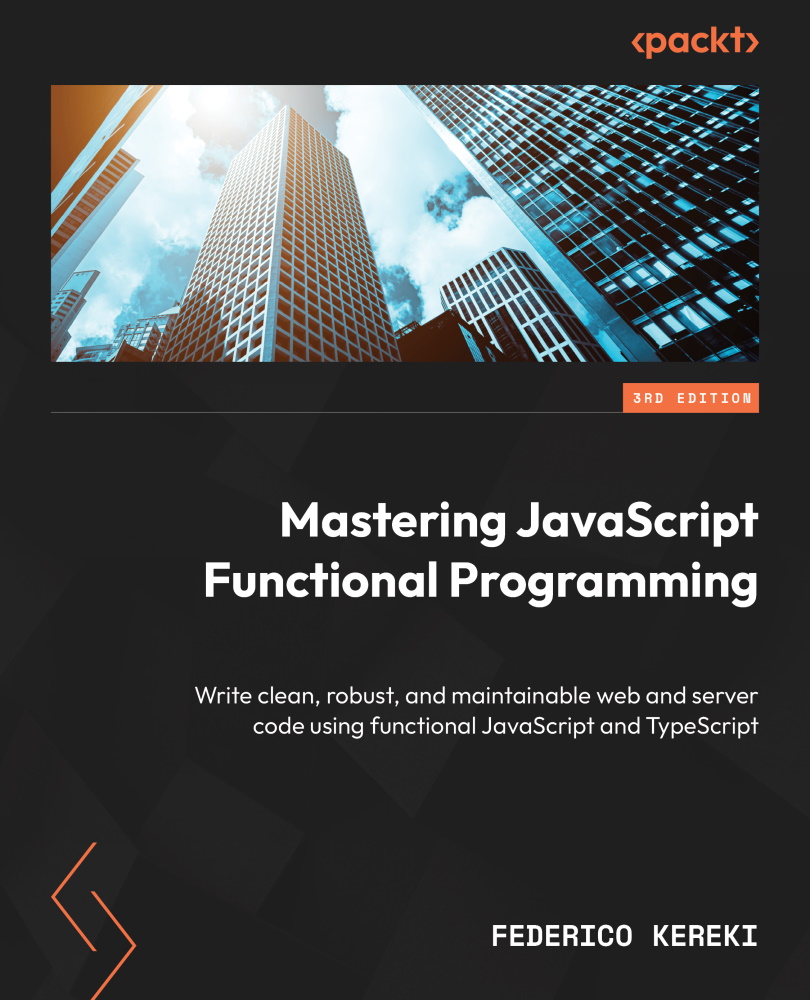
Mastering JavaScript Functional Programming - Third Edition
By :


Mastering JavaScript Functional Programming
By:
Overview of this book
Functional programming is a programming paradigm that uses functions for developing software. This book is filled with examples that enable you to leverage the latest JavaScript and TypeScript versions to produce modern and clean code, as well as teach you to how apply functional programming techniques to develop more efficient algorithms, write more concise code, and simplify unit testing.
This book provides comprehensive coverage of the major topics in functional programming to produce shorter, clearer, and testable programs. You’ll begin by getting to grips with writing and testing pure functions, reducing side effects, as well as other key features to make your applications functional in nature. The book specifically explores techniques to simplify coding, apply recursion, perform high-level coding, learn ways to achieve immutability, implement design patterns, and work with data types.
By the end of this book, you’ll have developed the practical programming skills needed to confidently enhance your applications by adding functional programming to wherever it’s most suitable.
Table of Contents (17 chapters)
Preface


Chapter 1: Becoming Functional – Several Questions
 Free Chapter
Chapter 2: Thinking Functionally – A First Example
Chapter 3: Starting Out with Functions – A Core Concept
Chapter 4: Behaving Properly – Pure Functions
Chapter 5: Programming Declaratively – A Better Style
Chapter 6: Producing Functions – Higher-Order Functions
Chapter 7: Transforming Functions – Currying and Partial Application
Chapter 8: Connecting Functions – Pipelining, Composition, and More

Chapter 9: Designing Functions – Recursion
Chapter 10: Ensuring Purity – Immutability
Chapter 11: Implementing Design Patterns – The Functional Way
Chapter 12: Building Better Containers – Functional Data Types
Answers to Questions
Bibliography
Index


