Sign In Start Free Trial
Account

Add to playlist

Create a Playlist

Modal Close icon
You need to login to use this feature.
  • Book Overview & Buying A Practical Guide to Quantum Machine Learning and Quantum Optimization
  • Table Of Contents Toc
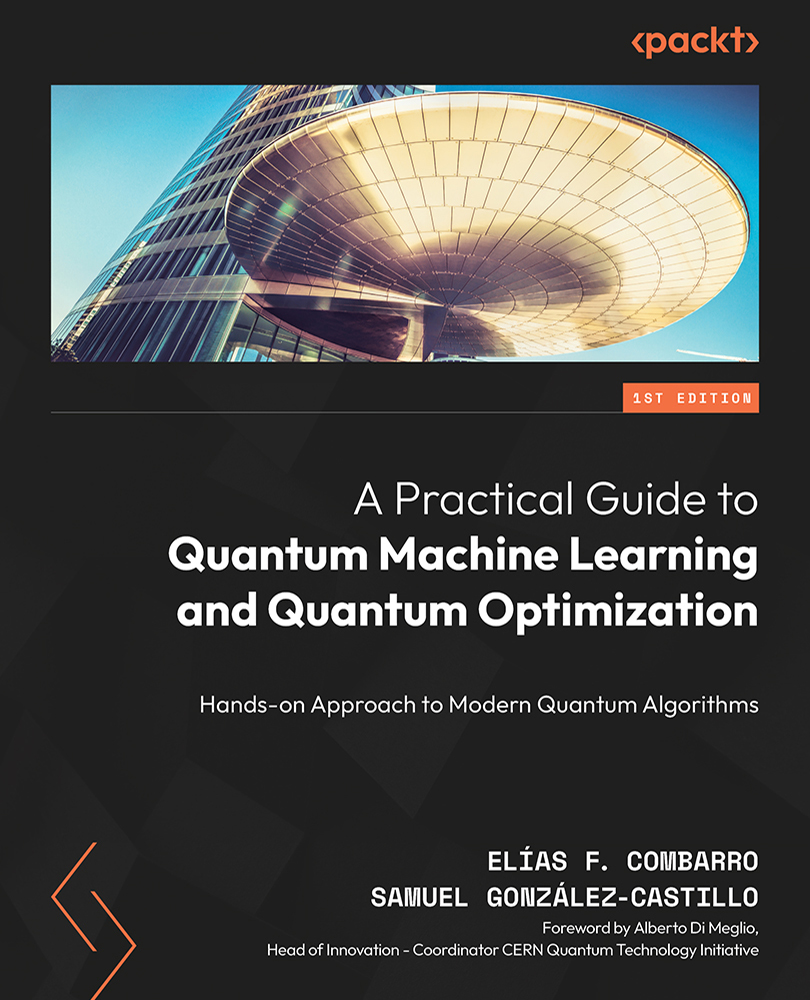
A Practical Guide to Quantum Machine Learning and Quantum Optimization

A Practical Guide to Quantum Machine Learning and Quantum Optimization

By : Elías F. Combarro Fernández-Combarro Álvarez, Samuel González Castillo
4.8 (14)
close
close
A Practical Guide to Quantum Machine Learning and Quantum Optimization

A Practical Guide to Quantum Machine Learning and Quantum Optimization

4.8 (14)
By: Elías F. Combarro Fernández-Combarro Álvarez, Samuel González Castillo

Overview of this book

This book provides deep coverage of modern quantum algorithms that can be used to solve real-world problems. You’ll be introduced to quantum computing using a hands-on approach with minimal prerequisites. You’ll discover many algorithms, tools, and methods to model optimization problems with the QUBO and Ising formalisms, and you will find out how to solve optimization problems with quantum annealing, QAOA, Grover Adaptive Search (GAS), and VQE. This book also shows you how to train quantum machine learning models, such as quantum support vector machines, quantum neural networks, and quantum generative adversarial networks. The book takes a straightforward path to help you learn about quantum algorithms, illustrating them with code that’s ready to be run on quantum simulators and actual quantum computers. You’ll also learn how to utilize programming frameworks such as IBM’s Qiskit, Xanadu’s PennyLane, and D-Wave’s Leap. Through reading this book, you will not only build a solid foundation of the fundamentals of quantum computing, but you will also become familiar with a wide variety of modern quantum algorithms. Moreover, this book will give you the programming skills that will enable you to start applying quantum methods to solve practical problems right away.
Table of Contents (27 chapters)
close
close
1
Part I: I, for One, Welcome our New Quantum Overlords
4
Part II: When Time is Gold: Tools for Quantum Optimization
10
Part III: A Match Made in Heaven: Quantum Machine Learning
16
Part IV: Afterword and Appendices
17
Chapter 13: Afterword: The Future of Quantum Computing
19
Bibliography
20
Index
1
Appendix A: Complex Numbers
5
Appendix E: Production Notes

Preface

See that the imagination of nature is far, far greater than the imagination of man.
— Richard Feynman

Many people believe that quantum computing is very difficult to learn, assuming that it requires knowledge of arcane and obscure branches of mathematics, and that it can only be mastered with a strong background in physics. We couldn't disagree more. In fact, the set of prerequisites that you need for a journey into the depths of quantum computing is surprisingly small: just some basic linear algebra, a few notions from probability, and some familiarity with computer programming. All of these are acquired by students of mathematics, physics, computer science, and engineering in their first year of college.

For this reason, a few years ago, one of us started designing quantum computing courses that focused only on the essentials, trying to demystify the subject and make it accessible to as many students as possible. Prominent among these courses is the series of lectures titled “A Practical Introduction to Quantum Computing: From Qubits to Quantum Machine Learning and Beyond" taught online from CERN in 2020 (you can find the materials and recordings at https://indico.cern.ch/event/970903/).

The seed of this book was already present in that series of lectures (and in others taught at the University of Oviedo, the University of Castilla-La Mancha and the University of Almería, among other places). Some of the material (greatly adapted and expanded) comes from what was prepared for the CERN course and, more importantly, the main guiding principles behind the design of the lectures (discussed in detail in [26]) have remained unchanged in the preparation of the book that you are now reading.

The first of those principles is our firm belief that quantum computing should be about computing. Let us clarify that a little bit. This means that our end goal will be to enable you to run quantum algorithms on quantum computers and solve problems with them. To achieve that, you will need to know how to write code that implements some quantum algorithms. And you cannot do that if you only study quantum computing from a purely theoretical perspective. Indeed, you need to get your hands dirty, learn (at least!) one quantum programming language, and be able to translate abstract quantum operations into executable instructions.

This is why a big part of this book is devoted to introducing different quantum programming frameworks (Qiskit, PennyLane, D-Wave's Ocean) and explaining how to run different quantum algorithms with them. Contrary to other (excellent!) quantum computing books out there, here you will find code. Lots of code. Code that you will be able to run straightaway on simulators and actual quantum computers. Code that you can modify, experiment with, and adapt to your own problems and projects.

But this is not just a quantum programming book. Our goal is not to give you recipes for solving particular instances of particular problems. Our goal is for you to understand quantum computing. So our second guiding principle is a commitment to discuss all the mathematics behind every quantum algorithm covered in the book and behind each line of code in our examples — at least in a reasonable amount of detail.

This is important for a couple of reasons. On the one hand, quantum computing is still a young field. New, improved algorithms are proposed in scientific publications every day and some of them will become standard in the short or medium term. Eventually, you will want to understand and use those algorithms. But you cannot do it if you do not fully understand the algorithms they come from.

On the other hand, successfully programming and running an algorithm is the ultimate test to know if you really understand its principles. Computers are merciless. They do not tolerate imprecision or ambiguities. You really need to know each and every detail of an algorithm in order to implement it. We completely agree with Donald Knuth when he says that “a person does not really understand something until he can teach it to a computer."

So those are the two main pillars upon which we have built this book: code and the mathematics behind it. Enough mathematics to understand the code and enough code to make the mathematics clear and useful. We won't lie to you: it was difficult to find a balance between the two. Sometimes you may feel that our mathematical explanations run for too long. But just be patient and we promise that it will pay off when you see the formulas coming alive in the examples.

These two pillars were already present in the CERN lectures. But there is a difference between the topics covered there and the ones that we have selected for this book. We have decided not to include basic methods such as quantum teleportation [14, 19] and quantum key distribution with the BB84 protocol [13], or canonical algorithms like the ones by Deutsch and Jozsa [29] and Shor [87], for instance.

Fortunately, there is much more quantum computing material out there than four or five years ago, when we started developing our introductory courses. We think that there is no longer an urgent need to explain methods that are perfectly discussed in other books such as the (highly recommended) one by Sutor [92].

However, we do feel that there exists a need for a unified, detailed and practice-oriented explanation of many algorithms that are central to modern quantum computing and that are difficult to find together in a sole source. This includes a lot of methods that have been developed to solve optimization problems with quantum computers, and most algorithms (especially the ones based on variational circuits) from the field of quantum machine learning.

Many of these algorithms have been proposed fairly recently and have been designed to run on the kind of quantum computers available today (small, not fully connected, and susceptible to noise) as opposed to on idealized, fault-tolerant quantum processors. For this reason, these algorithms are currently the subject of intense research, because their true capabilities are not yet completely understood. There is some evidence that they may surpass classical algorithms in certain tasks, but this is still not so well-established as with other, older quantum algorithms such as Shor's.

Does this mean that this book is advanced or only for people already experienced in quantum computing? Not at all! It is true that, traditionally, one used to start studying quantum computing by going through protocols with just a few qubits, and then learning about Deutsch-Jozsa's, Simon's [89], and Bernstein-Vazirani's [29] algorithms, climbing all the way up to Shor's and Grover's [48] methods. If you know about those algorithms, that knowledge will certainly be useful, but it is not, by any means, necessary or expected to understand the topics that we will cover.

With this book, we want to provide you with a solid understanding of the principles behind modern quantum algorithms that have been proposed for the fields of optimization and machine learning, as well as to show you how to implement them and run them on quantum simulators and on real quantum hardware. This will allow you to start experimenting on problems of your own right away. We strongly believe that this is the perfect moment to start searching for use cases with current quantum computers. The algorithms that we present in this book are strong candidates to be among the first to be applied in practical situations in the near future, because most of them need much fewer resources than other earlier quantum algorithms (such as Shor's) and do not require error correction. Moreover, they can be understood and used without the need to know about previous developments in the field.

In fact, we have designed this book assuming that you have had no previous experience with quantum computing at all (we do assume that you have a working knowledge of complex numbers and linear algebra, although we also provide a refresher of both topics in the appendices).

The style of our exposition is mainly informal, without following the usual structure of definition-theorem-proof-corollary of many mathematical texts, but without sacrificing rigor at any point in the book. Whenever possible, we give detailed derivations that justify the mathematical properties that we use in our developments and analyses (or, at least, we provide an argument that may be extended to a full proof by just adding some small technical details). In the cases that proving a particular fact is beyond the scope of the book, we provide references in which a full treatment can be found.

Throughout all the text, we propose exercises that will help you understand important concepts and develop practical skills for manipulating formulas and writing your own quantum code. They are intended to be readily solved (we try to give useful hints for those exercises that are a lit bit more challenging), but, at the end of the book, we provide full, detailed solutions so that you check your understanding of the subject.

Quantum computing is a field in constant evolution, so we feel that it is especially important to give pointers to new developments, to variants of the algorithms that we present in the book, and to alternative approaches to solve the kind of problems that we study. We do this by including numerous boxes with the label “To learn more…". You can skip these boxes if you wish, as they are not necessary to follow the main text. However, we strongly recommend reading them, since they help to situate in a wider context the topics under study. Other boxes that we use throughout the book serve to highlight important facts, to give warnings about subtle points, or to remind you of central definitions and formulas. These should not be skipped. They are labeled “Important note" for a reason!

We've had a great time writing this book and we hope that it shows. But, above all, we hope that you find it useful. If it helps you in understanding the fascinating field of quantum computers a little bit better, we will consider our mission to be fulfilled.

CONTINUE READING
83
Tech Concepts
36
Programming languages
73
Tech Tools
Icon Unlimited access to the largest independent learning library in tech of over 8,000 expert-authored tech books and videos.
Icon Innovative learning tools, including AI book assistants, code context explainers, and text-to-speech.
Icon 50+ new titles added per month and exclusive early access to books as they are being written.
A Practical Guide to Quantum Machine Learning and Quantum Optimization
notes
bookmark Notes and Bookmarks search Search in title playlist Add to playlist download Download options font-size Font size

Change the font size

margin-width Margin width

Change margin width

day-mode Day/Sepia/Night Modes

Change background colour

Close icon Search
Country selected

Close icon Your notes and bookmarks

Confirmation

Modal Close icon
claim successful

Buy this book with your credits?

Modal Close icon
Are you sure you want to buy this book with one of your credits?
Close
YES, BUY

Submit Your Feedback

Modal Close icon
Modal Close icon
Modal Close icon