Sign In Start Free Trial
Account

Add to playlist

Create a Playlist

Modal Close icon
You need to login to use this feature.
  • Book Overview & Buying Refactoring in Java
  • Table Of Contents Toc
Refactoring in Java

Refactoring in Java

By : Stefano Violetta
5 (1)
close
close
Refactoring in Java

Refactoring in Java

5 (1)
By: Stefano Violetta

Overview of this book

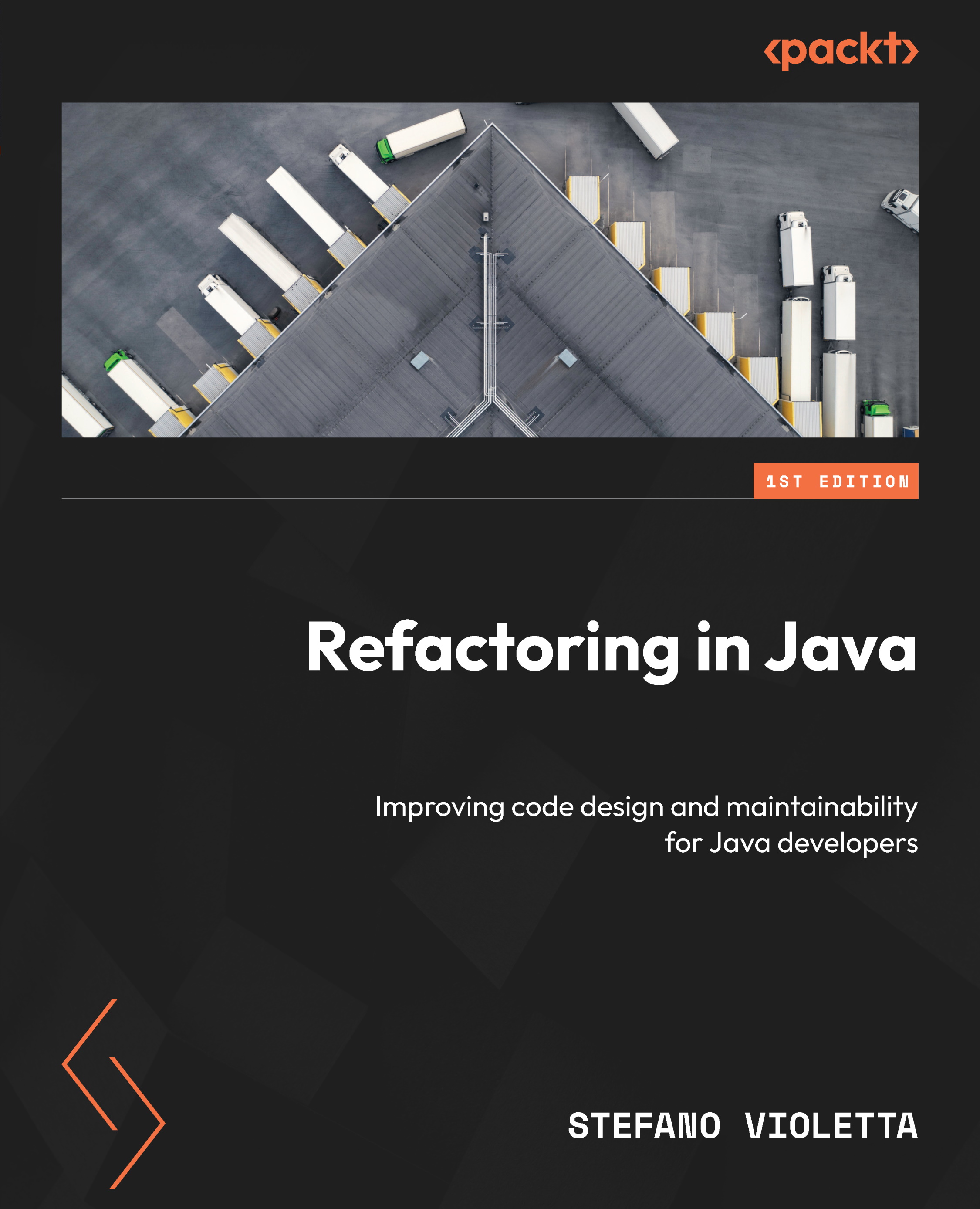
Refactoring in Java serves as an indispensable guide to enhancing your codebase’s quality and maintainability. The book begins by helping you get to grips with refactoring fundamentals, including cultivating good coding habits and identifying red flags. You’ll explore testing methodologies, essential refactoring techniques, and metaprogramming, as well as designing a good architecture. The chapters clearly explain how to refactor and improve your code using real-world examples and proven techniques. Part two equips you with the ability to recognize code smells, prioritize tasks, and employ automated refactoring tools, testing frameworks, and code analysis tools. You’ll discover best practices to ensure efficient code improvement so that you can navigate complexities with ease. In part three, the book focuses on continuous learning, daily practices enhancing coding proficiency, and a holistic view of the architecture. You’ll get practical tips to mitigate risks during refactoring, along with guidance on measuring impact to ensure that you become an efficient software craftsperson. By the end of this book, you’ll be able to avoid unproductive programming or architecturing, detect red flags, and propose changes to improve the maintainability of your codebase.
Table of Contents (15 chapters)
close
close
1
Part 1: Introduction to Refactoring
4
Part 2: Essence of Refactoring and Good Code
Lock Free Chapter
10
Part 3: Further Learning

What is Refactoring?

Picture this. It’s your first day at a new job, and you’re filled with excitement and eager to showcase your skills. Your new colleagues are enjoyable to be around, the company seems fine, and you’re itching to get started. Your “onboarding buddy” begins showing you the project that you’ll be working on for the next several months or even years. The concepts behind it are promising, and the business itself is stable. However, the code base is an enormous, chaotic mess—like a smoking, tangled plate of spaghetti. Well, perhaps you don’t need to imagine it. It’s likely you’ve been in that situation before. Maybe you’re even experiencing it right now.

As soon as you open your IDE, you’re greeted with a plethora of modules with very similar names. Once you enter a module, you’re met with a daunting number of classes, some of which run hundreds of lines. These classes often...

CONTINUE READING
83
Tech Concepts
36
Programming languages
73
Tech Tools
Icon Unlimited access to the largest independent learning library in tech of over 8,000 expert-authored tech books and videos.
Icon Innovative learning tools, including AI book assistants, code context explainers, and text-to-speech.
Icon 50+ new titles added per month and exclusive early access to books as they are being written.
Refactoring in Java
notes
bookmark Notes and Bookmarks search Search in title playlist Add to playlist download Download options font-size Font size

Change the font size

margin-width Margin width

Change margin width

day-mode Day/Sepia/Night Modes

Change background colour

Close icon Search
Country selected

Close icon Your notes and bookmarks

Confirmation

Modal Close icon
claim successful

Buy this book with your credits?

Modal Close icon
Are you sure you want to buy this book with one of your credits?
Close
YES, BUY

Submit Your Feedback

Modal Close icon
Modal Close icon
Modal Close icon