Sign In Start Free Trial
Account

Add to playlist

Create a Playlist

Modal Close icon
You need to login to use this feature.
  • Book Overview & Buying Modern Python Cookbook
  • Table Of Contents Toc
  • Feedback & Rating feedback
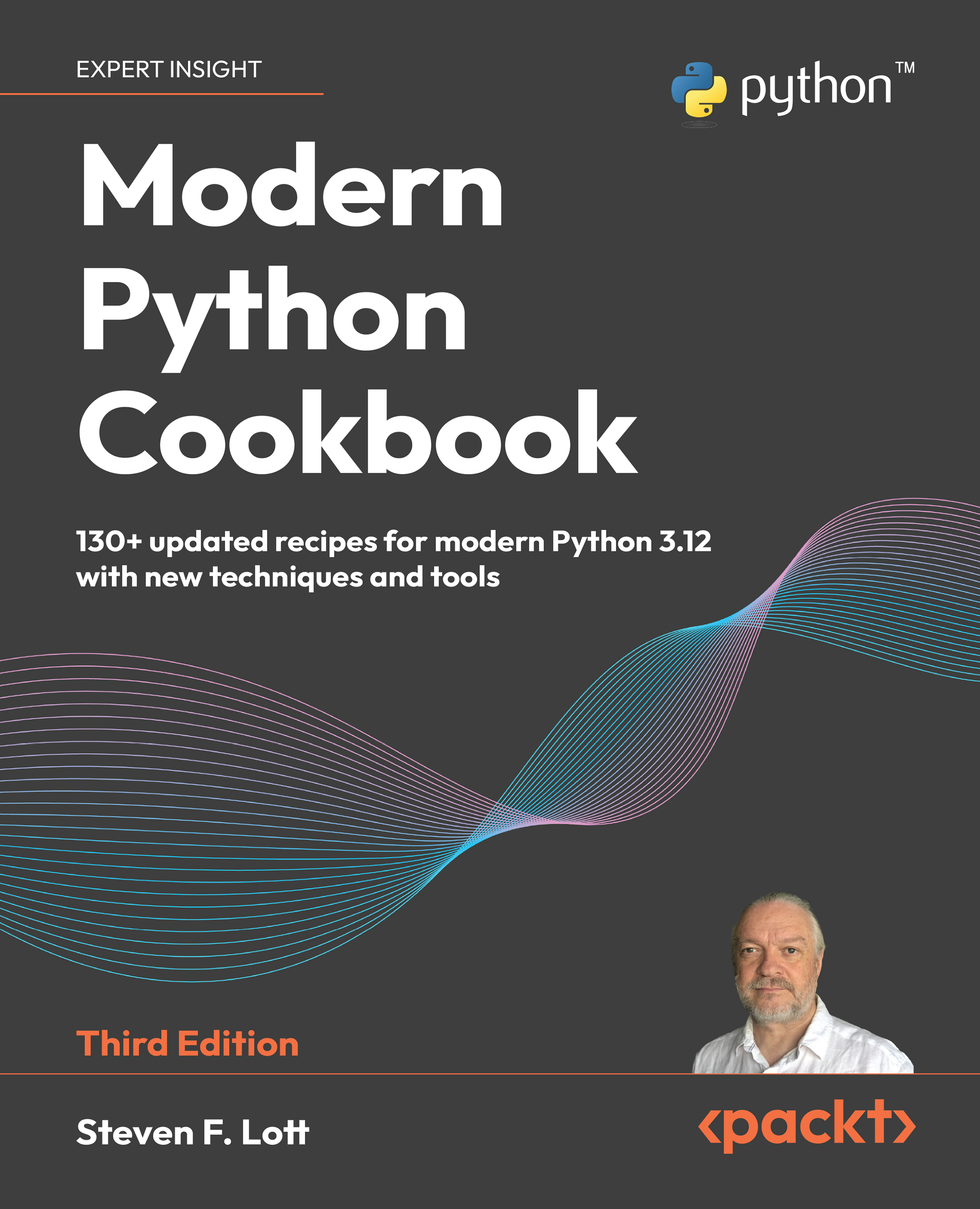
Modern Python Cookbook

Modern Python Cookbook - Third Edition

By : Steven F. Lott
4.9 (17)
close
close
Modern Python Cookbook

Modern Python Cookbook

4.9 (17)
By: Steven F. Lott

Overview of this book

Python is the go-to language for developers, engineers, data scientists, and hobbyists worldwide. Known for its versatility, Python can efficiently power applications, offering remarkable speed, safety, and scalability. This book distills Python into a collection of straightforward recipes, providing insights into specific language features within various contexts, making it an indispensable resource for mastering Python and using it to handle real-world use cases. The third edition of Modern Python Cookbook provides an in-depth look into Python 3.12, offering more than 140 new and updated recipes that cater to both beginners and experienced developers. This edition introduces new chapters on documentation and style, data visualization with Matplotlib and Pyplot, and advanced dependency management techniques using tools like Poetry and Anaconda. With practical examples and detailed explanations, this cookbook helps developers solve real-world problems, optimize their code, and get up to date with the latest Python features.
Table of Contents (20 chapters)
close
close
18
Other Books You May Enjoy
19
Index

1
Numbers, Strings, and Tuples

This chapter will look at some of the central types of Python objects. We’ll look at working with different kinds of numbers, working with strings, and using tuples. These are the simplest kinds of data that Python works with. In later chapters, we’ll look at data structures built on these foundations.

While these recipes start with a beginner’s level of understanding of Python 3.12, they also provide some deeper background for those familiar with the language. In particular, we’ll look at some details of how numbers are represented internally, because this can help when confronted with more advanced numerical programming problems. This will help us distinguish the uses cases for the rich variety of numeric types.

We’ll also look at the two different division operators. These have distinct use cases, and we’ll look at one kind of algorithm that demands truncated division.

When working with strings, there are several common operations that are important. We’ll explore some of the differences between bytes—as used by our OS files—and strings used to represent Unicode text. We’ll look at how we can exploit the full power of the Unicode character set.

In this chapter, we’ll show the recipes as if we’re working from the >>> prompt in interactive Python. This is the prompt that’s provided when running python from the command line or using the Python console in many Integrated Development Environment (IDE) tools. This is sometimes called the read-evaluate-print loop (REPL). In later chapters, we’ll change the style so it looks more like a script file. One goal of this chapter is to encourage interactive exploration because it’s a great way to learn the language.

We’ll cover these recipes to introduce basic Python data types:

  • Choosing between float, decimal, and fraction

  • Choosing between true division and floor division

  • String parsing with regular expressions

  • Building complicated strings with f-strings

  • Building complicated strings from lists of strings

  • Using the Unicode characters that aren’t on our keyboards

  • Encoding strings – creating ASCII and UTF-8 bytes

  • Decoding bytes – how to get proper characters from some bytes

  • Using tuples of items

  • Using NamedTuples to simplify item access in tuples

We’ll start with numbers, work our way through strings, and end up working with simple combinations of objects in the form of tuples and NamedTuple objects.

Visually different images
CONTINUE READING
83
Tech Concepts
36
Programming languages
73
Tech Tools
Icon Unlimited access to the largest independent learning library in tech of over 8,000 expert-authored tech books and videos.
Icon Innovative learning tools, including AI book assistants, code context explainers, and text-to-speech.
Icon 50+ new titles added per month and exclusive early access to books as they are being written.
Modern Python Cookbook
notes
bookmark Notes and Bookmarks search Search in title playlist Add to playlist download Download options font-size Font size

Change the font size

margin-width Margin width

Change margin width

day-mode Day/Sepia/Night Modes

Change background colour

Close icon Search
Country selected

Close icon Your notes and bookmarks

Confirmation

Modal Close icon
claim successful

Buy this book with your credits?

Modal Close icon
Are you sure you want to buy this book with one of your credits?
Close
YES, BUY

Submit Your Feedback

Modal Close icon
Modal Close icon
Modal Close icon