Sign In Start Free Trial
Account

Add to playlist

Create a Playlist

Modal Close icon
You need to login to use this feature.
  • Book Overview & Buying Learn Python Programming
  • Table Of Contents Toc
  • Feedback & Rating feedback
Learn Python Programming

Learn Python Programming - Fourth Edition

By : Fabrizio Romano, Heinrich Kruger
3.5 (2)
close
close
Learn Python Programming

Learn Python Programming

3.5 (2)
By: Fabrizio Romano, Heinrich Kruger

Overview of this book

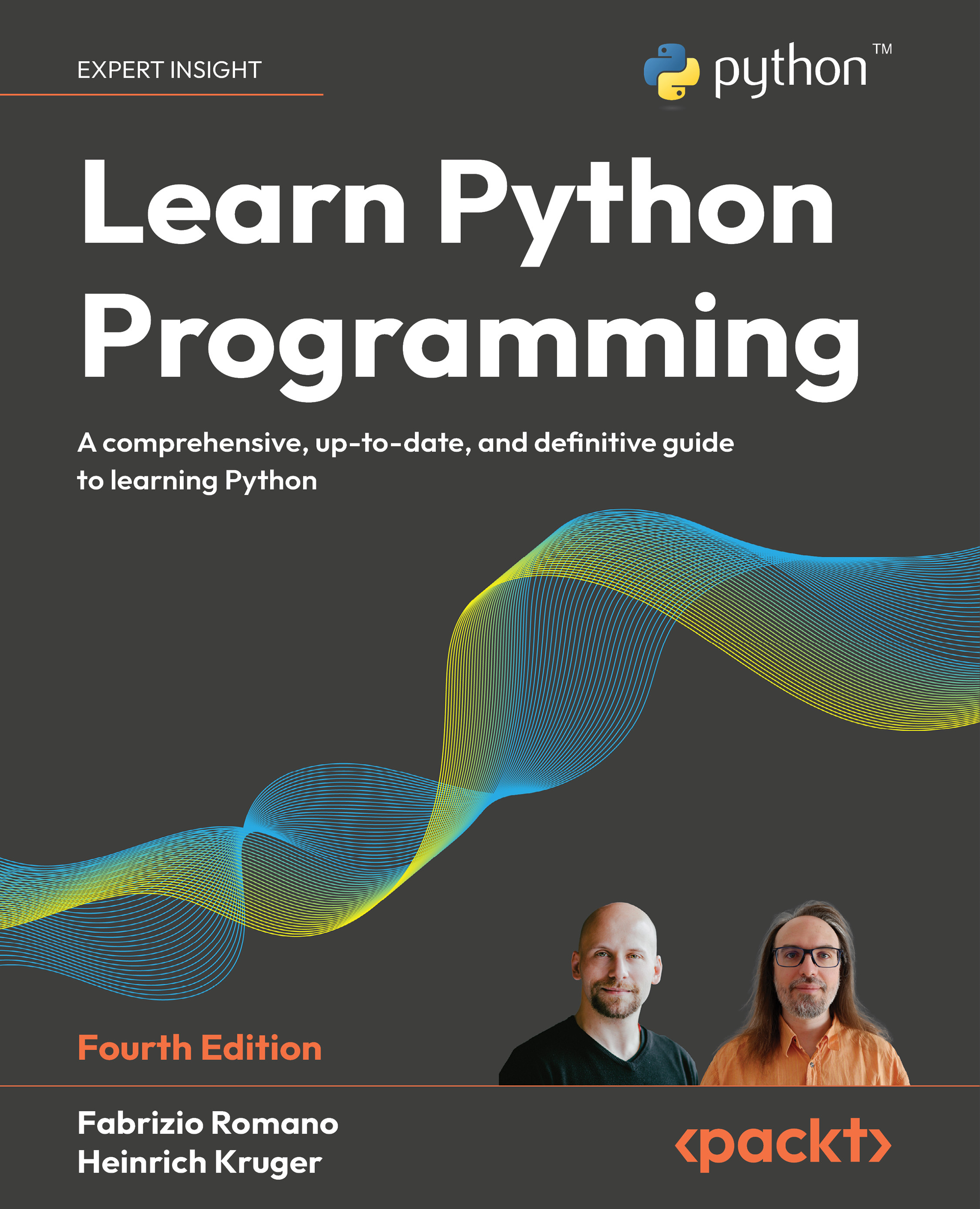
Learn Python Programming, Fourth Edition, provides a comprehensive, up-to-date introduction to Python programming, covering fundamental concepts and practical applications. This edition has been meticulously updated to include the latest features from Python versions 3.9 to 3.12, new chapters on type hinting and CLI applications, and updated examples reflecting modern Python web development practices. This Python book empowers you to take ownership of writing your software and become independent in fetching the resources you need. By the end of this book, you will have a clear idea of where to go and how to build on what you have learned from the book. Through examples, the book explores a wide range of applications and concludes by building real-world Python projects based on the concepts you have learned. This Python book offers a clear and practical guide to mastering Python and applying it effectively in various domains, such as data science, web development, and automation.
Table of Contents (20 chapters)
close
close
18
Other Books You May Enjoy
19
Index

Summary

In this chapter, we explored the concepts of iteration and generation a bit more deeply. We looked at the map(), zip(), and filter() functions in detail, and learned how to use them as an alternative to a regular for loop approach.

Then we covered the concept of comprehensions to construct lists, dictionaries, and sets. We explored their syntax and how to use them as an alternative to both the classic for loop approach and the map(), zip(), and filter() functions.

Finally, we talked about the concept of generators in two forms: generator functions and expressions. We learned how to save time and space by using generation techniques. We also saw how operations that are infeasible to perform with lists can be performed with generators instead.

We talked about performance and saw that for loops come last in terms of speed, but they provide the best readability and flexibility to change. On the other hand, functions such as map() and filter(), and comprehensions, can be much faster...

Visually different images
CONTINUE READING
83
Tech Concepts
36
Programming languages
73
Tech Tools
Icon Unlimited access to the largest independent learning library in tech of over 8,000 expert-authored tech books and videos.
Icon Innovative learning tools, including AI book assistants, code context explainers, and text-to-speech.
Icon 50+ new titles added per month and exclusive early access to books as they are being written.
Learn Python Programming
notes
bookmark Notes and Bookmarks search Search in title playlist Add to playlist download Download options font-size Font size

Change the font size

margin-width Margin width

Change margin width

day-mode Day/Sepia/Night Modes

Change background colour

Close icon Search
Country selected

Close icon Your notes and bookmarks

Confirmation

Modal Close icon
claim successful

Buy this book with your credits?

Modal Close icon
Are you sure you want to buy this book with one of your credits?
Close
YES, BUY

Submit Your Feedback

Modal Close icon
Modal Close icon
Modal Close icon