-
Book Overview & Buying
-
Table Of Contents
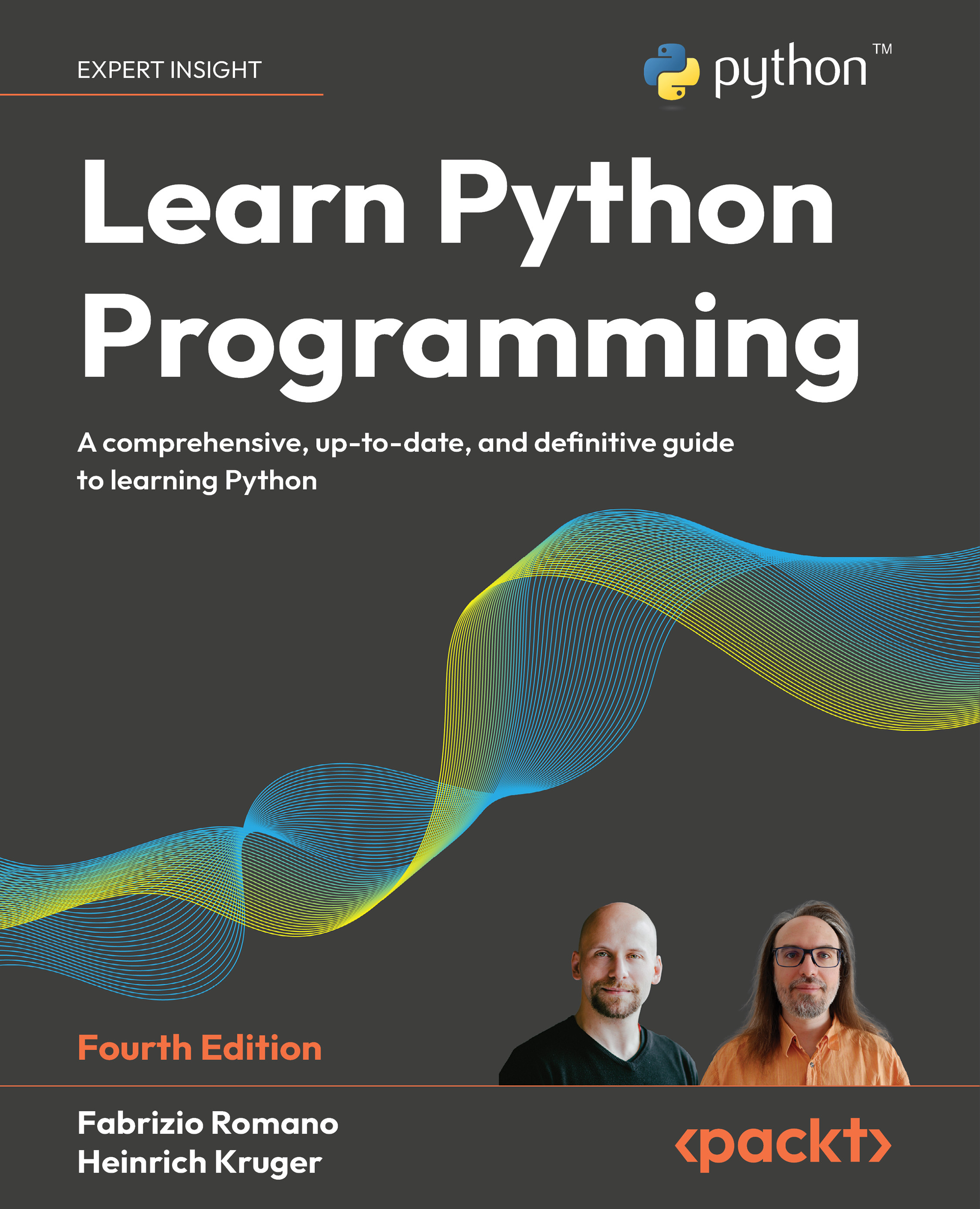
Learn Python Programming - Fourth Edition
By :
It is our great pleasure to introduce you to the fourth edition of our book. The first one came out in 2015, and since then the book has been a top seller all around the world.
Ten years ago, being a programmer meant working with certain tools, implementing certain paradigms. Today, the landscape is different. Developers tend to be even more specialized than before, and there is great focus on things like APIs, and distributed applications. We have tried to capture the current trends, and to offer you the best foundational layer we could think of, drawing from our experience as developers who work in a fast-paced industry.
Each new edition has brought about some kind of change. Obsolete chapters were removed, new ones were added, and others again have been amended to reflect the modern ways in which software is written.
This edition features three new chapters. The first one discusses the topic of type hinting. Type hinting is not new to Python, but now we feel it has become such an established practice that the book wouldn’t have been complete without it.
The second one, which discusses the topic of CLI applications, steps in by replacing an old chapter that was about GUIs. Most of what we do with a computer today happens in a browser, and many desktop applications have been built, or rewritten, by leveraging browser components, so we felt that a whole chapter dedicated to GUIs was perhaps a bit obsolete.
Finally, the third one explores the topic of competitive programming.
The remaining chapters have been updated to reflect the latest additions to the language, and improved to make the presentation even simpler and more fluid, while still aiming at offering interesting examples to the reader.
The soul of the book, its essence, is still intact. It shouldn’t feel like yet another Python book. It is, first and foremost, about programming. It tries to convey as much information as possible and, sometimes, when the page count couldn’t allow it, it points to the resources you need to further your knowledge.
It is designed to last. It explains concepts and information in a way that should stand the test of time, for as long as possible. There is great amount of work, thinking, and meetings, that goes into making sure of that.
It is also radically different than its first edition. It is much more mature, more professional, and focuses more on the language and slightly less on projects. We think the line that strikes the balance between these two parts has been drawn in the right place.
It will require you to focus and work hard. All the code is available for download. You can clone the repository from GitHub, if you like. Please check it out. It will help you cement what you will learn when reading these pages. Code is not a static thing. It is very much alive. It changes, it morphs. You will learn much more if you take the time to explore it, change it, and break it. We have left several guidelines in the book, to help you do that.
In closing, I want to express my gratitude to my co-author, Heinrich.
This book is now as much his as it is mine. Every chapter is infused with his talent, his creativity, and the depth of his knowledge. He is also gifted with tremendous memory: he can spot a redundant piece of information in chapters that are 200 pages apart. I can’t do that.
Like me, he has spent many long nights and weekends making sure everything was presented in the best possible way. It is because I have shared this journey with him, that I have so much confidence in the quality of this work.
Our advice for you is to study these pages well, and experiment with the source code. Once you are confident in your Python skills, please don’t stop learning. Try to go beyond the language, transcend it. A senior developer should know certain concepts and master certain skills that cannot be contained within one language, it’s just not possible. Studying other languages helps to learn how to discriminate between those features that pertain to a certain language, and others that are instead more generic, related to programming. Hopefully this book will help you get there.
Enjoy the journey and, whatever you learn, please share it with others.
Fabrizio
This book is for people who have some programming experience, but not necessarily with Python. Some knowledge of basic programming concepts will be useful, although it is not a strict requirement.
Even if you already have some experience with Python, this book can still be useful to you, both as a reference to Python’s fundamentals, and for providing a wide range of considerations and suggestions collected over four combined decades of experience.
Chapter 1, A Gentle Introduction to Python, introduces you to fundamental programming concepts and constructs of the Python language. It also guides you through getting Python up and running on your computer.
Chapter 2, Built-In Data Types, introduces you to Python built-in data types. Python has a very rich set of native data types, and this chapter will give you a description and examples for each of them.
Chapter 3, Conditionals and Iteration, teaches you how to control the flow of the code by inspecting conditions, applying logic, and performing loops.
Chapter 4, Functions, the Building Blocks of Code, teaches you how to write functions. Functions are essential to code reuse, to reducing debugging time, and, in general, to writing higher quality code.
Chapter 5, Comprehensions and Generators, introduces you to the functional aspects of Python programming. This chapter teaches you how to write comprehensions and generators, which are powerful tools that you can use to write faster, more concise code, and save memory.
Chapter 6, OOP, Decorators, and Iterators, teaches you the basics of object-oriented programming with Python. It shows you the key concepts and all the potentials of this paradigm. It also shows you one of the most useful features of the language: decorators.
Chapter 7, Exceptions and Context Managers, introduces the concept of exceptions, which represent errors that occur in applications, and how to handle them. It also covers context managers, which are very useful when dealing with resources.
Chapter 8, Files and Data Persistence, teaches you how to deal with files, streams, data interchange formats, and databases.
Chapter 9, Cryptography and Tokens, touches upon the concepts of security, hashes, encryption, and tokens, which are essential for writing secure software.
Chapter 10, Testing, teaches you the fundamentals of testing, and guides you through a few examples on how to test your code, in order to make it more robust, fast and reliable.
Chapter 11, Debugging and Profiling, shows you the main methods for debugging and profiling code and some examples of how to apply them.
Chapter 12, Introduction to Type Hinting, guides you through the syntax and main concepts of type hinting. Type hinting has become more and more popular in recent years because it enriches both the language and the tools that are part of its ecosystem.
Chapter 13, Data Science in Brief, illustrates a few key concepts by means of a comprehensive example, using the powerful Jupyter Notebook.
Chapter 14, Introduction to API Development, introduces API development using the FastAPI framework.
Chapter 15, CLI Applications, introduces command-line interface applications. They are run in a console or terminal, and are a common and natural way in which developers write several of their own day-to-day tools.
Chapter 16, Packaging Python Applications, guides you through the process of preparing a project to be published, and shows you how to upload the result on the Python Package Index (PyPI).
Chapter 17, Programming Challenges, introduces the concept of competitive programming, by showing you how to solve two problems from the Advent of Code website.
You are encouraged to follow the examples in this book. You will need a computer, an internet connection, and a browser. The book is written for Python 3.12, but it should also work, for the most part, with any recent version of Python 3. We have given guidelines on how to install Python on your operating system. The procedures to do that normally get out of date quickly, so we recommend you refer to the most up-to-date guide on the web to find precise setup instructions. We have also explained how to install all the extra libraries used in the various chapters. No particular editor is required to type the code; however, we suggest that those who are interested in following the examples should consider adopting a proper coding environment. We have offered suggestions on this matter in the first chapter.
We also provide a PDF file that has color images of the screenshots/diagrams used in this book. You can download it here: https://packt.link/gbp/9781835882948.
The code bundle for the book is hosted on GitHub at https://github.com/PacktPublishing/Learn-Python-Programming-Fourth-Edition. We also have other code bundles from our rich catalog of books and videos available at https://github.com/PacktPublishing/. Check them out!
There are a number of text conventions used throughout this book.
CodeInText: Indicates code words in text, database table names, folder names, filenames, file extensions, pathnames, dummy URLs, user input, and Twitter handles. For example: “The as_integer_ratio() method has also been added to integers and Booleans.”
Bold: Indicates a new term, an important word, or words that you see on the screen. For instance, words in menus or dialog boxes appear in the text like this. For example: “They are immutable sequences of Unicode code points.”
Warnings or important notes appear like this.
Tips and tricks appear like this.
Feedback from our readers is always welcome.
General feedback: Email [email protected] and mention the book’s title in the subject of your message. If you have questions about any aspect of this book, please email us at [email protected].
Errata: Although we have taken every care to ensure the accuracy of our content, mistakes do happen. If you have found a mistake in this book, we would be grateful if you reported this to us. Please visit http://www.packtpub.com/submit-errata, click Submit Errata, and fill in the form.
Piracy: If you come across any illegal copies of our works in any form on the internet, we would be grateful if you would provide us with the location address or website name. Please contact us at [email protected] with a link to the material.
If you are interested in becoming an author: If there is a topic that you have expertise in and you are interested in either writing or contributing to a book, please visit http://authors.packtpub.com.
This book comes with free benefits to support your learning. Activate them now for instant access (see the “How to Unlock” section for instructions).
Here’s a quick overview of what you can instantly unlock with your purchase:

Scan the QR code (or go to packtpub.com/unlock). Search for this book by name, confirm the edition, and then follow the steps on the page.


Note: Keep your invoice handy. Purchases made directly from Packt don’t require one
Once you’ve read Learn Python Programming, Fourth Edition, we’d love to hear your thoughts! Please click here to go straight to the Amazon review page for this book and share your feedback.
Your review is important to us and the tech community and will help us make sure we’re delivering excellent quality content.
Change the font size
Change margin width
Change background colour