Sign In Start Free Trial
Account

Add to playlist

Create a Playlist

Modal Close icon
You need to login to use this feature.
  • Book Overview & Buying Asynchronous Programming in Python
  • Table Of Contents Toc
  • Feedback & Rating feedback
Asynchronous Programming in Python

Asynchronous Programming in Python

By : Nicolas Bohorquez
close
close
Asynchronous Programming in Python

Asynchronous Programming in Python

By: Nicolas Bohorquez

Overview of this book

Asynchronous programming is one of the most effective but often misunderstood techniques for building fast, scalable, and responsive systems in Python. While it can significantly improve performance, efficiency, and sustainability, using async without a clear understanding of its trade-offs can lead to fragile designs and hard-to-debug issues. This book offers a structured approach to applying asynchronous programming in Python. It begins with a conceptual framework to help you distinguish between synchronous and asynchronous execution models, and shows how async relates to other concurrency strategies such as multithreading and multiprocessing. From there, you will explore the core tools available for building async applications in Python. You will also learn how to measure the impact of async programming in practical scenarios, profile and debug asynchronous code, and evaluate performance improvements using real-world metrics. The final chapters focus on applying async techniques to common cloud-based systems, such as web frameworks, database interactions, and data-pipelines tools. Designed for developers looking to apply async programming with confidence, this book blends real-world examples with core concepts to help you write efficient, maintainable Python code.
Table of Contents (14 chapters)
close
close
12
Other Books You May Enjoy
13
Index

Understanding synchronous and asynchronous programming

As in many aspects of life, programming requires clear objectives if success is to be achieved, and those objectives are usually formulated as objectively testable requirements. A set of requirements represents all the characteristics that a software solution must exhibit to be deemed satisfactory, i.e. the things that you must check to accept or reject a solution. They can include functional and non-functional aspects. Functional aspects are directly related to the product definition (‘If I do X, Y happens’) whereas non-functional requirements are not directly related to the solution per se but may be required for other reasons (e.g. ‘Implement using the Cloud to guarantee a certain level of availability’).

For example, in sports or board games there is usually the clear objective of winning a match, and it is usually easy to evaluate whether the player has achieved that objective or not. In basketball, you can see if the ball has passed through the hoop. The shot clock is an example of a non-functional requirement: it’s not necessary for scoring but is an important rule of the game nonetheless that must be complied with to avoid a penalty.

Synchronous programming: chess

A good way to learn how to think in a synchronous and structured way is to solve little chess puzzles. Chess is a ‘complete information’ game, which means that everybody involved in a game has complete awareness of the situation of the game. A chess puzzle is an individual practice mode in which the player must find a solution for an established game situation to finish the game (checkmate). Usually, chess puzzles have an optimal solution which is defined as the solution requiring the fewest moves to reach checkmate.

Important note

If you don’t know the rules of chess, a good introduction is available from the libre/free community-driven server located at https://lichess.org/learn.

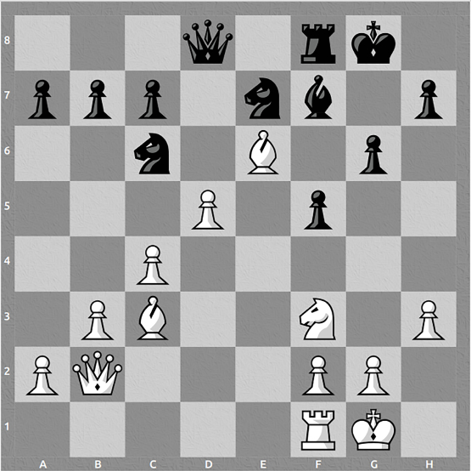
The following chess puzzle can be optimally solved by the white player in three moves:

Figure 1.2: A chess puzzle solvable in three moves by white

To solve this kind of problem the player must make their moves sequentially, taking into account the global state of the game (the positions of the pieces on the board), the value of each piece (for in chess each available piece type has a different value), and the potential reactions the opponent may make to the player’s moves. Remember that chess is a turn-based strategy game.

Many problems can be solved in this way, which we refer to as synchronous programming – the decomposition of steps into a cascade having a single line or thread of control. The execution of each step and time of execution are perfectly synchronized, and each step has full information about the global status, variables and available resources.

The following table shows the solution of the previous puzzle in three moves for white. Notice that the flow might change if conditions varied with the opponent’s moves (for example if in Step 1(b) the black player made a mistake):

Step

White (a)

Black (b)

1

Bh8

Nd4

2

Qd4

Be6

3

Qg7

Table 1.1: Solution for the chess puzzle

Asynchronous programming: soccer

A game like soccer is much more complex than chess. It involves two teams composed of 11 players each, and players are assigned positions (goalkeeper, defender, midfielder, forward) which impact their initial locations and potentially their ability to perform certain actions. The overall objective is to score (cause the ball to cross the opponent’s goal line). Any player can do this, and although at any given moment one team is defending and the other is attacking, the roles are fluid and continuous and ‘turns’ at shooting to goal are often unexpected.

The nature of the game allows for an infinite number of strategies. Usually, a team’s strategy involves not only retaining the ball but also making teammates run to distract the opposing team and to gradually occupy favorable ‘real estate’ on the field to improve the chances of any given shot.

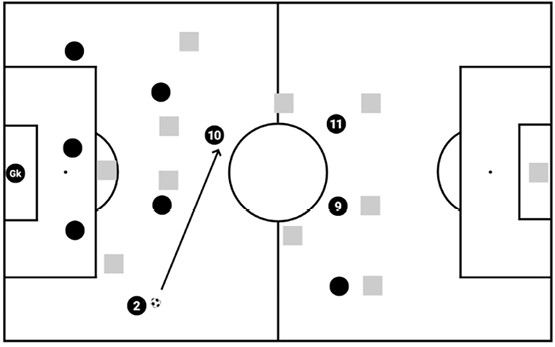
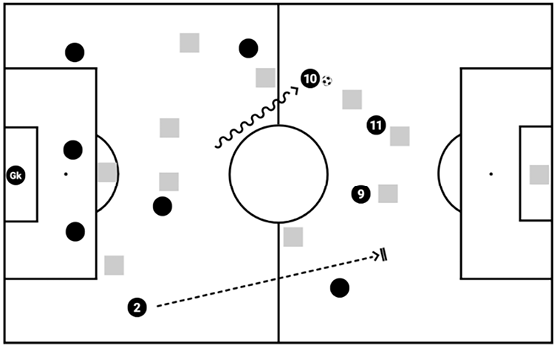
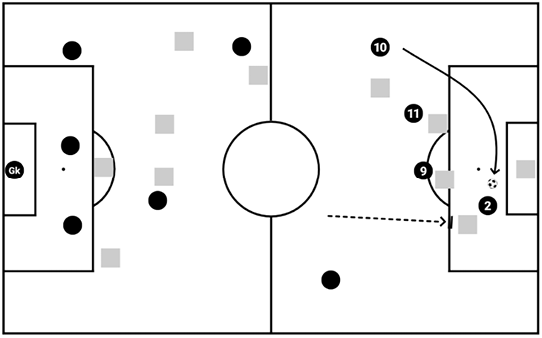
The following three diagrams show a typical soccer play in which a defender takes control of the ball and after three moves scores a goal:

Figure 1.3: A soccer play starts with number 2 making a pass to number 10

The main execution timeline is always the one in which the ball is involved. Here it starts with player 2 taking control of the ball and making a pass to player 10, but once the pass is executed player 2 starts to run to a new position.

Figure 1.4: Second move: a dribble by number 10 and a run by number 2

At the second instant in time, multiple things are happening: player 10 dribbles past an opponent, while players 9, 2, and 11 move downfield for better positioning.

Figure 1.5: Third move: number 2 scores

At the third instant, player 10 waits until player 2 is in position to score, after which he passes the ball and player 2 is able to hit the net. The main execution line (scoring the goal) cannot be achieved if the supporting, parallel executions by multiple players are not completed.

Note

The previous example is an adaptation of a real play executed by the Slovenian national soccer team in the 2024 UEFA European Football Championship, the match report for which is available at https://www.uefa.com.

In the same way, asynchronous programming is a technique in which some of an algorithm’s steps are executed in different lines of control than the main one, and those executions may occur simultaneously. Simultaneous execution is usually managed by the operating system or the programming language runtime, but simultaneous execution is not a requirement for asynchronous programming: asynchronous operations can also be run sequentially if desired.

It’s important to note that the multiple control lines in asynchronous programming don’t block each other. As in soccer, individual operations (the equivalent of players in soccer) are free to run unimpeded as other actions occur around them.

We have used the idea of control line in both examples without a formal definition. This is because there are several ways that modern computers control the execution of programs, depending on hardware characteristics, scheduling algorithms, memory management, and I/O handling. Moreover, programming languages and frameworks have their own approaches to concurrency that may vary depending on OS or hardware constraints.

In this section, we have introduced three key concepts which will be developed throughout the book: synchronous solutions, asynchronous solutions, and lines of control. Those concepts will be further elaborated in the specific context of computer science in the following section, to help you move from intuition and sports metaphors to real computer programming.

Visually different images
CONTINUE READING
83
Tech Concepts
36
Programming languages
73
Tech Tools
Icon Unlimited access to the largest independent learning library in tech of over 8,000 expert-authored tech books and videos.
Icon Innovative learning tools, including AI book assistants, code context explainers, and text-to-speech.
Icon 50+ new titles added per month and exclusive early access to books as they are being written.
Asynchronous Programming in Python
notes
bookmark Notes and Bookmarks search Search in title playlist Add to playlist download Download options font-size Font size

Change the font size

margin-width Margin width

Change margin width

day-mode Day/Sepia/Night Modes

Change background colour

Close icon Search
Country selected

Close icon Your notes and bookmarks

Confirmation

Modal Close icon
claim successful

Buy this book with your credits?

Modal Close icon
Are you sure you want to buy this book with one of your credits?
Close
YES, BUY

Submit Your Feedback

Modal Close icon
Modal Close icon
Modal Close icon