Sign In Start Free Trial
Account

Add to playlist

Create a Playlist

Modal Close icon
You need to login to use this feature.
  • Book Overview & Buying Building Programming Language Interpreters
  • Table Of Contents Toc
Building Programming Language Interpreters

Building Programming Language Interpreters

By : Daniel Ruoso
close
close
Building Programming Language Interpreters

Building Programming Language Interpreters

By: Daniel Ruoso

Overview of this book

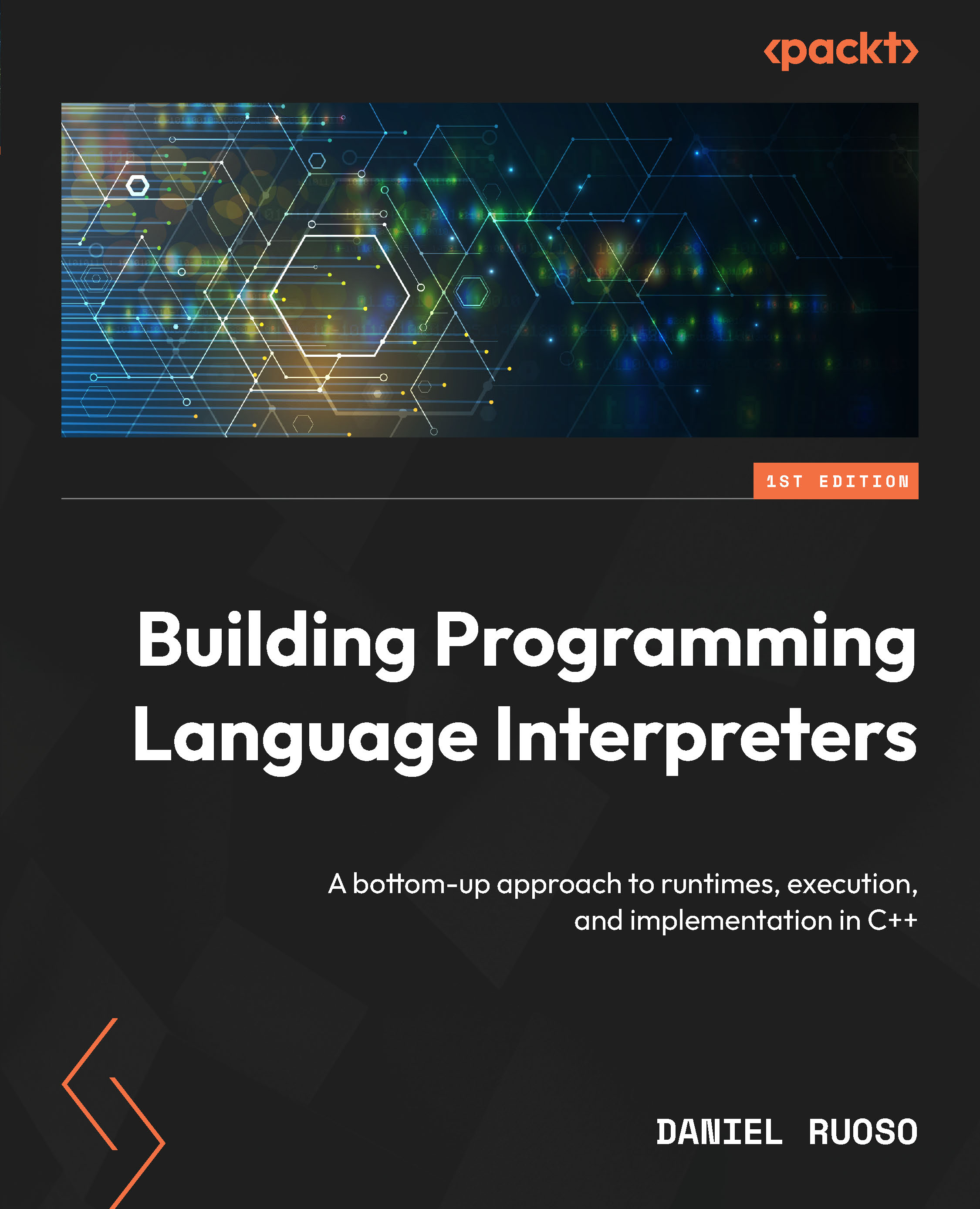
Designing a custom programming language can be the most effective way to solve certain types of problems—especially when precision, safety, or domain-specific expressiveness matters. This book guides you through the full process of designing and implementing your own programming language and interpreter, from language design to execution, using modern C++. You’ll start by exploring when and why building a domain-specific language is worth it, and how to design one to fit a specific problem domain. Along the way, you’ll examine real-world interpreter architectures and see how their design decisions affect language behavior, capabilities, and runtime trade-offs. The book then walks through the entire process of interpreter implementation: defining syntax, building a lexer and parser, designing an abstract syntax tree, generating executable instructions, and implementing a runtime. All examples are in modern C++, with a focus on clean architecture and real-world usability. By the end, you’ll have a fully working interpreter for a domain-specific language designed to handle network protocols—plus the knowledge and tools to design your own programming language from scratch. *Email sign-up and proof of purchase required
Table of Contents (25 chapters)
close
close
1
Modeling the Programming Language Runtime Environment
7
Modeling the Programming Language Syntax
12
Implementing the Interpreter Runtime
16
Interpreting Source Code
24
Index

Why do we keep creating new languages?

I suppose it is tempting, if the only tool you have is a hammer, to treat everything as if it were a nail.

—Abraham Maslow, 1966, The Psychology of Science

We tend to underestimate how the programming languages we use define the way we write code and the way we handle the problems that are presented to us as software developers. The shape of our solutions is influenced by the tools we have when we’re working on them.

The environments and ecosystems of the programming languages we use shape us as developers. We can sometimes recognize the accent a developer has when they move from one programming language to another, and it takes a certain amount of effort and code review to become familiar with another language and to start talking like a native.

While it’s true that you can solve any computable problem in any Turing-complete language, it’s also true that some problem spaces are better addressed by certain languages, and those tend to become used persistently, even when they’re no longer in fashion.

Fortran is a very good example of that. It has seen an important resurgence in the scientific computing community. It has straightforward semantics, very good support for numerical types, and a lot of efficiency when it comes to computing lots of numerical operations. Those characteristics make it extremely useful in that context, and it doesn’t matter that Fortran is quite literally the oldest programming language still in use.

The ecosystem also defines a lot regarding how problems are solved. C++ has a significant deficiency in how code reuse is managed, particularly across projects. It still has no uniform package management, even though it is probably the language that needs the most amount of support from outside the language for its build to work properly. Header-only libraries in C++ were developers’ response to this deficiency in the ecosystem, and it became a defining aspect of how libraries are made in the language.

Of course, sometimes we also just want to express aesthetic preferences on how we write our code. Programming is not a mathematical exercise; it is much closer to telling a story—a story you tell the computer, of course, but it’s also a story you tell other developers. And it’s easy to underestimate how strongly software developers feel about the choices that are made to solve programming problems.

Those choices are not always made based on empirical evidence—more often than not, they’re derived from the culture that is built around a given community. The Perl community, for instance, was heavily informed by the “There is more than one way to do it” principle of the language itself. This could also be seen in how libraries were designed, with more flexible interfaces and the idea that the goal was to make it easier to solve problems.

This ended up becoming the fuel for a lot of the detraction from Perl, and opposition to it became a driving force in the design of Python, where “There should be one—and preferably only one—obvious way to do it.”

You may have read the previous paragraphs thinking that I would present you with a definitive way to talk about the most important aspects of programming language design and give you the answer to the question: “What is the best and worst programming language?” But I’m going to go in quite the opposite direction.

Instead of trying to find the one ultimate language, our goal should be to use the programming language that best fits the specific problem we’re trying to solve. Sometimes, we may have strong opinions regarding that programming language, but if it allows us to solve the problem more easily (maybe there’s a library in that ecosystem that fits our problem), then we should prioritize solving the problem, independent of our opinions about that particular programming language.

Sometimes, disruption comes from unexpected places, and a language that takes a different approach will allow developers to create better solutions to existing problems. That can create a turning point and attract a lot of people to bootstrap an entirely new community. We’ve seen how fast Rust is gaining popularity, and how its memory management model changes the way people solve problems in that language.

Other times, disruptions occur without us having to replace any existing language. Focusing on niche use cases can create entirely new ways of solving problems. In the next section, we will focus on scenarios like that.

CONTINUE READING
83
Tech Concepts
36
Programming languages
73
Tech Tools
Icon Unlimited access to the largest independent learning library in tech of over 8,000 expert-authored tech books and videos.
Icon Innovative learning tools, including AI book assistants, code context explainers, and text-to-speech.
Icon 50+ new titles added per month and exclusive early access to books as they are being written.
Building Programming Language Interpreters
notes
bookmark Notes and Bookmarks search Search in title playlist Add to playlist download Download options font-size Font size

Change the font size

margin-width Margin width

Change margin width

day-mode Day/Sepia/Night Modes

Change background colour

Close icon Search
Country selected

Close icon Your notes and bookmarks

Confirmation

Modal Close icon
claim successful

Buy this book with your credits?

Modal Close icon
Are you sure you want to buy this book with one of your credits?
Close
YES, BUY

Submit Your Feedback

Modal Close icon
Modal Close icon
Modal Close icon