Sign In Start Free Trial
Account

Add to playlist

Create a Playlist

Modal Close icon
You need to login to use this feature.
  • Book Overview & Buying Advanced C++
  • Table Of Contents Toc
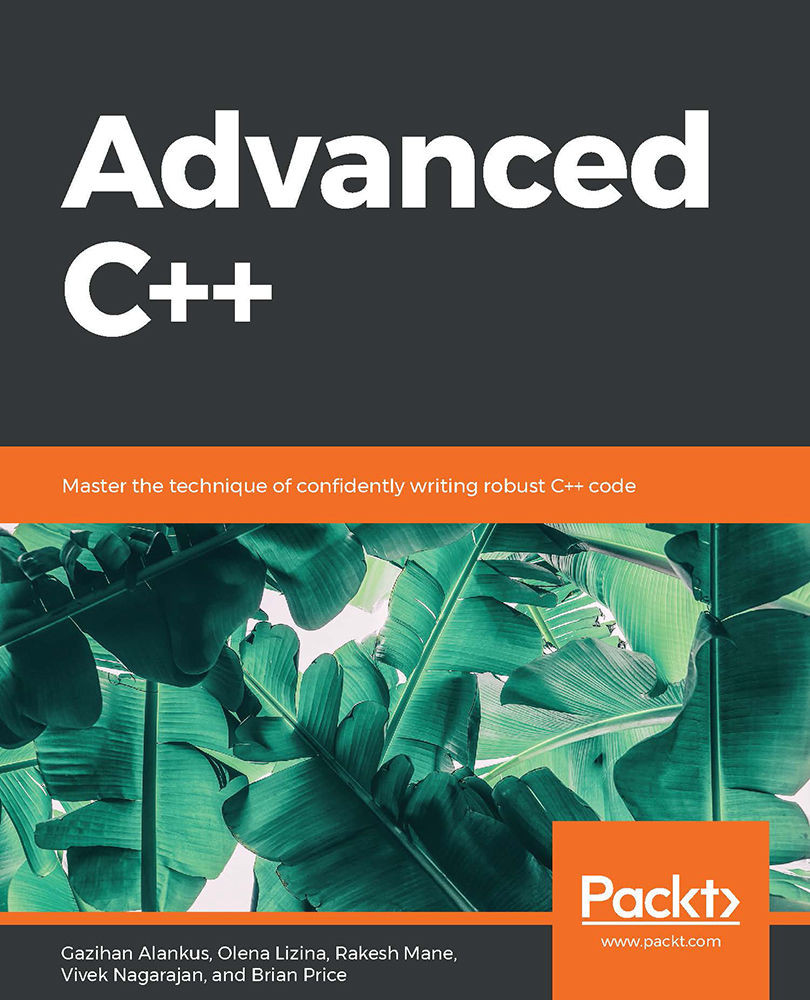
Advanced C++

Advanced C++

By : Gazihan Alankus , Olena Lizina , Rakesh Mane, Vivek Nagarajan , Brian Price
1 (1)
close
close
Advanced C++

Advanced C++

1 (1)
By: Gazihan Alankus , Olena Lizina , Rakesh Mane, Vivek Nagarajan , Brian Price

Overview of this book

C++ is one of the most widely used programming languages and is applied in a variety of domains, right from gaming to graphical user interface (GUI) programming and even operating systems. If you're looking to expand your career opportunities, mastering the advanced features of C++ is key. The book begins with advanced C++ concepts by helping you decipher the sophisticated C++ type system and understand how various stages of compilation convert source code to object code. You'll then learn how to recognize the tools that need to be used in order to control the flow of execution, capture data, and pass data around. By creating small models, you'll even discover how to use advanced lambdas and captures and express common API design patterns in C++. As you cover later chapters, you'll explore ways to optimize your code by learning about memory alignment, cache access, and the time a program takes to run. The concluding chapter will help you to maximize performance by understanding modern CPU branch prediction and how to make your code cache-friendly. By the end of this book, you'll have developed programming skills that will set you apart from other C++ programmers.
Table of Contents (11 chapters)
close
close
7
6. Streams and I/O

Performance Measurement

The most important aspect of optimization is the measurement of code execution time. Unless we measure our application's performance with a wide range of input datasets, we will have no clue as to which part takes the most time and, our optimization efforts will be shot in the dark, with no guarantee of a result. There are several approaches for measurement, and some of them are listed here:

  • Runtime instrumentation or profiling
  • Source code instrumentation
  • Manual execution timing
  • Studying generated assembly code
  • Manual estimation by studying the code and algorithms used

The preceding list is ordered in terms of how accurate the measurement is (with the most accurate one first). However, each of these methods has different advantages. The choice of which approach to adopt depends on the goals and scope of the optimization effort. In an all-out effort to get the fastest possible implementation, all of these may be required. We...

CONTINUE READING
83
Tech Concepts
36
Programming languages
73
Tech Tools
Icon Unlimited access to the largest independent learning library in tech of over 8,000 expert-authored tech books and videos.
Icon Innovative learning tools, including AI book assistants, code context explainers, and text-to-speech.
Icon 50+ new titles added per month and exclusive early access to books as they are being written.
Advanced C++
notes
bookmark Notes and Bookmarks search Search in title playlist Add to playlist download Download options font-size Font size

Change the font size

margin-width Margin width

Change margin width

day-mode Day/Sepia/Night Modes

Change background colour

Close icon Search
Country selected

Close icon Your notes and bookmarks

Confirmation

Modal Close icon
claim successful

Buy this book with your credits?

Modal Close icon
Are you sure you want to buy this book with one of your credits?
Close
YES, BUY

Submit Your Feedback

Modal Close icon
Modal Close icon
Modal Close icon