Sign In Start Free Trial
Account

Add to playlist

Create a Playlist

Modal Close icon
You need to login to use this feature.
  • Book Overview & Buying Oracle JRockit: The Definitive Guide
  • Table Of Contents Toc
Oracle JRockit: The Definitive Guide

Oracle JRockit: The Definitive Guide

By : Marcus Hirt, Marcus Lagergren
4.8 (10)
close
close
Oracle JRockit: The Definitive Guide

Oracle JRockit: The Definitive Guide

4.8 (10)
By: Marcus Hirt, Marcus Lagergren

Overview of this book

Oracle JRockit is one of the industry’s highest performing Java Virtual Machines. Java developers are always on the lookout for better ways to analyze application behavior and gain performance. As we all know, this is not as easy as it looks. Welcome to JRockit: The Definitive Guide.This book helps you gain in-depth knowledge of Java from the JVM’s point of view. We will explain how to write code that works well with the JVM to gain performance and scalability. Starting with the inner workings of the JRockit JVM and finishing with a thorough walkthrough of the tools in the JRockit Mission Control suite, this book is for anyone who wants to know more about how the JVM executes your Java application and how to profile for better performance.
Table of Contents (23 chapters)
close
close
Oracle JRockit
Credits
Foreword
About the Authors
Acknowledgement
About the Reviewers
Preface
12
Using the JRockit Management APIs
1
Bibliography
2
Glossary
Icon
AST
Icon
CAS
Icon
HIR
Icon
IR
Icon
JFR
Icon
JMX
Icon
JRA
Icon
JSR
Icon
LIR
Icon
MD5
Icon
MIR
Icon
PDE
Icon
RCP
Icon
SWT
Icon
TLA
3
Index

Allocation traces


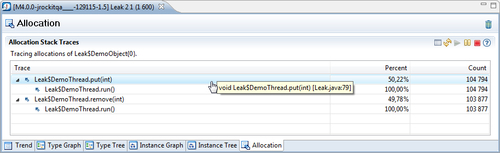
The last major feature in Memleak to be discussed in this book, is the ability to turn on allocation tracing for any given type. To, for instance, find out where the Leak$DemoObjects are being allocated in our previous example, simply right click on the type and then click on Trace Allocations. The example has been tailored to do allocations in the vicinity of the code that causes the actual leak (note that this is normally not the case).

As can be readily seen from the screenshot, we are invoking put more often than remove. If we are running Memleak from inside Eclipse, we can jump directly to the corresponding line in the Leak class by right clicking on the stack frame and then clicking on Open Method from the context menu.

Allocation traces can only be enabled for one type (class) at a time.

Note

A word of caution: Enabling allocation traces for types with a high allocation pressure can introduce significant overhead. For example, it is, in general, a very bad idea to...

CONTINUE READING
83
Tech Concepts
36
Programming languages
73
Tech Tools
Icon Unlimited access to the largest independent learning library in tech of over 8,000 expert-authored tech books and videos.
Icon Innovative learning tools, including AI book assistants, code context explainers, and text-to-speech.
Icon 50+ new titles added per month and exclusive early access to books as they are being written.
Oracle JRockit: The Definitive Guide
notes
bookmark Notes and Bookmarks search Search in title playlist Add to playlist font-size Font size

Change the font size

margin-width Margin width

Change margin width

day-mode Day/Sepia/Night Modes

Change background colour

Close icon Search
Country selected

Close icon Your notes and bookmarks

Confirmation

Modal Close icon
claim successful

Buy this book with your credits?

Modal Close icon
Are you sure you want to buy this book with one of your credits?
Close
YES, BUY

Submit Your Feedback

Modal Close icon
Modal Close icon
Modal Close icon