Sign In Start Free Trial
Account

Add to playlist

Create a Playlist

Modal Close icon
You need to login to use this feature.
  • Book Overview & Buying Python for Secret Agents - Volume II
  • Table Of Contents Toc
Python for Secret Agents - Volume II

Python for Secret Agents - Volume II - Second Edition

By : Steven F. Lott
5 (1)
close
close
Python for Secret Agents - Volume II

Python for Secret Agents - Volume II

5 (1)
By: Steven F. Lott

Overview of this book

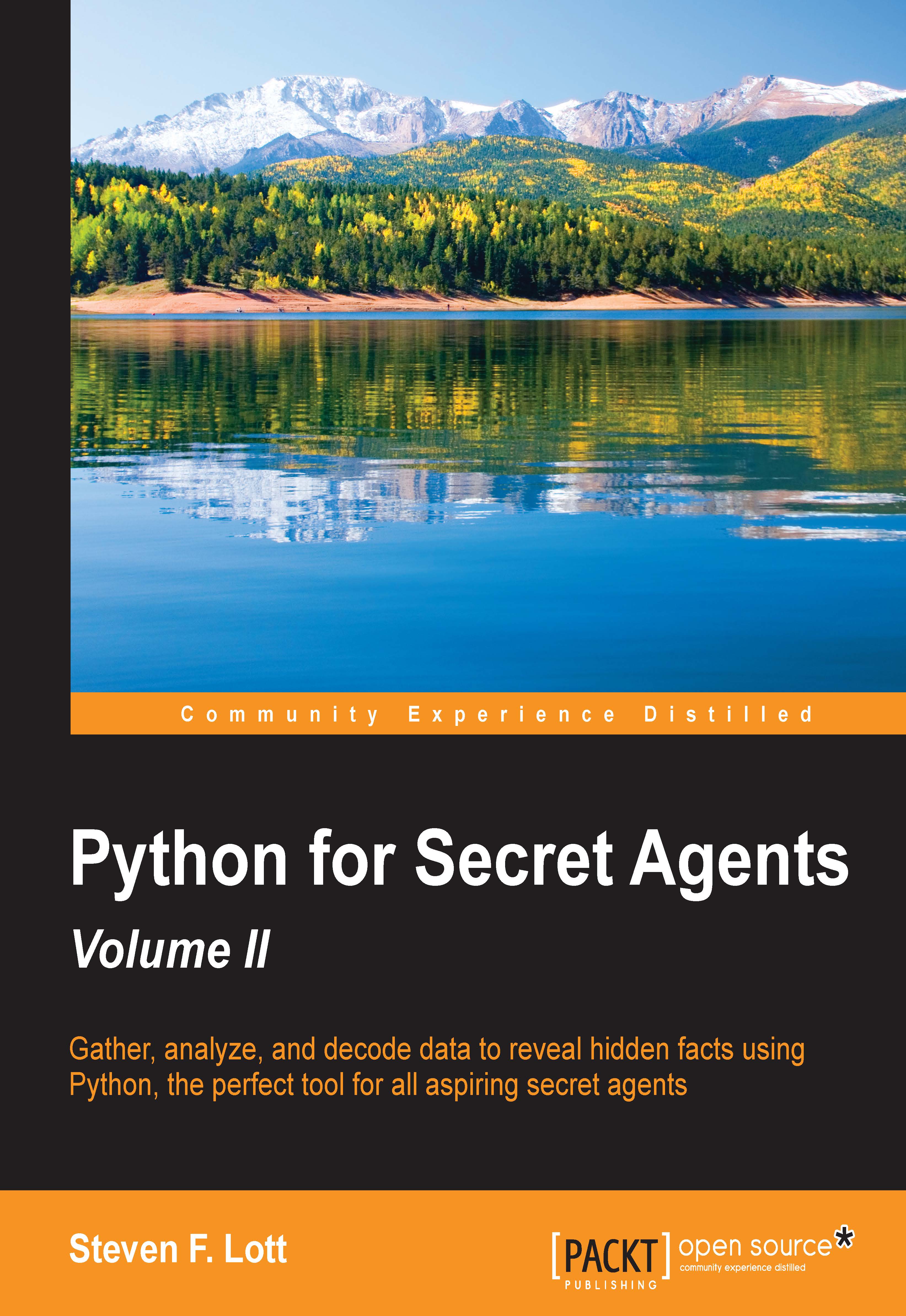
Python is easy to learn and extensible programming language that allows any manner of secret agent to work with a variety of data. Agents from beginners to seasoned veterans will benefit from Python's simplicity and sophistication. The standard library provides numerous packages that move beyond simple beginner missions. The Python ecosystem of related packages and libraries supports deep information processing. This book will guide you through the process of upgrading your Python-based toolset for intelligence gathering, analysis, and communication. You'll explore the ways Python is used to analyze web logs to discover the trails of activities that can be found in web and database servers. We'll also look at how we can use Python to discover details of the social network by looking at the data available from social networking websites. Finally, you'll see how to extract history from PDF files, which opens up new sources of data, and you’ll learn about the ways you can gather data using an Arduino-based sensor device.
Table of Contents (7 chapters)
close
close
6
Index

Reading remote files


We've given these functions names such as local_text and local_gzip because the files are located on our local machine. We might want to write other variations that use urrlib.request.urlopen() to open remote files. For example, we might have a log file on a remote server that we'd like to process. This allows us to write a generator function, which yields lines from a remote file allowing us to interleave processing and downloading in a single operation.

We can use the urllib.request module to handle remote files using URLs of this form: ftp://username:password@/server/path/to/file. We can also use URLs of the form file:///path/to/file to read local files. Because of this transparency, we might want to look at using urllib.request for all file access.

As a practical matter, it's somewhat more common to use FTP to acquire files in bulk.

CONTINUE READING
83
Tech Concepts
36
Programming languages
73
Tech Tools
Icon Unlimited access to the largest independent learning library in tech of over 8,000 expert-authored tech books and videos.
Icon Innovative learning tools, including AI book assistants, code context explainers, and text-to-speech.
Icon 50+ new titles added per month and exclusive early access to books as they are being written.
Python for Secret Agents - Volume II
notes
bookmark Notes and Bookmarks search Search in title playlist Add to playlist font-size Font size

Change the font size

margin-width Margin width

Change margin width

day-mode Day/Sepia/Night Modes

Change background colour

Close icon Search
Country selected

Close icon Your notes and bookmarks

Confirmation

Modal Close icon
claim successful

Buy this book with your credits?

Modal Close icon
Are you sure you want to buy this book with one of your credits?
Close
YES, BUY

Submit Your Feedback

Modal Close icon
Modal Close icon
Modal Close icon