
Sign In Start Free Trial
Account

Add to playlist

Create a Playlist

Modal Close icon
You need to login to use this feature.
  • Book Overview & Buying Mastering Metasploit
  • Table Of Contents Toc
  • Feedback & Rating feedback
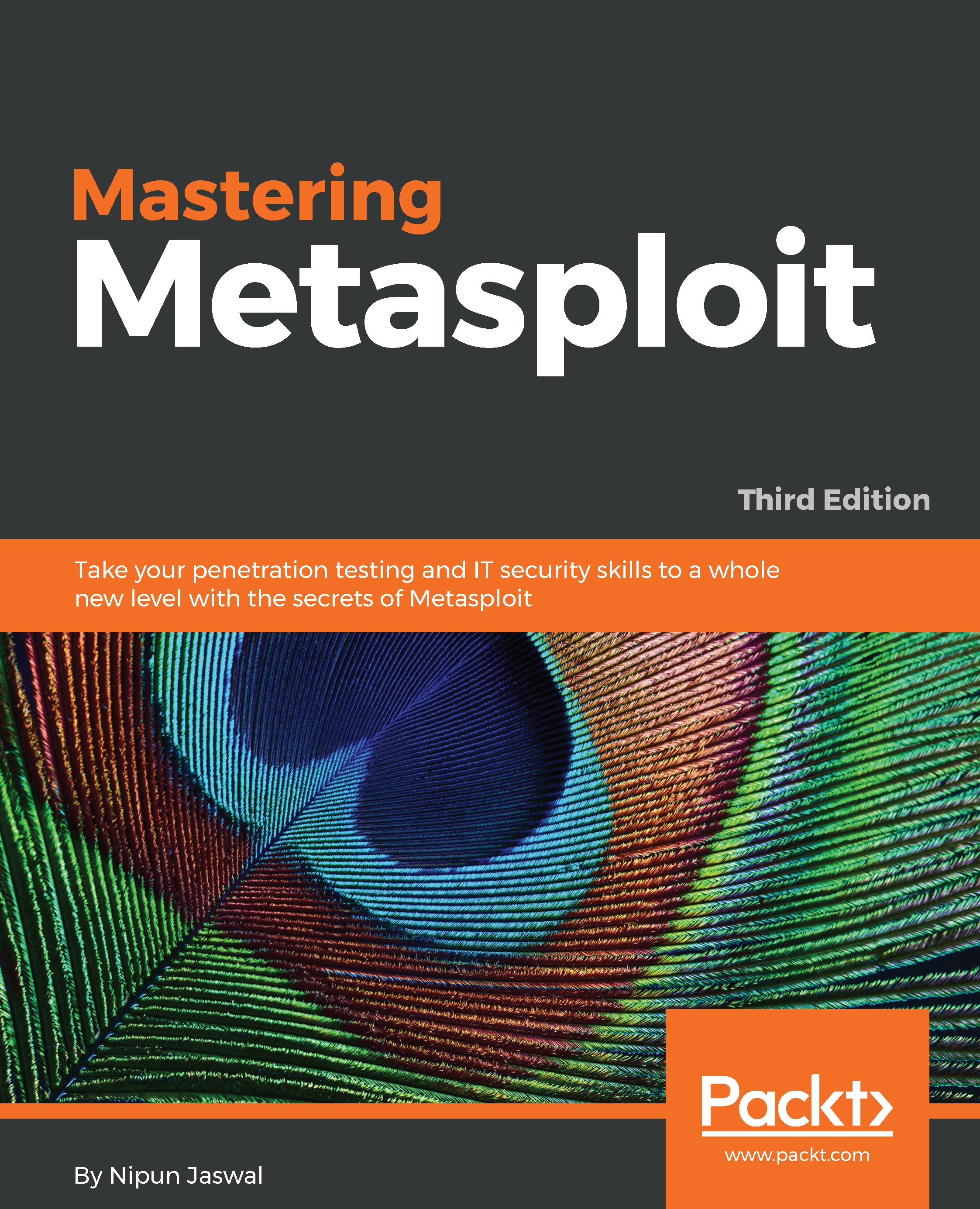
Mastering Metasploit

Mastering Metasploit - Third Edition

By : Nipun Jaswal
3.3 (3)
close
close
Mastering Metasploit

Mastering Metasploit

3.3 (3)
By: Nipun Jaswal

Overview of this book

We start by reminding you about the basic functionalities of Metasploit and its use in the most traditional ways. You’ll get to know about the basics of programming Metasploit modules as a refresher and then dive into carrying out exploitation as well building and porting exploits of various kinds in Metasploit. In the next section, you’ll develop the ability to perform testing on various services such as databases, Cloud environment, IoT, mobile, tablets, and similar more services. After this training, we jump into real-world sophisticated scenarios where performing penetration tests are a challenge. With real-life case studies, we take you on a journey through client-side attacks using Metasploit and various scripts built on the Metasploit framework. By the end of the book, you will be trained specifically on time-saving techniques using Metasploit.
Table of Contents (14 chapters)
close
close

The absolute basics of exploitation

In this section, we will look at the most critical components required for exploitation. We will discuss a wide variety of registers in the x86 architecture, along with necessary Opcodes such as NOPs (No Operations), JMP (Jump), JNZ (Jump if not Zero), and CALL.

The basics

Let's cover the terminologies that are necessary when learning about exploit writing. The following terms are based on hardware, software, and security perspectives in exploit development:

  • Register: This is an area on the processor used to store information. Also, the processor leverages registers to handle process execution, memory manipulation, API calls, and much more.
  • x86 instruction set: This is a family of system architectures that are found mostly on Intel-based systems and are generally 32-bit systems, while x64 are 64-bit systems.
  • Assembly language: This is a low-level and somewhat readable programming language with simple operations. However...
Visually different images
CONTINUE READING
83
Tech Concepts
36
Programming languages
73
Tech Tools
Icon Unlimited access to the largest independent learning library in tech of over 8,000 expert-authored tech books and videos.
Icon Innovative learning tools, including AI book assistants, code context explainers, and text-to-speech.
Icon 50+ new titles added per month and exclusive early access to books as they are being written.
Mastering Metasploit
notes
bookmark Notes and Bookmarks search Search in title playlist Add to playlist download Download options font-size Font size

Change the font size

margin-width Margin width

Change margin width

day-mode Day/Sepia/Night Modes

Change background colour

Close icon Search
Country selected

Close icon Your notes and bookmarks

Confirmation

Modal Close icon
claim successful

Buy this book with your credits?

Modal Close icon
Are you sure you want to buy this book with one of your credits?
Close
YES, BUY

Submit Your Feedback

Modal Close icon
Modal Close icon
Modal Close icon