
Sign In Start Free Trial
Account

Add to playlist

Create a Playlist

Modal Close icon
You need to login to use this feature.
  • Book Overview & Buying Mastering Kali Linux for Advanced Penetration Testing
  • Table Of Contents Toc
Mastering Kali Linux for Advanced Penetration Testing

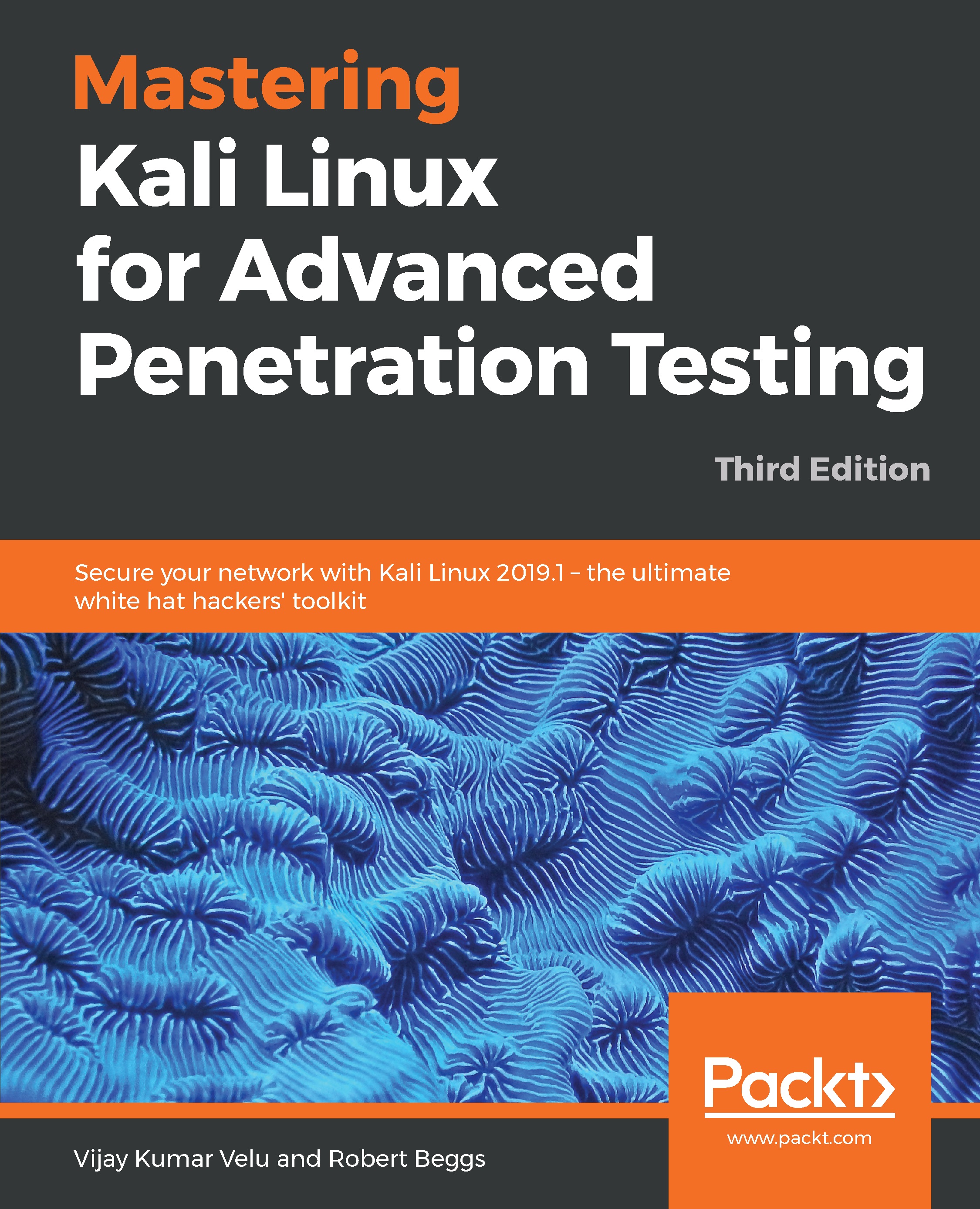
Mastering Kali Linux for Advanced Penetration Testing - Third Edition

By : Vijay Kumar Velu, Robert Beggs
4.4 (8)
close
close
Mastering Kali Linux for Advanced Penetration Testing

Mastering Kali Linux for Advanced Penetration Testing

4.4 (8)
By: Vijay Kumar Velu, Robert Beggs

Overview of this book

This book takes you, as a tester or security practitioner, through the reconnaissance, vulnerability assessment, exploitation, privilege escalation, and post-exploitation activities used by pentesters. To start with, you'll use a laboratory environment to validate tools and techniques, along with an application that supports a collaborative approach for pentesting. You'll then progress to passive reconnaissance with open source intelligence and active reconnaissance of the external and internal infrastructure. You'll also focus on how to select, use, customize, and interpret the results from different vulnerability scanners, followed by examining specific routes to the target, which include bypassing physical security and the exfiltration of data using a variety of techniques. You'll discover concepts such as social engineering, attacking wireless networks, web services, and embedded devices. Once you are confident with these topics, you'll learn the practical aspects of attacking user client systems by backdooring with fileless techniques, followed by focusing on the most vulnerable part of the network – directly attacking the end user. By the end of this book, you'll have explored approaches for carrying out advanced pentesting in tightly secured environments, understood pentesting and hacking techniques employed on embedded peripheral devices.
Table of Contents (16 chapters)
close
close

Active Reconnaissance of External and Internal Networks

The main goal of the active reconnaissance phase is to collect and weaponize information about the target as much as possible in order to facilitate the exploitation phase of the kill chain methodology.

We have seen in the last chapter how to perform passive reconnaissance using OSINT, which is almost undetectable and can yield a significant amount of information about the target organization and its users.

Active reconnaissance builds on the results of OSINT and passive reconnaissance and emphasizes more focused probes to identify the path to the target and the exposed attack surface of the target. In general, complex systems have a greater attack surface, and each surface may be exploited and then leveraged to support additional attacks.

Although active reconnaissance produces more useful information, interactions with...

CONTINUE READING
83
Tech Concepts
36
Programming languages
73
Tech Tools
Icon Unlimited access to the largest independent learning library in tech of over 8,000 expert-authored tech books and videos.
Icon Innovative learning tools, including AI book assistants, code context explainers, and text-to-speech.
Icon 50+ new titles added per month and exclusive early access to books as they are being written.
Mastering Kali Linux for Advanced Penetration Testing
notes
bookmark Notes and Bookmarks search Search in title playlist Add to playlist font-size Font size

Change the font size

margin-width Margin width

Change margin width

day-mode Day/Sepia/Night Modes

Change background colour

Close icon Search
Country selected

Close icon Your notes and bookmarks

Confirmation

Modal Close icon
claim successful

Buy this book with your credits?

Modal Close icon
Are you sure you want to buy this book with one of your credits?
Close
YES, BUY

Submit Your Feedback

Modal Close icon
Modal Close icon
Modal Close icon