
Sign In Start Free Trial
Account

Add to playlist

Create a Playlist

Modal Close icon
You need to login to use this feature.
  • Book Overview & Buying Learning Python for Forensics
  • Table Of Contents Toc
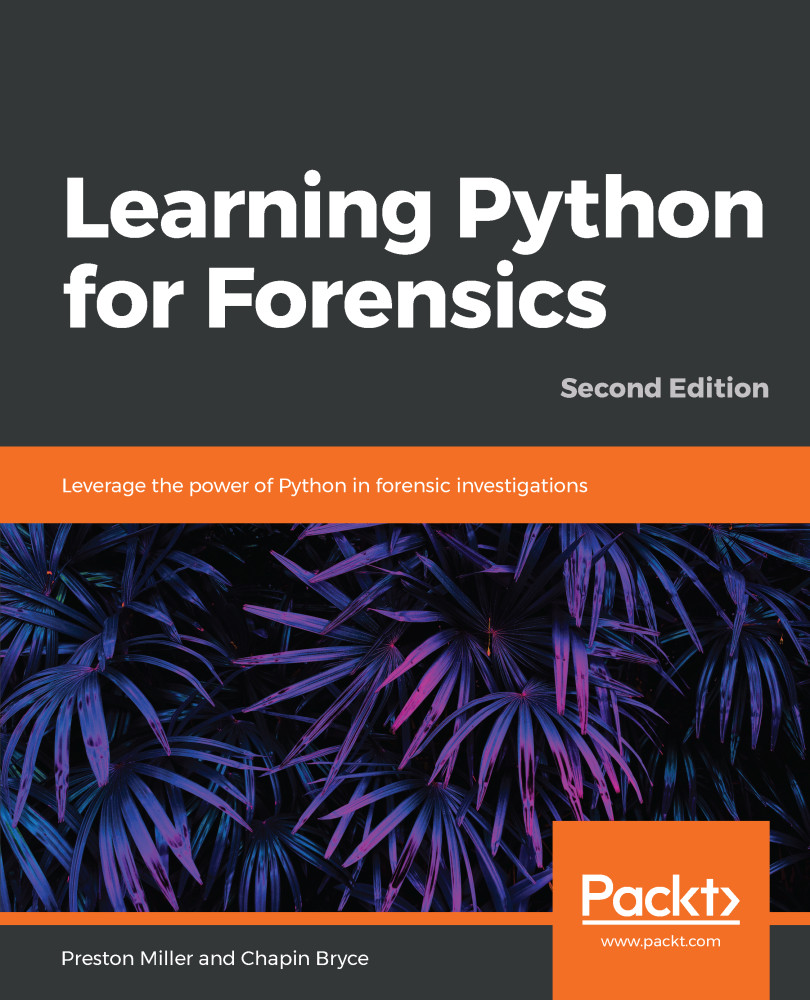
Learning Python for Forensics

Learning Python for Forensics

By : Miller, Chapin Bryce
close
close
Learning Python for Forensics

Learning Python for Forensics

By: Miller, Chapin Bryce

Overview of this book

This book will illustrate how and why you should learn Python to strengthen your analysis skills and efficiency as you creatively solve real-world problems through instruction-based tutorials. The tutorials use an interactive design, giving you experience of the development process so you gain a better understanding of what it means to be a forensic developer. Each chapter walks you through a forensic artifact and one or more methods to analyze the evidence. It also provides reasons why one method may be advantageous over another. We cover common digital forensics and incident response scenarios, with scripts that can be used to tackle case work in the field. Using built-in and community-sourced libraries, you will improve your problem solving skills with the addition of the Python scripting language. In addition, we provide resources for further exploration of each script so you can understand what further purposes Python can serve. With this knowledge, you can rapidly develop and deploy solutions to identify critical information and fine-tune your skill set as an examiner.
Table of Contents (15 chapters)
close
close

Advanced data types and functions

This section highlights two common features of Python that we will frequently encounter in forensic scripts. Therefore, we will introduce these objects and functionality in great detail.

Iterators

You have previously learned several iterable objects, such as lists, sets, and tuples. In Python, a data type is considered an iterator if an __iter__ method is defined or elements can be accessed using indices. These three data types (that is, lists, sets, and tuples) allow us to iterate through their contents in a simple and efficient manner. For this reason, we often use these data types when iterating through the lines in a file, file entries within a directory listing, or trying to identify a file based on a series of file signatures.

The iter data type allows us to step through data in a manner that doesn't preserve the initial object. This seems undesirable; however, when working with large sets or on machines with limited resources, it is very useful...

Visually different images
CONTINUE READING
83
Tech Concepts
36
Programming languages
73
Tech Tools
Icon Unlimited access to the largest independent learning library in tech of over 8,000 expert-authored tech books and videos.
Icon Innovative learning tools, including AI book assistants, code context explainers, and text-to-speech.
Icon 50+ new titles added per month and exclusive early access to books as they are being written.
Learning Python for Forensics
notes
bookmark Notes and Bookmarks search Search in title playlist Add to playlist download Download options font-size Font size

Change the font size

margin-width Margin width

Change margin width

day-mode Day/Sepia/Night Modes

Change background colour

Close icon Search
Country selected

Close icon Your notes and bookmarks

Confirmation

Modal Close icon
claim successful

Buy this book with your credits?

Modal Close icon
Are you sure you want to buy this book with one of your credits?
Close
YES, BUY

Submit Your Feedback

Modal Close icon
Modal Close icon
Modal Close icon