
Sign In Start Free Trial
Account

Add to playlist

Create a Playlist

Modal Close icon
You need to login to use this feature.
  • Book Overview & Buying Learning Python for Forensics
  • Table Of Contents Toc
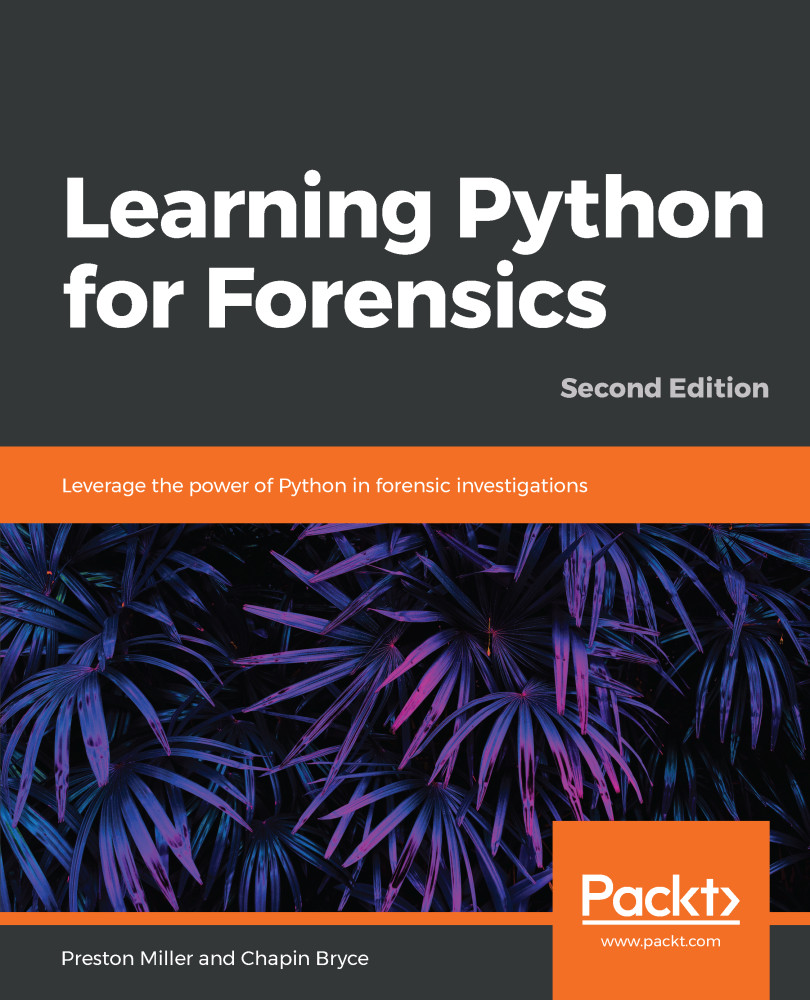
Learning Python for Forensics

Learning Python for Forensics - Second Edition

By : Preston Miller, Chapin Bryce
close
close
Learning Python for Forensics

Learning Python for Forensics

By: Preston Miller, Chapin Bryce

Overview of this book

Digital forensics plays an integral role in solving complex cybercrimes and helping organizations make sense of cybersecurity incidents. This second edition of Learning Python for Forensics illustrates how Python can be used to support these digital investigations and permits the examiner to automate the parsing of forensic artifacts to spend more time examining actionable data. The second edition of Learning Python for Forensics will illustrate how to develop Python scripts using an iterative design. Further, it demonstrates how to leverage the various built-in and community-sourced forensics scripts and libraries available for Python today. This book will help strengthen your analysis skills and efficiency as you creatively solve real-world problems through instruction-based tutorials. By the end of this book, you will build a collection of Python scripts capable of investigating an array of forensic artifacts and master the skills of extracting metadata and parsing complex data structures into actionable reports. Most importantly, you will have developed a foundation upon which to build as you continue to learn Python and enhance your efficacy as an investigator.
Table of Contents (15 chapters)
close
close

Python Fundamentals

We have explored the basic concepts behind Python and fundamental elements used to construct scripts. We will now build a series of scripts throughout this book using the data types and built-in functions that we have discussed in the first chapter. Before we begin developing scripts, let's walk through some additional important features of the Python language, building upon our existing knowledge.

In this chapter, we will explore more advanced features that we will utilize when building our forensic Python scripts. This includes complex data types and functions, creating our first script, handling errors, using libraries, interacting with the user, and some best practices for development. After completing this chapter, we will be ready to dive into real-world examples featuring the utility of Python in forensic casework.

This chapter will cover the following...

CONTINUE READING
83
Tech Concepts
36
Programming languages
73
Tech Tools
Icon Unlimited access to the largest independent learning library in tech of over 8,000 expert-authored tech books and videos.
Icon Innovative learning tools, including AI book assistants, code context explainers, and text-to-speech.
Icon 50+ new titles added per month and exclusive early access to books as they are being written.
Learning Python for Forensics
notes
bookmark Notes and Bookmarks search Search in title playlist Add to playlist download Download options font-size Font size

Change the font size

margin-width Margin width

Change margin width

day-mode Day/Sepia/Night Modes

Change background colour

Close icon Search
Country selected

Close icon Your notes and bookmarks

Confirmation

Modal Close icon
claim successful

Buy this book with your credits?

Modal Close icon
Are you sure you want to buy this book with one of your credits?
Close
YES, BUY

Submit Your Feedback

Modal Close icon
Modal Close icon
Modal Close icon