Sign In Start Free Trial
Account

Add to playlist

Create a Playlist

Modal Close icon
You need to login to use this feature.
  • Book Overview & Buying Learn Computer Forensics – 2nd edition
  • Table Of Contents Toc
Learn Computer Forensics – 2nd edition

Learn Computer Forensics – 2nd edition - Second Edition

By : William Oettinger
4.9 (62)
close
close
Learn Computer Forensics – 2nd edition

Learn Computer Forensics – 2nd edition

4.9 (62)
By: William Oettinger

Overview of this book

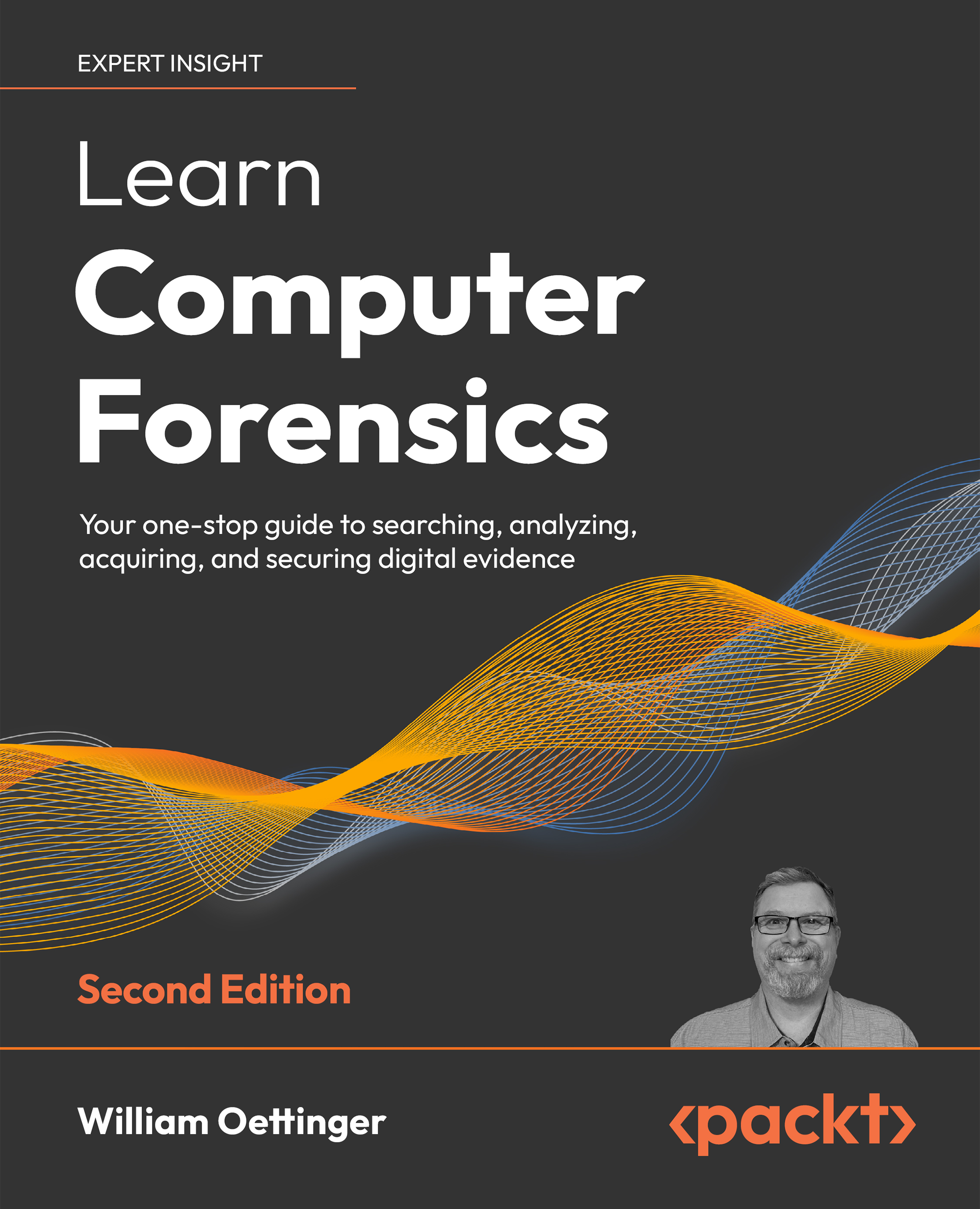
Computer Forensics, being a broad topic, involves a variety of skills which will involve seizing electronic evidence, acquiring data from electronic evidence, data analysis, and finally developing a forensic report. This book will help you to build up the skills you need to work in a highly technical environment. This book's ideal goal is to get you up and running with forensics tools and techniques to successfully investigate crime and corporate misconduct. You will discover ways to collect personal information about an individual from online sources. You will also learn how criminal investigations are performed online while preserving data such as e-mails, images, and videos that may be important to a case. You will further explore networking and understand Network Topologies, IP Addressing, and Network Devices. Finally, you will how to write a proper forensic report, the most exciting portion of the forensic exam process. By the end of this book, you will have developed a clear understanding of how to acquire, analyze, and present digital evidence, like a proficient computer forensics investigator.
Table of Contents (17 chapters)
close
close
15
Other Books You May Enjoy
16
Index

Internet Artifacts

The internet has become a staple in commercial and consumer environments. Digital communication between users is a daily activity. It is uncommon for a household not to have a device connected to the internet in some manner. They give students in elementary school devices to connect to the internet to enhance their education. Email addresses, URLs, social media, and file sharing are all vectors of activities a user can partake in. It is up to the user to decide whether their online activities will meet social norms and be accepted or whether they will cross the line and conduct criminal activity. Your job as a digital forensic investigator will be to investigate their activities in the digital realm.

In this chapter, we will be discussing some of the common browsers and social media sites and the artifacts they provide. We will also discuss P2P file-sharing tools, cloud computing services, and their artifacts.

We’ll be covering them in the following...

CONTINUE READING
83
Tech Concepts
36
Programming languages
73
Tech Tools
Icon Unlimited access to the largest independent learning library in tech of over 8,000 expert-authored tech books and videos.
Icon Innovative learning tools, including AI book assistants, code context explainers, and text-to-speech.
Icon 50+ new titles added per month and exclusive early access to books as they are being written.
Learn Computer Forensics – 2nd edition
notes
bookmark Notes and Bookmarks search Search in title playlist Add to playlist download Download options font-size Font size

Change the font size

margin-width Margin width

Change margin width

day-mode Day/Sepia/Night Modes

Change background colour

Close icon Search
Country selected

Close icon Your notes and bookmarks

Confirmation

Modal Close icon
claim successful

Buy this book with your credits?

Modal Close icon
Are you sure you want to buy this book with one of your credits?
Close
YES, BUY

Submit Your Feedback

Modal Close icon
Modal Close icon
Modal Close icon