Sign In Start Free Trial
Account

Add to playlist

Create a Playlist

Modal Close icon
You need to login to use this feature.
  • Book Overview & Buying The Ultimate Linux Shell Scripting Guide
  • Table Of Contents Toc
  • Feedback & Rating feedback
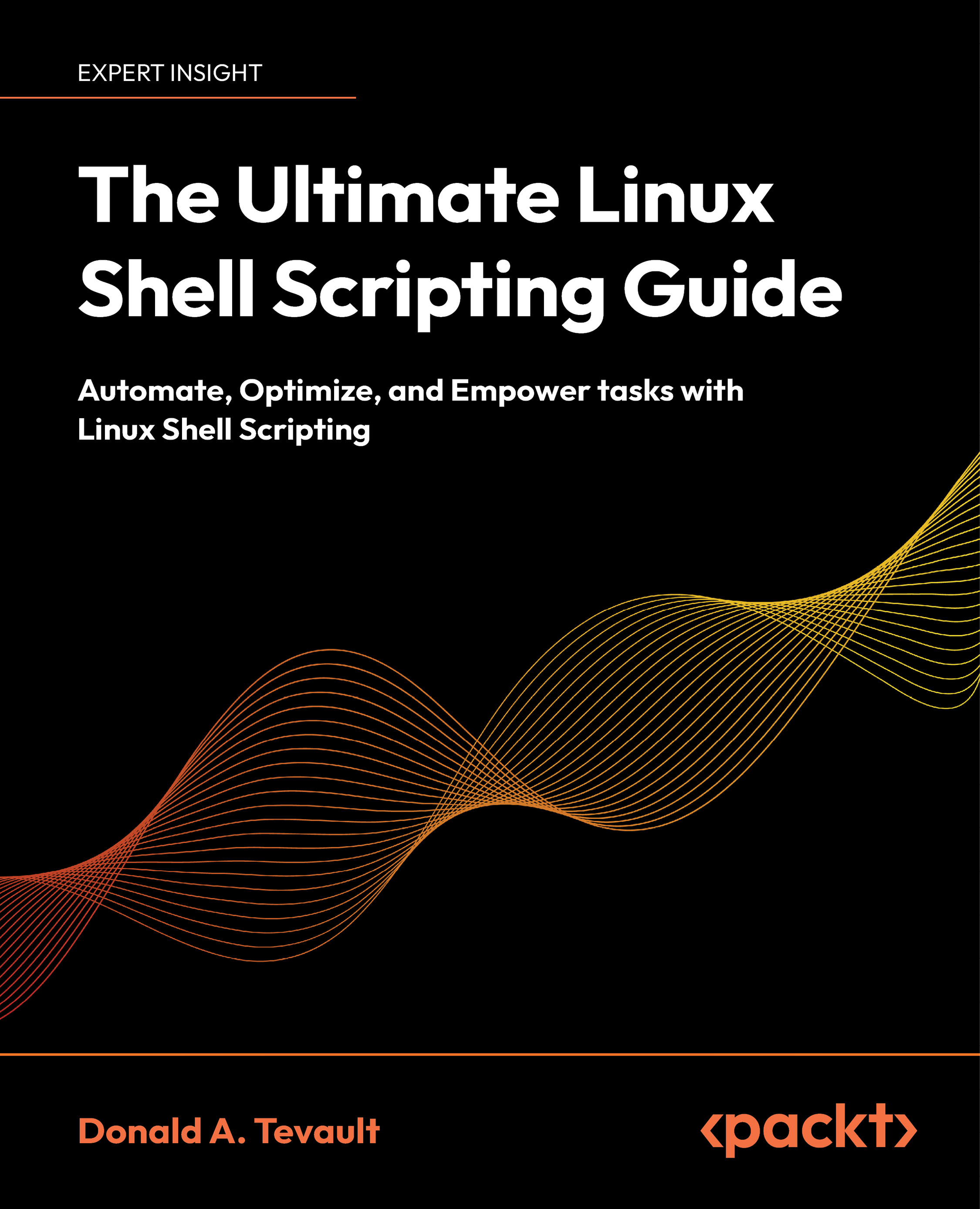
The Ultimate Linux Shell Scripting Guide

The Ultimate Linux Shell Scripting Guide

By : Donald A. Tevault
4.9 (8)
close
close
The Ultimate Linux Shell Scripting Guide

The Ultimate Linux Shell Scripting Guide

4.9 (8)
By: Donald A. Tevault

Overview of this book

Dive into the world of Linux shell scripting with this hands-on guide. If you’re comfortable using the command line on Unix or Linux but haven’t fully explored Bash, this book is for you. It’s designed for programmers familiar with languages like Python, JavaScript, or PHP who want to make the most of shell scripting. This isn’t just another theory-heavy book—you’ll learn by doing. Each chapter builds on the last, taking you from shell basics to writing practical scripts that solve real-world problems. With nearly a hundred interactive labs, you’ll gain hands-on experience in automation, system administration, and troubleshooting. While Bash is the primary focus, you'll also get a look at Z Shell and PowerShell, expanding your skills and adaptability. From mastering command redirection and pipelines to writing scripts that work across different Unix-like systems, this book equips you for real-world Linux challenges. By the end, you'll be equipped to write efficient shell scripts that streamline your workflow and improve system automation.
Table of Contents (26 chapters)
close
close
24
Other Books You May Enjoy
25
Index

Understanding Compiled versus Interpreted Programming

Compiled programming consists of writing program code in a text editor, and then using a compiler to convert the text file into an executable binary file. Once that’s done, users of the program won’t be able to easily view the source code of the program. With interpreted programming, the program runs directly from a text file, without having to compile it first.

Compiled programming languages, such as C, C++, or Fortran, are good for when you need maximum performance from your programs. However, they can be fairly hard to learn, especially when it comes to the lower-level functions such as working with files. Interpreted languages might not offer quite as high a level of performance, but they are generally quite flexible, and generally easier to learn. Interpreted languages in general also offer a higher degree of portability between different operating systems. Shell scripting falls into the category of interpreted languages.

Here are some reasons why you might consider using an interpreted language:

  • When you are looking for a simple solution.
  • When you need a solution that is portable. If you pay attention to portability concerns, you can write one script that will work on different Linux distros, as well as on Unix/Unix-like systems. That can come in handy if you’re working in a large corporation with a large network of mixed operating systems. (You might even find some larger corporations that are still running legacy Unix systems, such as AIX, HPUX, or SUNOS, alongside more modern implementations of Linux, BSD, or macOS.)

And, here are some reasons why you might consider using a compiled language:

  • When the tasks require intensive use of system resources. This is especially true when speed is extremely important.
  • When you are using math operations that require heavy number crunching.
  • When you need complex applications.
  • When your application has many sub-components with dependencies.
  • When you want to create proprietary applications, and prevent users from viewing the application source code.

When you think about it, pretty much every example of productivity, server, gaming, or scientific software falls into one or more of these categories, which means that they really should be built with compiled languages for best performance.

Okay, let’s now talk about sudo.

Visually different images
CONTINUE READING
83
Tech Concepts
36
Programming languages
73
Tech Tools
Icon Unlimited access to the largest independent learning library in tech of over 8,000 expert-authored tech books and videos.
Icon Innovative learning tools, including AI book assistants, code context explainers, and text-to-speech.
Icon 50+ new titles added per month and exclusive early access to books as they are being written.
The Ultimate Linux Shell Scripting Guide
notes
bookmark Notes and Bookmarks search Search in title playlist Add to playlist download Download options font-size Font size

Change the font size

margin-width Margin width

Change margin width

day-mode Day/Sepia/Night Modes

Change background colour

Close icon Search
Country selected

Close icon Your notes and bookmarks

Confirmation

Modal Close icon
claim successful

Buy this book with your credits?

Modal Close icon
Are you sure you want to buy this book with one of your credits?
Close
YES, BUY

Submit Your Feedback

Modal Close icon
Modal Close icon
Modal Close icon