-
Book Overview & Buying
-
Table Of Contents
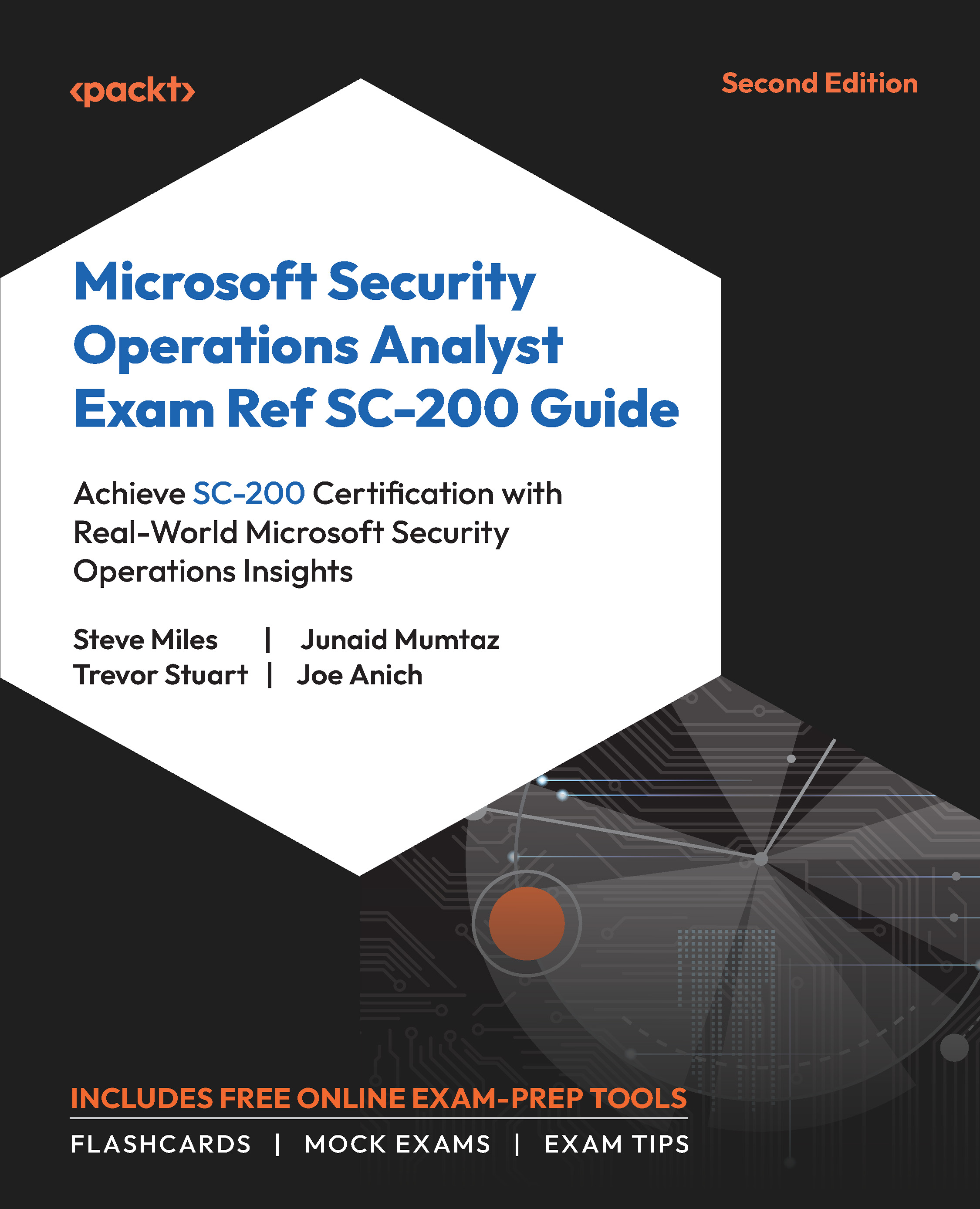
Microsoft Security Operations Analyst Exam Ref SC-200 Guide - Second Edition
By :
Security operations has changed. Analysts are no longer working from a single console, a single alert, or a single source of evidence. Modern incidents move across identities, endpoints, email, cloud apps, data, workloads, and infrastructure. A phishing email may become an identity compromise. An identity compromise may lead to endpoint activity. Endpoint activity may expose data movement, cloud access, lateral movement, or suspicious application behavior. For a security operations analyst, the real skill is not just knowing where each tool lives, but understanding how the evidence connects.
This book provides a practical guide to the Microsoft security operations skills covered by the SC-200: Microsoft Security Operations Analyst exam. It explains how Microsoft Defender XDR, Microsoft Sentinel, Microsoft Entra ID, Microsoft Purview, Microsoft Defender for Endpoint, Microsoft Defender for Office 365, Microsoft Defender for Cloud Apps, Microsoft Defender for Identity, and Microsoft Defender for Cloud workload protections support detection, investigation, response, automation, and threat hunting.
The focus throughout the book is on how security operations actually work. You will learn how data is collected, how detections are created, how alerts become incidents, how entities help explain attacker activity, and how analysts move from triage to investigation and response. You will also see how Kusto Query Language, Advanced Hunting, Microsoft Sentinel hunting, automation rules, playbooks, attack disruption, case management, and agentic AI experiences such as embedded Copilot for Security fit into the wider investigation workflow.
The book is structured to build from exam readiness and SOC foundations into the operational areas tested by SC-200. You will begin by understanding the exam objectives and the evolution of modern security operations. You will then configure Microsoft Sentinel, ingest security data, create detections, investigate threats across Microsoft Defender XDR and Microsoft 365, respond to alerts and incidents, perform endpoint investigation, and configure automation across Microsoft Defender XDR and Microsoft Sentinel.
By the end of the book, you should be able to recognize how Microsoft security tools work together in a real SOC workflow. More importantly, you should be able to make the kind of decisions the SC-200 exam expects: which evidence matters, which tool should be used, which action should be taken, and why that action is the right one for the scenario.
This book is written for learners preparing for the SC-200: Microsoft Security Operations Analyst exam. It is designed as an exam study guide for readers who need to understand how Microsoft security operations tools are used to detect, investigate, respond to, and hunt for threats across Microsoft cloud, hybrid, and on-premises environments.
The book is especially useful for SOC analysts, security engineers, incident responders, Microsoft 365 administrators, Azure administrators, and security professionals who work with or support Microsoft Defender XDR and Microsoft Sentinel. It is also suitable for readers moving into a security operations role who need a clear, practical path through the SC-200 objectives.
Chapter 1, Preparing for Your Microsoft Exam and SC-200 Objectives, introduces the SC-200 exam structure, the current security operations objectives, and the resources you can use to prepare effectively.
Chapter 2, The Evolution of Security and Security Operations, explains how security operations have moved from traditional perimeter-based models to modern, identity-first, cloud-connected, and automation-driven SOC operations.
Chapter 3, Configure the Microsoft Sentinel SIEM and Platform, covers Sentinel roles, data retention, workbooks, and platform optimization so that Sentinel can support effective security operations.
Chapter 4, Ingest Data into Microsoft Sentinel, explains how to connect and collect security data from Windows events, Syslog, CEF, Azure activity logs, and threat intelligence sources.
Chapter 5, Configure Detections, covers custom detections in Microsoft Defender XDR, analytics rules in Microsoft Sentinel, MITRE ATT&CK coverage, anomaly detection, and machine learning-based detections.
Chapter 6, Detect Threats by Using Microsoft Defender XDR, explains how to use KQL, Advanced Hunting, threat analytics, hunting graphs, blast radius analysis, and entity relationships to identify suspicious activity.
Chapter 7, Detect Threats by Using the Microsoft Sentinel Platform, covers hunting queries, KQL jobs, summary rules, notebooks, and large-scale analysis techniques for proactive threat hunting.
Chapter 8, Investigate Microsoft 365 Activities to Identify Threats, explains how to use Microsoft Purview Audit, Content Search, and Microsoft Graph activity logs to reconstruct activity and validate suspicious behavior.
Chapter 9, Respond to Alerts and Incidents in Microsoft Defender XDR, covers investigation and remediation across Defender XDR workloads, including email, identities, cloud apps, data, cloud workload protections, Sentinel incidents, case management, complex attacks, and Copilot-assisted investigations.
Chapter 10, Respond to Alerts and Incidents in Microsoft Defender for Endpoint, focuses on endpoint investigation using device timelines, evidence and entity analysis, live response, investigation packages, and automated attack disruption.
Chapter 11, Configure Automation for Microsoft Defender XDR and Microsoft Sentinel, covers alert and email notifications, Defender for Endpoint settings, automated investigation and response, attack disruption, device groups, automation rules, and Sentinel playbooks.
We also provide a PDF file that has color images of the screenshots/diagrams used in this book. You can download it here: https://packt.link/gbp/9781836204411.
Feedback from our readers is always welcome.
General feedback: If you have questions about any aspect of this book or have any general feedback, please email us at [email protected] and mention the book's title in the subject of your message.
Errata: Although we have taken every care to ensure the accuracy of our content, mistakes do happen. If you have found a mistake in this book, we would be grateful if you reported this to us. Please visit http://www.packt.com/submit-errata, click Submit Errata, and fill in the form. All valid errata will be timely updated on GitHub: https://github.com/PacktPublishing/Microsoft-Security-Operations-Analyst-Exam-Ref-SC-200-Guide
Piracy: If you come across any illegal copies of our works in any form on the internet, we would be grateful if you would provide us with the location address or website name. Please contact us at [email protected] with a link to the material.
If you are interested in becoming an author: If there is a topic that you have expertise in and you are interested in either writing or contributing to a book, please visit http://authors.packt.com/.
Once you've read Microsoft Security Operations Analyst Exam Ref SC-200 Guide-Second Edition, we'd love to hear your thoughts! Scan the QR code below to go straight to the Amazon review page for this book and share your feedback.

https://packt.link/r/1836204418
Your review is important to us and the tech community and will help us make sure we're delivering excellent quality content.